Introduction to String Theory
Vibrating Strings
Beyond the Point Particle
For centuries, physics has told a story about fundamental particles. In this story, particles like electrons and quarks are tiny, zero-dimensional points. They have properties like mass and charge, but no size. They are the smallest possible dots you can imagine, and then some.
String theory offers a different story. It suggests that if we could zoom in on a particle with unimaginable magnification, we wouldn't see a point. Instead, we would see a tiny, one-dimensional loop of energy. A string.
What’s unique about String Theory is that rather than treating particles as 0-dimensional points, it suggests they are 1-dimensional objects—strings.
These aren't strings like the kind you'd use to tie a box. They are unimaginably small, far smaller than an atom's nucleus. These tiny strands of energy can vibrate, oscillate, and wiggle. And that's where things get interesting.
A Cosmic Symphony
Think of a guitar string. Plucking it in different ways produces different musical notes. The same string can create a C, a G, or an E, depending on its vibrational pattern. The frequency of the vibration determines the pitch of the note we hear. String theory proposes that the universe works in a similar way.
Every fundamental particle we observe—electrons, photons, quarks, and all the rest—is just a different 'note' being played on a fundamental string. The properties of a particle, like its mass and electric charge, are determined by the specific way its underlying string is vibrating.
A string vibrating in one pattern might appear to us as an electron. A different vibration pattern would result in a photon, the particle of light. Another would be a quark. All the different particles and forces we see in the universe are just different manifestations of these vibrating strings. There is no fundamental difference between the stuff that makes up matter (like electrons) and the stuff that carries forces (like photons). They are all just strings playing different tunes.
One string, many particles. This is the central idea that allows string theory to unify our picture of the universe.
Unifying the Forces
Physics has identified four fundamental forces of nature: gravity, electromagnetism, and the strong and weak nuclear forces. For decades, the greatest challenge in theoretical physics has been to unite these forces under a single, coherent theory. The Standard Model of particle physics successfully describes three of the four forces but leaves out gravity.
String theory provides a potential solution. By treating particles as vibrations, it naturally includes a particle with the exact properties of the graviton, the hypothetical particle that carries the gravitational force.
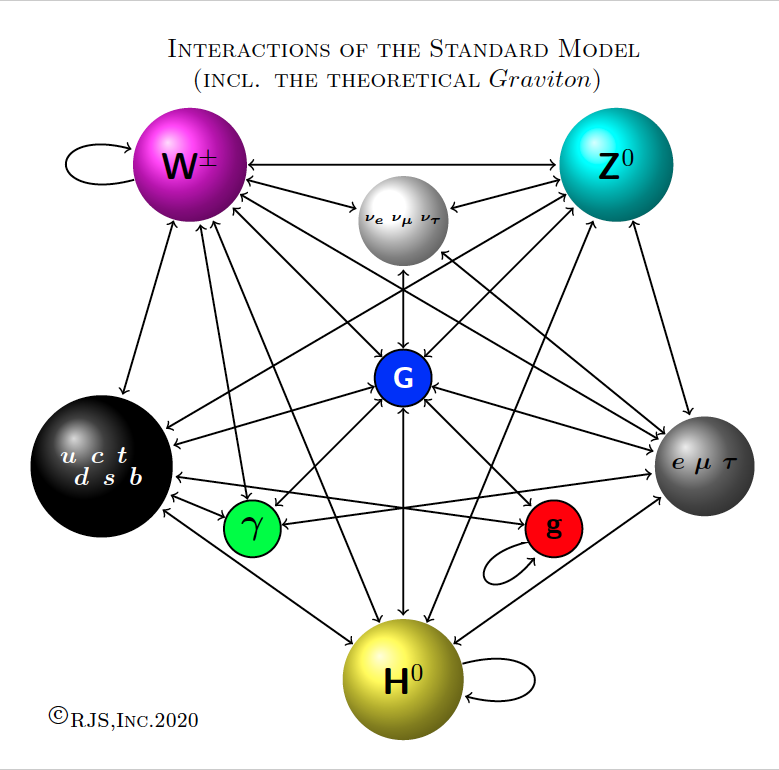
One specific vibrational mode of a string corresponds to a massless particle with two units of spin. These are precisely the characteristics predicted for the graviton. This was a major breakthrough. For the first time, a theory that described the quantum world of particles inherently contained the force of gravity. In the symphony of strings, gravity is not a special case; it's just another note.
By replacing point particles with strings, the theory smooths out some of the mathematical problems that arise when trying to combine quantum mechanics and gravity. This simple shift in perspective—from points to vibrating strings—provides a powerful framework for a unified theory of everything, where all matter and all forces arise from the same fundamental entity.
Ready to test your understanding?
According to string theory, what is the fundamental nature of an elementary particle like an electron?
In the analogy of a guitar string, different musical notes are produced by different vibrations. In string theory, what do these 'different notes' correspond to?
This paradigm shift from points to strings is the first step into a radical new way of viewing the cosmos.