Introduction to Stocks and Shares Investing
Introduction to Stock Market
What Is a Stock Market?
At its core, the stock market isn't a single place. It's a vast network where people buy and sell tiny pieces of ownership in public companies. These pieces are called stocks or shares.
Think of a company like a big pizza. If the owners want to grow the business, they might need more money than they have. So, they can slice the pizza into thousands or millions of pieces and sell them to the public. Each slice represents a stock. When you buy a stock, you're buying one of those slices, making you a part-owner, or shareholder.
The stock market facilitates this entire process. It serves two main purposes:
- It allows companies to raise money (capital) to fund expansion, research, or new projects by selling ownership stakes.
- It provides a platform for investors—people like you—to buy and sell these stakes, hopefully for a profit.
Essentially, the stock market connects companies that need money with people who have money to invest.
These transactions don't happen on a street corner. They occur in organized markets called stock exchanges. Two of the most famous are in the United States: the New York Stock Exchange (NYSE) and the Nasdaq.
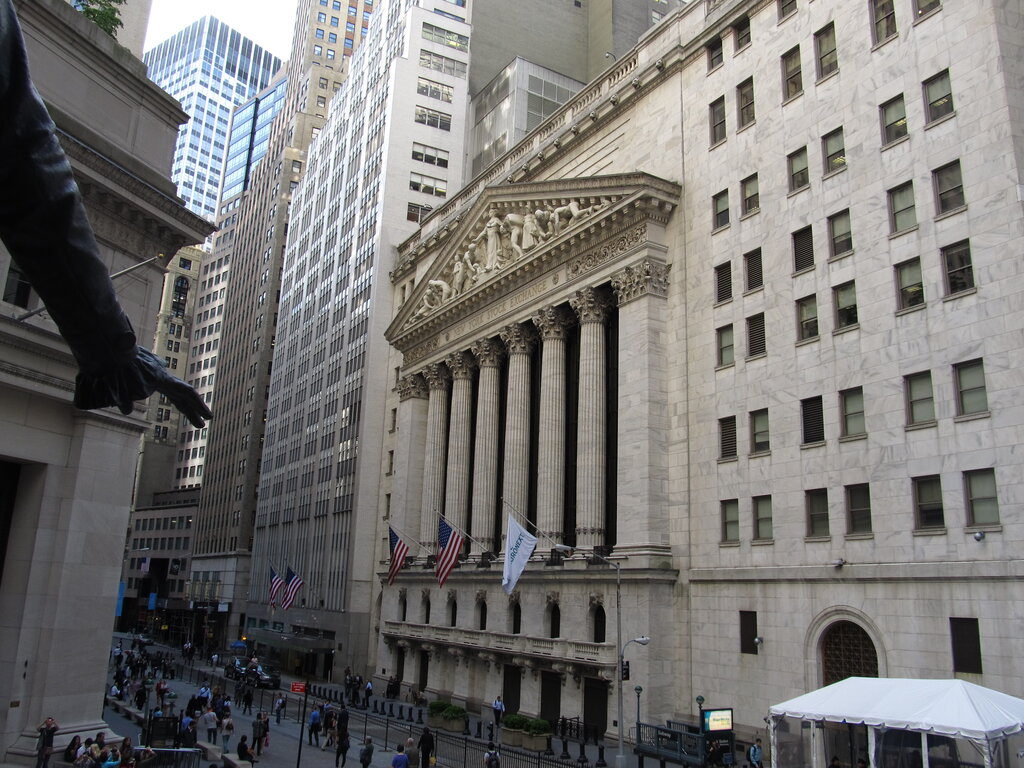
The NYSE, founded in 1792, traditionally operated as a physical auction, with traders shouting orders on a bustling floor. While much of its trading is now electronic, it still maintains that iconic trading floor. The Nasdaq, on the other hand, was born digital. It has always been a fully electronic market, with no physical trading floor.
The Key Players
Several key participants keep the stock market running smoothly.
Investor
noun
Any individual or institution (like a pension fund or a bank) that buys and sells stocks. Their goal is typically to grow their money over time.
As an individual investor, you don't trade directly on an exchange. You need an intermediary to place trades for you. That's where brokers come in.
Broker
noun
A person or firm that is licensed to buy and sell stocks and other securities on behalf of an investor. In return for executing these orders, the broker receives a fee or commission.
Today, most people use online brokerage firms, which provide websites and apps to manage investments. A third, less visible group is also crucial: market makers. These are high-volume trading firms that are always ready to buy or sell a particular stock. By doing so, they provide liquidity, ensuring that you can almost always find a buyer when you want to sell, or a seller when you want to buy.
Measuring the Market
With thousands of companies to track, how can you tell if the stock market is generally having a good day or a bad one? You look at a stock market index.
An index is a curated basket of stocks that represents a portion of the market. Its performance is a weighted average of the stocks within it, providing a quick snapshot of the market's health and direction. It’s like taking a poll to gauge the mood of a huge crowd instead of asking every single person.
A stock index acts as a barometer for the market or a specific sector.
Two of the most frequently cited indices are:
- The S&P 500: Tracks the performance of 500 of the largest U.S. companies. Because it's so broad, it's often considered the best representation of the overall U.S. stock market.
- The Dow Jones Industrial Average (DJIA): Often just called "the Dow," this index tracks 30 large, well-known U.S. companies. While it includes far fewer companies than the S&P 500, it's the oldest and one of the most famous market benchmarks.
How Trading Works
The fundamental process of trading is simple: buying and selling. Stock prices are determined by supply and demand. If more people want to buy a stock (demand) than sell it (supply), the price goes up. If more people want to sell than buy, the price goes down.
When you decide to buy a stock through your broker, you'll place an order. There are two basic types of orders:
| Order Type | Description |
|---|---|
| Market Order | Buy or sell immediately at the best available current price. |
| Limit Order | Buy or sell at a specific price or better. The trade only happens if the stock reaches your set price. |
For example, if a stock is trading at $50, a market order to buy would execute at or very near $50. A limit order to buy could be set at $48, meaning your order would only go through if the stock's price drops to $48.
This constant dance of buying and selling, driven by company performance, economic news, and investor sentiment, is what makes the stock market a dynamic and powerful force in the global economy.