Introduction to Spiking Neural Networks
Introduction to Neural Networks
The Building Blocks of AI
Artificial Neural Networks, or ANNs, are the engines behind many of the AI tools we use every day. They're computing systems inspired by the way brains work, designed to recognize patterns in data. Think of them as digital detectives, sifting through clues to find an answer.
An Artificial Neural Network (ANN) is an information processing paradigm that is inspired by the brain.
Just like a brain is made of neurons, an ANN is built from artificial neurons. These aren't physical cells, but rather mathematical functions that process information. A single neuron on its own is simple, but connecting thousands or millions of them creates a powerful network capable of complex tasks.
Neurons and Layers
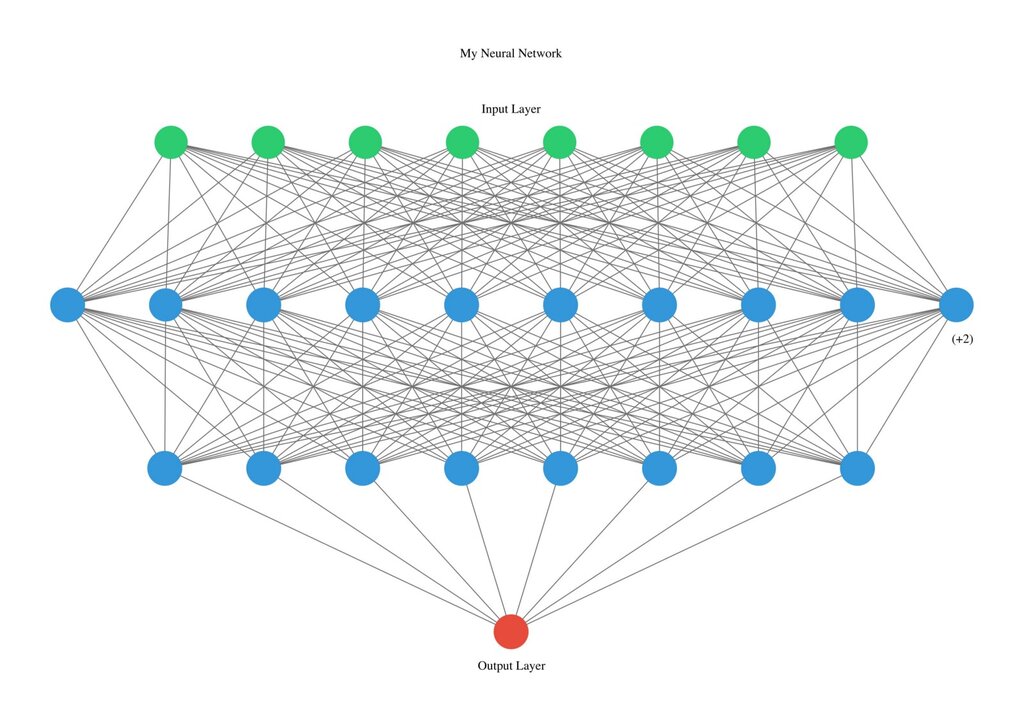
At its core, a neural network is a collection of interconnected nodes, or neurons, organized in layers. Information flows from one layer to the next, getting processed at each step.
Each neuron receives one or more inputs. It then performs two simple calculations:
- Summation: It multiplies each input value by a corresponding weight—a number that signifies the input's importance. It then adds all these weighted inputs together, along with a special value called a bias.
- Activation: The result of the sum is passed through an activation function. This function decides whether the neuron should "fire" and what its output signal should be. A common type of activation function is the ReLU (Rectified Linear Unit), which simply outputs the value if it's positive, and zero otherwise.
Neurons are organized into at least three types of layers:
- Input Layer: Receives the initial data. For an image, each neuron might correspond to a single pixel.
- Hidden Layers: These are the layers between the input and output. This is where most of the computation happens. A network can have zero, one, or many hidden layers. Networks with multiple hidden layers are called "deep neural networks."
- Output Layer: Produces the final result. For a cat-or-dog classifier, this layer might have two neurons, one for "cat" and one for "dog".
Learning and Making Predictions
How does a neural network learn? It learns by adjusting its weights and biases. This process, called training, involves showing the network many examples from a dataset. For each example, the network makes a prediction.
synapse
noun
In an artificial neural network, the connection between two neurons that transmits a signal from one to the other. The strength of this connection is represented by its weight.
The network's prediction is compared to the correct answer, and an error, or "loss," is calculated. The goal is to minimize this error. The network uses an algorithm, most commonly backpropagation, to figure out how much each weight and bias contributed to the error. It then adjusts them slightly in the right direction to make the error smaller on the next attempt.
This cycle repeats thousands or millions of times. Gradually, the network's weights are fine-tuned, and it gets better and better at making correct predictions for new, unseen data.
This learning process is what allows ANNs to perform a huge range of tasks, from recognizing faces in photos to translating languages and driving cars.
Let's review the key terms we've covered.
Now, let's test your understanding of these core concepts.
What is the fundamental building block of an Artificial Neural Network?
What is the primary role of the 'hidden layers' in a neural network?
With these fundamentals in place, you're ready to explore more advanced types of neural networks and how they build on these core ideas.