Introduction to Special Relativity
Introduction to Special Relativity
A Tale of Two Theories
By the end of the 19th century, physics seemed to be settling down. Two major pillars stood tall: Isaac Newton's laws of motion and gravity, which described how things move, from apples to planets, and James Clerk Maxwell's theory of electromagnetism, which unified electricity, magnetism, and light itself.
But a crack was showing between these two pillars. Maxwell's equations predicted that the speed of light in a vacuum is a constant value, about 299,792 kilometers per second. Let's call it . According to his theory, this speed shouldn't change, ever. But according to Newton, speeds should always add up. If you're on a train moving at 100 km/h and you throw a baseball forward at 50 km/h, someone standing on the ground sees the ball moving at 150 km/h. Simple enough.
So what happens if you're on a super-fast train and you shine a flashlight forward? Shouldn't the person on the ground see the light moving faster than ? Maxwell's theory said no, but Newton's ideas about relative motion suggested yes. Physics couldn't be right if its two main theories contradicted each other.
Einstein's Bold Leap
In 1905, a young patent clerk named Albert Einstein proposed a radical solution. Instead of trying to patch one theory to fit the other, he suggested that our fundamental understanding of space and time was wrong. He based his new theory, called special relativity, on two simple but powerful statements, or postulates.
First Postulate (The Principle of Relativity): The laws of physics are the same for everyone in uniform motion.
This idea extends a concept from Galileo. "Uniform motion" means you're moving at a constant speed in a straight line. Physicists call this an "inertial frame of reference." If you're in a smoothly moving airplane with the windows closed, you can't perform any experiment to tell whether you're moving or standing still on the runway. A dropped pen falls straight down, a thrown ball follows a normal arc. All the laws of physics work exactly the same. Einstein declared that this must be true for all laws of physics, including electromagnetism.
Second Postulate (The Constancy of the Speed of Light): The speed of light in a vacuum is the same for all observers, no matter how fast the source of light or the observer is moving.
This is where things get strange. Let's go back to that train. You're on it, moving at half the speed of light, and you shine a flashlight forward. You measure the speed of the light from your flashlight to be . What about your friend standing on the ground as you zip past? According to Einstein, your friend also measures the speed of that same light beam to be exactly , not plus half of . This breaks our everyday intuition, but it's the cornerstone of relativity.
The Consequences
If the speed of light is absolute, something else must not be. Speed is calculated as distance divided by time. If two observers moving at different speeds both measure the same speed for a beam of light, they must disagree on the distance the light traveled or the time it took to travel it.
This is the mind-bending implication of Einstein's postulates. Space and time are not fixed, universal quantities that everyone experiences in the same way. Instead, they are relative. Measurements of length and the passage of time can change depending on your motion. This realization demolished Newton's idea of an absolute, clockwork universe and paved the way for a century of new physics.
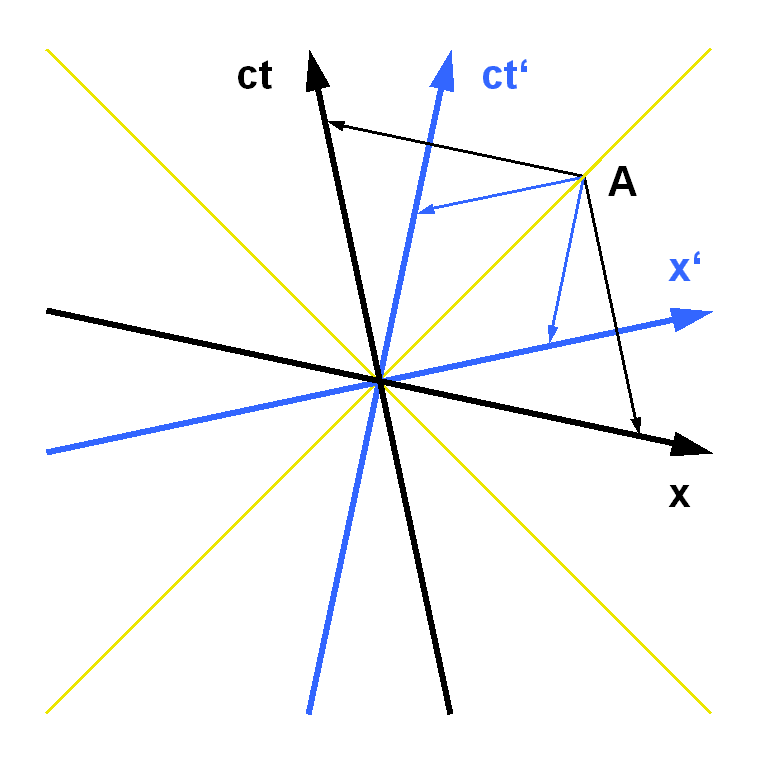
Let's test your understanding of these foundational ideas.
What was the fundamental conflict in late 19th-century physics that paved the way for special relativity?
Imagine you are on a spaceship traveling at 90% the speed of light () and you turn on a laser beam, pointing it forward. How fast would an observer stationary on Earth measure that laser light to be traveling?