Introduction to Sound Therapy
Introduction to Sound and Human Physiology
The Nature of Sound
Sound begins with a vibration. When you pluck a guitar string, it wiggles back and forth. This movement pushes the air molecules around it, creating waves of pressure that travel outwards, much like ripples in a pond. These are sound waves. To understand them, we need to look at three key properties: frequency, amplitude, and wavelength.
Frequency is how many waves pass a point per second. It's measured in Hertz (Hz). A high frequency means the waves are packed closely together, creating a high-pitched sound like a whistle. A low frequency means the waves are spread out, resulting in a low-pitched sound like a bass drum.
Amplitude refers to the intensity or power of the wave, which we perceive as loudness. A wave with a large amplitude has a lot of energy and sounds loud, while a wave with a small amplitude is quiet.
Wavelength is the physical distance between two consecutive peaks of a wave. It's inversely related to frequency: high-frequency sounds have short wavelengths, and low-frequency sounds have long wavelengths.
Frequency
noun
The rate at which a vibration occurs that constitutes a wave, measured in hertz (Hz). It determines the pitch of a sound.
How We Hear
Our ears are sophisticated instruments designed to capture and interpret these vibrations. The process of hearing is a remarkable journey from a simple pressure wave in the air to a complex neural signal in the brain.
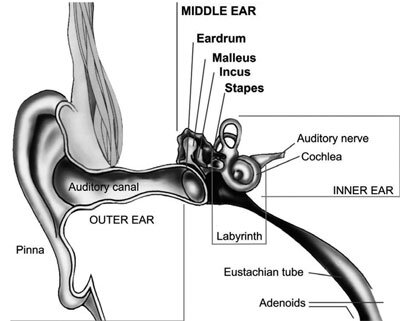
First, the outer ear funnels the sound wave into the ear canal, where it hits the eardrum, causing it to vibrate. These vibrations are then amplified by three tiny bones in the middle ear: the malleus, incus, and stapes. The last bone, the stapes, presses against a small membrane called the oval window, transmitting the vibrations into the fluid-filled cochlea of the inner ear.
Inside the cochlea, thousands of tiny hair cells are bent by the fluid's movement. This bending action converts the mechanical vibrations into electrical signals. The auditory nerve picks up these signals and sends them to the brain, which interprets them as the sounds we recognize.
Sound and the Body
Sound doesn't just enter our ears; it affects our entire body. The vibrations can have profound physiological and psychological impacts, influencing everything from our heart rate to our mood. Think about how a sudden, loud noise can make you jump. That's your sympathetic nervous system kicking in, triggering a fight-or-flight response. Your heart rate increases, and your body releases stress hormones like cortisol.
Conversely, calming sounds can have the opposite effect. The gentle rhythm of ocean waves or soft, slow music can activate the parasympathetic nervous system, which helps the body relax and recover. This can lead to a lower heart rate, reduced muscle tension, and a calmer state of mind. Our bodies are constantly responding to the soundscape around us, whether we're aware of it or not.
The frequency and amplitude of a sound wave directly influence not just what we hear, but how our body feels and reacts.
Now let's review what we've learned about the fundamental properties of sound and how our bodies perceive it.