Introduction to Sound Engineering
Introduction to Acoustics
What Is Sound?
At its core, sound is simple: it's a vibration. When you clap your hands, the sudden impact creates a pressure wave that travels through the air. This wave is what your ears interpret as sound. Think of it like dropping a pebble into a still pond. The pebble creates ripples that spread out in all directions. Sound waves do the same thing, but they travel through a medium like air, water, or even solid objects.
These waves are made of two parts: compressions and rarefactions. As a sound wave moves, it squeezes air molecules together (compression) and then spreads them apart (rarefaction). This alternating pattern of high and low pressure is the physical form of a sound wave.
The scientific study of sound waves is known as acoustics.
The Building Blocks of Sound
Every sound you hear has two key characteristics: amplitude and frequency. They determine a sound's loudness and pitch.
Amplitude
noun
The maximum extent of a vibration or oscillation, measured from the position of equilibrium.
Amplitude is essentially the strength of the sound wave. In our pond analogy, it's the height of the ripples. A bigger splash creates taller waves. In sound, higher amplitude means more intense pressure changes in the air, which we perceive as a louder sound. It’s measured in decibels (dB).
Frequency
noun
The rate at which a vibration occurs, measured in cycles per second.
Frequency is the speed of the vibration. How many compression/rarefaction cycles happen in one second? This is what we perceive as pitch. A low frequency, like the rumble of thunder, has slow vibrations. A high frequency, like a whistle, has very fast vibrations. Frequency is measured in Hertz (Hz).
| Property | Perceived As | Measured In |
|---|---|---|
| Amplitude | Loudness | Decibels (dB) |
| Frequency | Pitch | Hertz (Hz) |
Why Your Room Changes Everything
Sound doesn’t just travel in a straight line from a source to your ear. When you speak in a room, the sound waves bounce off the walls, ceiling, floor, and furniture before they reach a listener. This is called room acoustics, and it has a huge impact on what we hear.
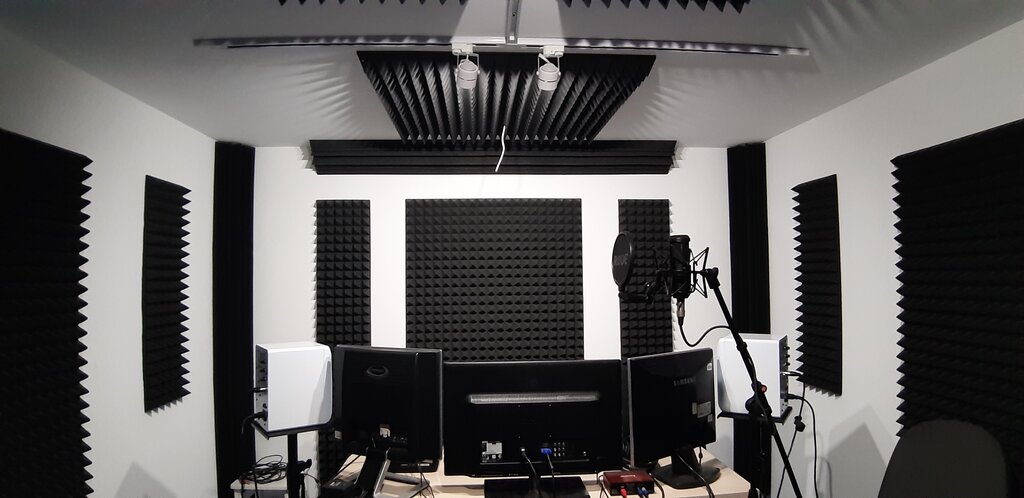
The main factors at play are reflection, absorption, and diffusion.
-
Reflection: Hard, flat surfaces like concrete walls or glass windows act like mirrors for sound. They bounce sound waves around, which can create echo and reverb. This is why singing in the shower sounds so full; the hard tiles reflect the sound back at you multiple times.
-
Absorption: Soft, porous materials like carpets, curtains, and acoustic foam absorb sound energy instead of reflecting it. This reduces echoes and makes a room sound “dead” or quiet. A library is full of sound-absorbing materials like books and carpet.
-
Diffusion: Uneven surfaces scatter sound waves in many different directions. This breaks up strong reflections and creates a more natural, pleasant-sounding space. Bookshelves filled with books of different sizes are great natural diffusers.
An empty room with hardwood floors will sound very different from the same room filled with furniture, rugs, and decorations. The furnishings absorb and diffuse sound, taming reflections.
Understanding how a room affects sound is the first step toward controlling it. Whether you're setting up a home theater, recording a podcast, or just want a quieter office, managing reflections and absorption is key.
Ready to test your knowledge? Let's see what you've learned about the fundamentals of sound.
What are the two parts that make up the alternating pattern of a sound wave's pressure?
Which characteristic of a sound wave determines its perceived pitch?
With these basics of how sound travels, how we measure it, and how it interacts with its environment, you're on your way to thinking like a sound engineer.