Introduction to Solid-State Chemistry
Introduction to Solid-State Chemistry
The World of Solids
When we think about states of matter, we usually stop at solid, liquid, and gas. But the world of solids is far more diverse than it first appears. What makes a diamond hard enough to cut glass, while graphite in a pencil is soft enough to write with? Both are just carbon. The secret lies in how their atoms are arranged.
Solid-state chemistry explores the structure, properties, and synthesis of solid materials. It all starts with understanding the two fundamental ways atoms can organize themselves in a solid: with order or with chaos.
Order vs. Disorder
Imagine building a wall. You could carefully place each brick in a repeating pattern, creating a strong, uniform structure. Or, you could just dump the bricks in a pile. Both are solid walls, but their internal structure is completely different. This is the main distinction between the two major classes of solids.
Crystalline solid
adjective
A solid material whose atoms, molecules, or ions are arranged in a highly ordered, repeating three-dimensional pattern.
In a crystalline solid, the atoms form a predictable, long-range pattern called a crystal lattice. Think of it as the material's scaffolding. This internal order gives crystalline solids distinct properties, like sharp, well-defined melting points and flat, geometric surfaces when they break.
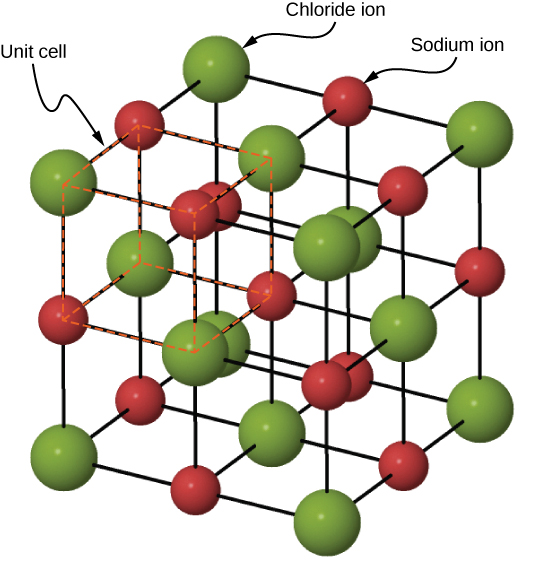
On the other hand, some solids are more like that pile of bricks.
Amorphous solid
adjective
A solid that lacks the long-range order characteristic of a crystal. Its atoms are arranged randomly, much like in a liquid.
Amorphous solids, from the Greek for "without form," have a disordered internal structure. They don't have sharp melting points; instead, they soften gradually over a range of temperatures. Common examples include glass, rubber, and many plastics.
Why Structure Matters
This difference in atomic arrangement isn't just cosmetic, it dictates a material's physical and chemical properties. The classic example is carbon. In diamond, each carbon atom is bonded to four others in a rigid, tetrahedral lattice. This structure makes diamond one of the hardest substances known.
In graphite, carbon atoms are arranged in flat, hexagonal sheets. These sheets are weakly bonded to each other, allowing them to slide past one another easily. This is why graphite is soft and slippery, making it useful as a lubricant and for pencil lead. Same atoms, different arrangement, completely different materials.
The Glue Holding Solids Together
The forces that hold these atomic structures together are chemical bonds. The type and strength of these bonds determine many of a solid's properties, like its melting point, electrical conductivity, and hardness. There are four main types of bonding found in solids.
Ionic Bonds: Formed when one atom transfers an electron to another, creating oppositely charged ions that attract each other. Solids like table salt (NaCl) are held together this way.
Covalent Bonds: Formed when atoms share electrons to form strong, directional bonds. This is the type of bonding in diamond and silicon.
Metallic Bonds: Found in metals, where valence electrons are delocalized and form a "sea" of electrons that surrounds a lattice of positive ions. This electron sea allows metals to conduct electricity.
Molecular Solids: Composed of discrete molecules held together by weaker intermolecular forces (like van der Waals forces). Ice is a common example, where individual H₂O molecules are linked in a crystal.
Understanding these basic classifications and bonding principles is the first step into the vast and fascinating field of solid-state chemistry. It's the key to designing new materials with specific properties, from stronger alloys to more efficient semiconductors.
Ready to check your understanding?
What is the key structural difference between crystalline and amorphous solids?
Diamond and graphite are both forms of pure carbon, but diamond is extremely hard while graphite is soft. What is the primary reason for this difference?
By grasping how atoms are arranged and bonded, we can begin to understand why different solids behave the way they do.