Introduction to Sketching
Introduction to Sketching
The Power of a Line
Every drawing, no matter how complex, starts with a single line. But not all lines are created equal. The character of your line, its quality, is the first tool you'll learn to control. Think of it like your handwriting. A rushed, scratchy note feels different from one written with care.
Line quality comes down to two things: pressure and speed. Pressing harder with your pencil creates a dark, bold line. A lighter touch results in a faint, delicate line. Similarly, a quick stroke feels energetic and loose, while a slow, deliberate one is controlled and precise. Mastering this control is the first step to making your sketches feel alive. Practice drawing lines with varying pressure, from as light as a whisper to as dark as you can go. Then, experiment with speed, making fast, sweeping marks and slow, careful ones.
Once you can control your lines, you can start using them to create shapes.
Building with Basic Shapes
Look around you. The most complicated objects are just combinations of simple shapes. Your coffee mug is a cylinder and part of a circle. A house is a collection of squares and triangles. Learning to see the world this way is a superpower for any artist. It simplifies the challenge of drawing and gives you a clear starting point.
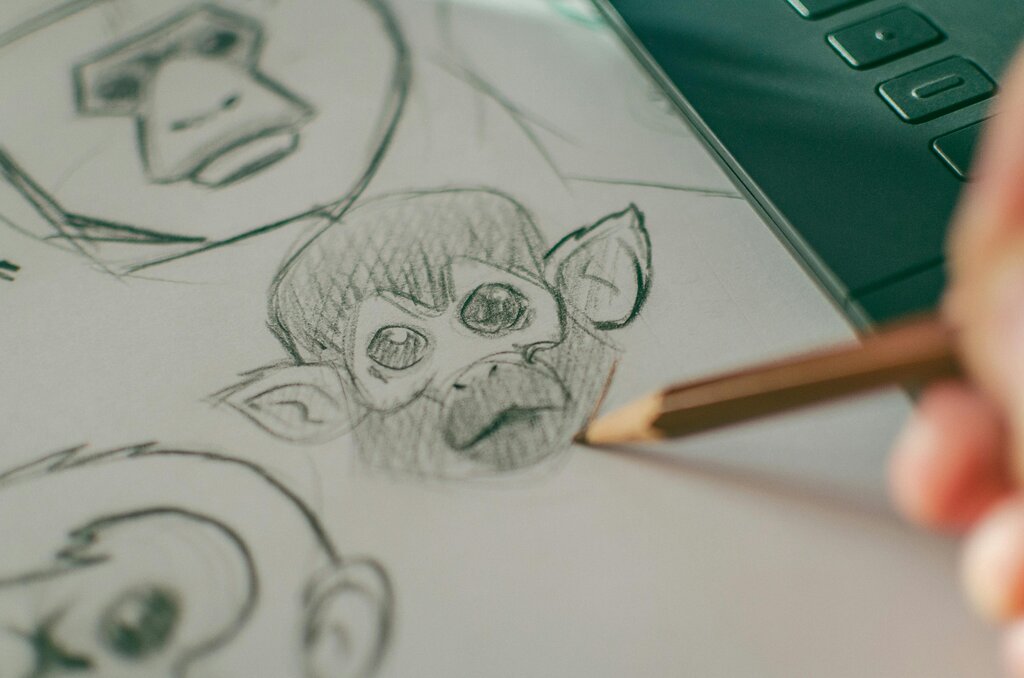
Sketching can be thought of as a form of mapping out an idea or concept, while drawing is the refinement and finishing of those ideas.
Start by practicing the three foundational shapes: the circle, the square, and the triangle. Draw them over and over. Don't worry about perfection. The goal is to train your hand and eye to work together. Once you're comfortable with these flat shapes, you can give them dimension.
By adding a little depth, these 2D shapes transform into 3D forms. A circle becomes a sphere. A square becomes a cube. A triangle can become a cone or a pyramid. These forms are the basic building blocks you'll use to construct everything you draw, from a simple apple to a detailed portrait.
Creating Depth with Shading
Drawing shapes and forms gets you a flat outline, but shading is what makes them pop off the page. Shading, or rendering, is the technique of adding value to create the illusion of light, shadow, and volume. The key is to first imagine a light source. Where is the light coming from? The surfaces facing the light will be the brightest, and the surfaces facing away will be the darkest.
There are many ways to shade, but we'll start with three fundamental techniques:
- Hatching: Creating value with a series of parallel lines. The closer the lines are to each other, the darker the area appears.
- Cross-hatching: This is just like hatching, but with a second set of lines drawn over the first at an angle. It's a great way to create even darker, richer tones.
- Stippling: Building up value using tiny dots. The denser the concentration of dots, the darker the shadow. This technique can be time-consuming, but it creates wonderful texture.
These three elements, line, shape, and shading, are the bedrock of sketching. Practice them individually, then combine them. Try sketching a simple object from your desk using only basic shapes and one of the shading techniques you just learned. The more you practice, the more natural it will become.
Ready to test your knowledge? Let's see what you've learned.
What are the two primary factors that control the quality and character of a line in a drawing?
According to the lesson, transforming a 2D square into a 3D form results in a ________.
With these basics, you have everything you need to start turning blank pages into your own unique creations.