Introduction to Siemens PLCs and TIA Portal
Introduction to PLCs
The Brains of the Factory
In any factory, from a car assembly line to a bottling plant, thousands of actions need to happen in a precise sequence. Conveyor belts start and stop, robotic arms weld and paint, and valves open and close. What coordinates this complex dance? In most modern industrial settings, the answer is a Programmable Logic Controller, or PLC.
PLCs or Programmable Logic Controllers are the backbone of industrial automation, while Human Machine Interfaces (HMI) enable user interaction with these processes.
Think of a PLC as a small, ruggedized computer designed specifically to survive harsh industrial environments and control automated processes. Unlike your desktop computer, it's built to withstand vibrations, extreme temperatures, and electrical noise. Its job is simple but critical: receive information from sensors and input devices, make decisions based on a program, and send out commands to control machines.
Inside the Box
A PLC system isn't just one single item; it's a collection of essential parts working together. While they come in many shapes and sizes, nearly all PLCs share the same fundamental architecture.
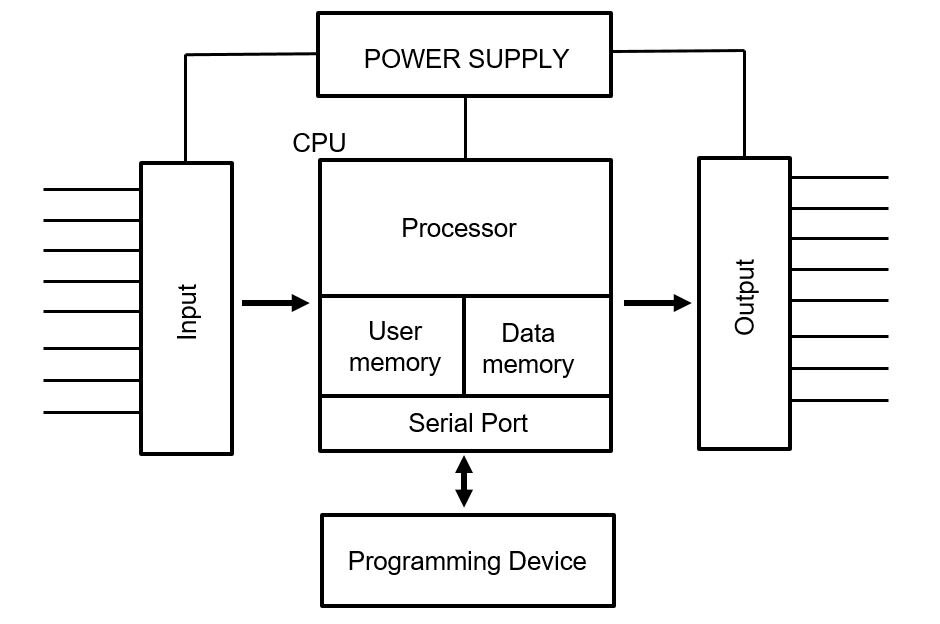
Let's break down the main components:
-
Central Processing Unit (CPU): This is the PLC's brain. It runs the user-created program, processes input signals, and determines which output signals to turn on or off. It’s where all the logic happens.
-
Input/Output (I/O) Modules: These are the PLC's senses and hands. Input modules connect to devices like push buttons, sensors, and switches, converting their electrical signals into data the CPU can understand. Output modules connect to devices like motors, lights, and solenoids, converting the CPU's decisions back into electrical signals to control them.
-
Power Supply: This component takes the incoming line voltage (like from a wall outlet) and converts it into the low-voltage DC power that the CPU and I/O modules need to operate.
Why Not Just Use a Regular Computer?
Before PLCs, factories used massive, complex panels of electromechanical relays to control processes. Each time a process changed, electricians had to physically rewire the entire panel, a tedious and error-prone task. PLCs were invented to solve this problem.
But how do they stack up against other control options, like a simple microcontroller (the chip inside your smart thermostat) or a standard PC?
| Feature | Relay Logic | PLC | Microcontroller |
|---|---|---|---|
| Flexibility | Very Low (hard-wired) | High (software) | High (software) |
| Environment | Robust | Very Robust | Fragile |
| Scalability | Difficult | Easy (modular) | Application-specific |
| Cost | Low (for simple tasks) | Medium | Very Low (chip only) |
| Programming | None (wiring) | Simple (visual languages) | Complex (code like C++) |
The key advantages of PLCs are their ruggedness, flexibility, and modularity. They are built for the factory floor. Changing the logic is as simple as uploading a new program, and adding more inputs or outputs is often just a matter of plugging in a new module.
This invention kicked off a revolution in manufacturing. Automation became cheaper, more reliable, and far more adaptable. The ability to quickly reprogram a production line without extensive rewiring allowed for faster innovation and product changes, laying the groundwork for the highly automated factories we see today.
What is the primary function of a Programmable Logic Controller (PLC) in an industrial setting?
Which PLC component is responsible for executing the user-created program and making logical decisions?
PLCs are the unsung heroes of the modern world, quietly working behind the scenes to make, package, and process many of the goods we use every day.