Introduction to Security Applications
Cybersecurity Fundamentals
The Core Principles
Cybersecurity isn't just about hackers in dark rooms. At its heart, it's about protecting information. To do that, we rely on three core ideas that form the foundation of all digital security.
The core objectives of cybersecurity are structured around a fundamental framework known as the CIA Triad: Confidentiality, Integrity, and Availability.
Think of it like protecting a valuable package. You want to make sure only the right person can open it (Confidentiality), that nothing inside has been tampered with (Integrity), and that the recipient can actually get the package when they need it (Availability). Let's break these down.
Confidentiality
noun
Ensuring that information is not disclosed to unauthorized individuals, entities, or processes.
This is the secrecy part of security. It's about preventing sensitive information from falling into the wrong hands. When you use your password to log into your email, you're practicing confidentiality. You are the only one authorized to see your messages.
Integrity
noun
Maintaining and assuring the accuracy and completeness of data over its entire lifecycle.
Integrity means the information is trustworthy and hasn't been modified improperly. Imagine a bank transfer. If you send $100, you need to be certain that the bank's records can't be secretly changed to show $10 or $1,000. Data integrity ensures the information is reliable and accurate.
Availability
noun
Ensuring that authorized users have timely and reliable access to data and resources when they are needed.
Information is useless if you can't get to it. Availability means that systems, networks, and data are up and running for legitimate users. If a website crashes due to overwhelming traffic or an attack, its availability is compromised.
Each principle is crucial. Without confidentiality, secrets are exposed. Without integrity, data can't be trusted. Without availability, information is inaccessible. A strong security posture requires a balance of all three.
A Landscape of Threats
The need for the CIA triad is driven by the vast and interconnected digital world we live in. Our critical infrastructure, from power grids and hospitals to financial markets and transportation, relies on computer systems. This deep integration brings incredible benefits but also creates vulnerabilities that malicious actors seek to exploit.

Protecting these systems is no longer optional. A successful attack can disrupt daily life, cause economic damage, and even threaten public safety. This is why cybersecurity has become a vital field in modern society, focused on protecting our digital way of life from a wide range of threats.
Attackers use various methods, or attack vectors, to compromise systems. Understanding the most common ones is the first step toward building a defense.
| Threat Type | Goal |
|---|---|
| Phishing | Tricking a user into revealing sensitive information, like passwords or credit card numbers, by pretending to be a trustworthy entity. |
| Malware | Malicious software (viruses, worms, spyware) designed to disrupt operations, steal data, or gain unauthorized access to a system. |
| Ransomware | A type of malware that encrypts a victim's files, with the attacker demanding a ransom to restore access. |
| Denial-of-Service (DoS) | Overwhelming a system with traffic to make it unavailable to legitimate users. |
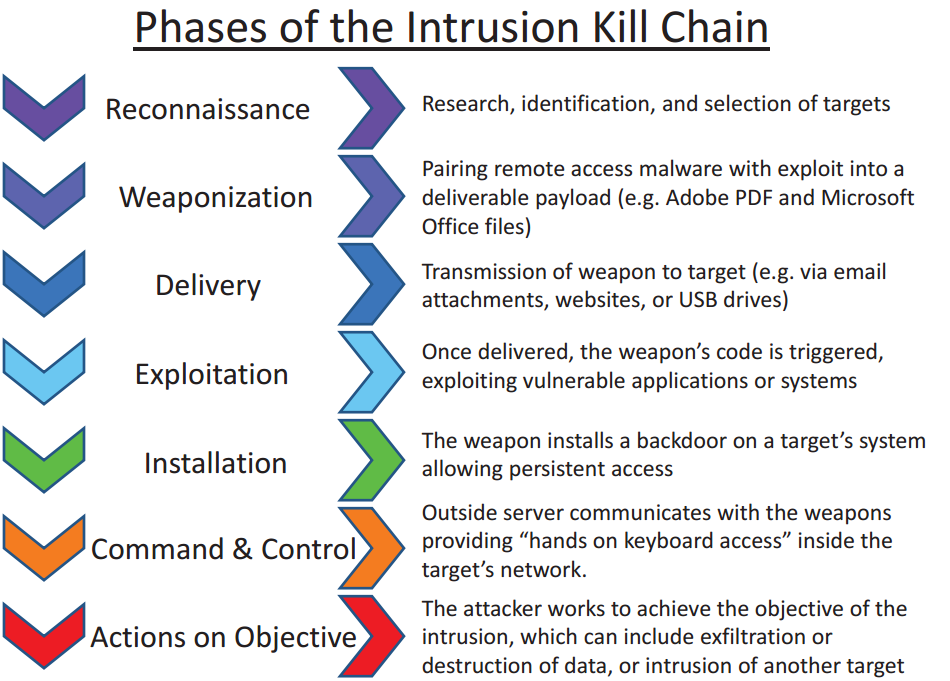
These threats often follow a predictable pattern, sometimes called a 'kill chain,' which outlines the stages of an attack from initial reconnaissance to the final objective.
Now that you understand the core principles and the threats they guard against, let's test your knowledge.
A hospital's patient record system is hit by a ransomware attack, encrypting all files and making them inaccessible to doctors. Which principle of the CIA triad is most directly compromised?
An attacker intercepts a bank transfer and alters the amount from $100 to $10,000. This action is a direct violation of which security principle?