Introduction to Sanskrit
Devanagari Script
The Devanagari Script
Devanagari is the script used to write Sanskrit, Hindi, and several other languages. It might look intricate, but it has a secret weapon: it’s almost completely phonetic. What you see is what you say. This makes learning to read it surprisingly straightforward.
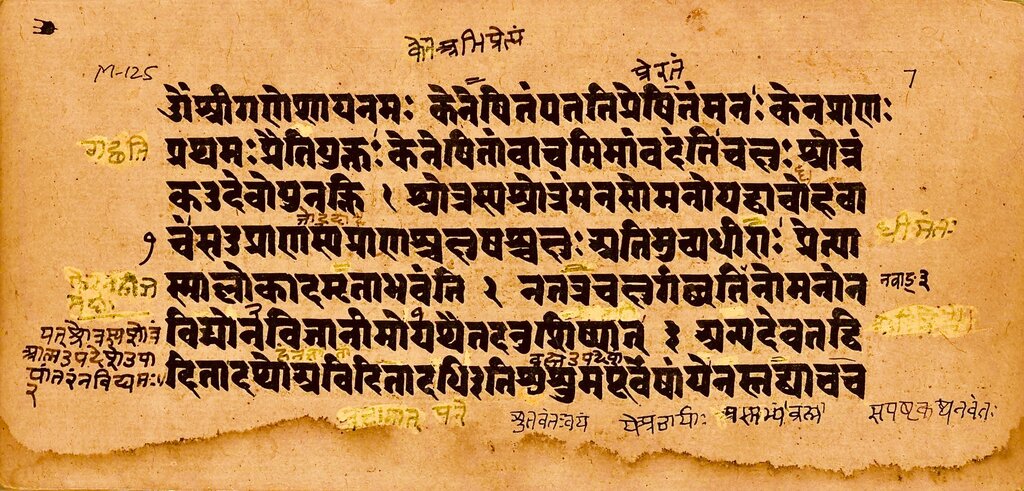
The script is an abugida, which means that consonants have an inherent vowel sound built into them. Don't worry, we'll break down exactly what that means. For now, just know that Devanagari is written from left to right, and letters in a word are typically connected by a horizontal line running along the top.
Vowels The Svaras
Sanskrit vowels are called svaras (स्वर). There are 13 of them, and they come in two forms: a full form used when the vowel starts a word or stands alone, and a combining form (a diacritical mark) used when it follows a consonant.
Let's start with the full, independent forms. Each has a short (hrasva) and a long (dīrgha) version, which affects pronunciation.
| Devanagari | Transliteration | Pronunciation Guide |
|---|---|---|
| अ | a | like the 'u' in 'but' |
| आ | ā | like the 'a' in 'father' |
| इ | i | like the 'i' in 'pin' |
| ई | ī | like the 'ee' in 'see' |
| उ | u | like the 'u' in 'put' |
| ऊ | ū | like the 'oo' in 'pool' |
| ऋ | ṛ | a syllabic 'r', like 'ri' in 'river' |
| ए | e | like the 'ay' in 'say' |
| ऐ | ai | like the 'ai' in 'aisle' |
| ओ | o | like the 'o' in 'go' |
| औ | au | like the 'ow' in 'how' |
There are also two other important characters often grouped with vowels: anusvāra (अं) which adds a nasal sound (like 'm' or 'n'), and visarga (अः) which adds a final, breathy 'h' sound.
Consonants The Vyanjanas
The consonants, or vyanjanas (व्यञ्जन), are the backbone of the script. The key thing to remember is that every consonant has an inherent short 'a' (अ) vowel sound. So, the character क is not just 'k', it's 'ka'. To represent just the 'k' sound without a vowel, a special mark called a virāma (or halant) is added underneath: क्.
The consonants are brilliantly organized in a grid based on where in the mouth they are pronounced, moving from the back of the throat to the lips.
| Category | Voiceless | Voiceless (Aspirated) | Voiced | Voiced (Aspirated) | Nasal |
|---|---|---|---|---|---|
| Gutturals (back of throat) | क ka | ख kha | ग ga | घ gha | ङ ṅa |
| Palatals (palate) | च ca | छ cha | ज ja | झ jha | ञ ña |
| Retroflex (roof of mouth) | ट ṭa | ठ ṭha | ड ḍa | ढ ḍha | ण ṇa |
| Dentals (teeth) | त ta | थ tha | द da | ध dha | न na |
| Labials (lips) | प pa | फ pha | ब ba | भ bha | म ma |
Besides these core consonants, there are a few semi-vowels and sibilants.
| Devanagari | Transliteration |
|---|---|
| य | ya |
| र | ra |
| ल | la |
| व | va |
| श | śa |
| ष | ṣa |
| स | sa |
| ह | ha |
Putting It All Together
Now, how do we change the inherent 'a' vowel? By adding the combining form of other vowels to a consonant. Each vowel has a unique mark that attaches to the consonant in a specific way: above, below, to the right, or to the left.
Let’s see how this works with the consonant क (ka).
Notice how the vowel signs can appear on all sides of the consonant. This system allows any consonant to be combined with any vowel to create a specific syllable.
Finally, the horizontal top line, called a shirorekha (शिरोरेखा), is drawn at the end, after all the letters in a word are written. It connects them into a single unit, with small breaks over certain characters.
Practice is key. Start by writing each vowel and consonant, paying attention to the stroke order. Then, try combining each consonant with each vowel sign. This muscle memory will make reading and writing feel natural over time.
What is a key characteristic of the Devanagari script as an abugida?
What is the name of the horizontal line that connects the letters in a Devanagari word?
Mastering the script is the first and most important step to reading Sanskrit. With these fundamentals, you're ready to start recognizing and forming words.