Introduction to Salts in Chemistry
Introduction to Salts
More Than Just Table Salt
When you hear the word “salt,” you probably think of the white stuff you sprinkle on your food. That’s sodium chloride, and it’s just one example of a huge family of chemical compounds called salts.
In chemistry, a salt is any ionic compound formed from a cation (a positively charged ion) from a base and an anion (a negatively charged ion) from an acid. This means salts are made of positively and negatively charged ions held together by strong electrostatic attraction.
Salts are the ionic compounds which are produced after the neutralization reaction between acid and base.
The most common way to make a salt is through a neutralization reaction. This is what happens when you mix an acid with a base. They neutralize each other, producing a salt and water. The basic formula for this reaction is:
Acid + Base → Salt + Water
The Signature Traits of Salts
Salts share several distinct properties because of their ionic nature. One of the most visible is their structure. Salts are crystalline solids, meaning their ions are arranged in a highly ordered, three-dimensional pattern called a crystal lattice. This is why table salt grains look like tiny cubes.
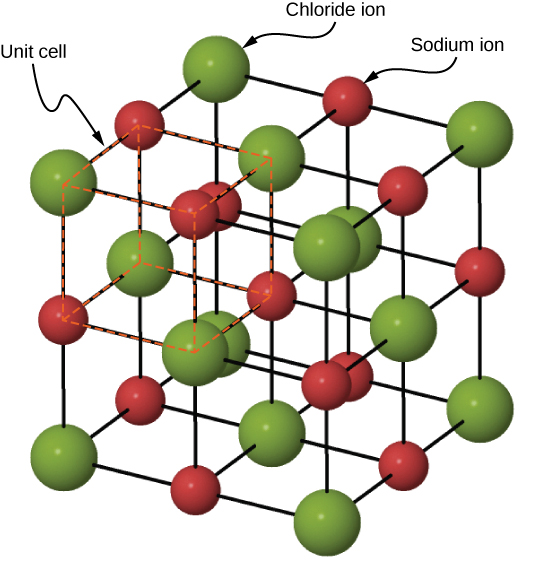
The strong ionic bonds holding the crystal lattice together give salts high melting and boiling points. It takes a lot of heat energy to break these bonds and allow the ions to move freely as a liquid or gas. For example, sodium chloride melts at a scorching 801°C (1474°F).
Many salts are soluble in water. When a salt like sodium chloride dissolves, the water molecules surround the individual sodium () and chloride () ions, pulling them apart and allowing them to move freely throughout the solution.
This ability to dissolve and separate into ions is key to another important property: electrical conductivity. Solid salts do not conduct electricity because their ions are locked in place. However, when a salt is dissolved in water or melted into a liquid, its ions are free to move. These mobile charged particles can carry an electric current.
A Diverse Family
While sodium chloride is the most famous salt, there are countless others. Potassium nitrate () is used in fertilizers and fireworks. Calcium carbonate () is the main component of seashells and limestone.
Salts are not all white and salty-tasting. Their color and taste depend on the specific ions they contain. For example, copper sulfate () forms beautiful blue crystals, while potassium permanganate () is a deep purple. Some salts are sweet, like lead(II) acetate (though it is highly toxic), and some are bitter, like magnesium sulfate (Epsom salt).
In essence, salts are a fundamental class of compounds in chemistry, formed from the reaction of acids and bases and characterized by their unique ionic structure and properties.
What is the chemical definition of a salt?
The reaction is known as what type of reaction?