Introduction to Sailing
Sailboat Parts
The Body of the Boat
Every sailboat starts with a hull. It's the main body of the boat, the part that sits in the water. Think of it as the watertight shell that provides buoyancy, keeping everything and everyone afloat.
hull
noun
The main body or shell of a ship or boat.
On top of the hull is the deck. This is the flat, walkable surface where the crew operates the boat. The very front of the boat is called the bow, and the very back is the stern. The flat surface at the stern is the transom.
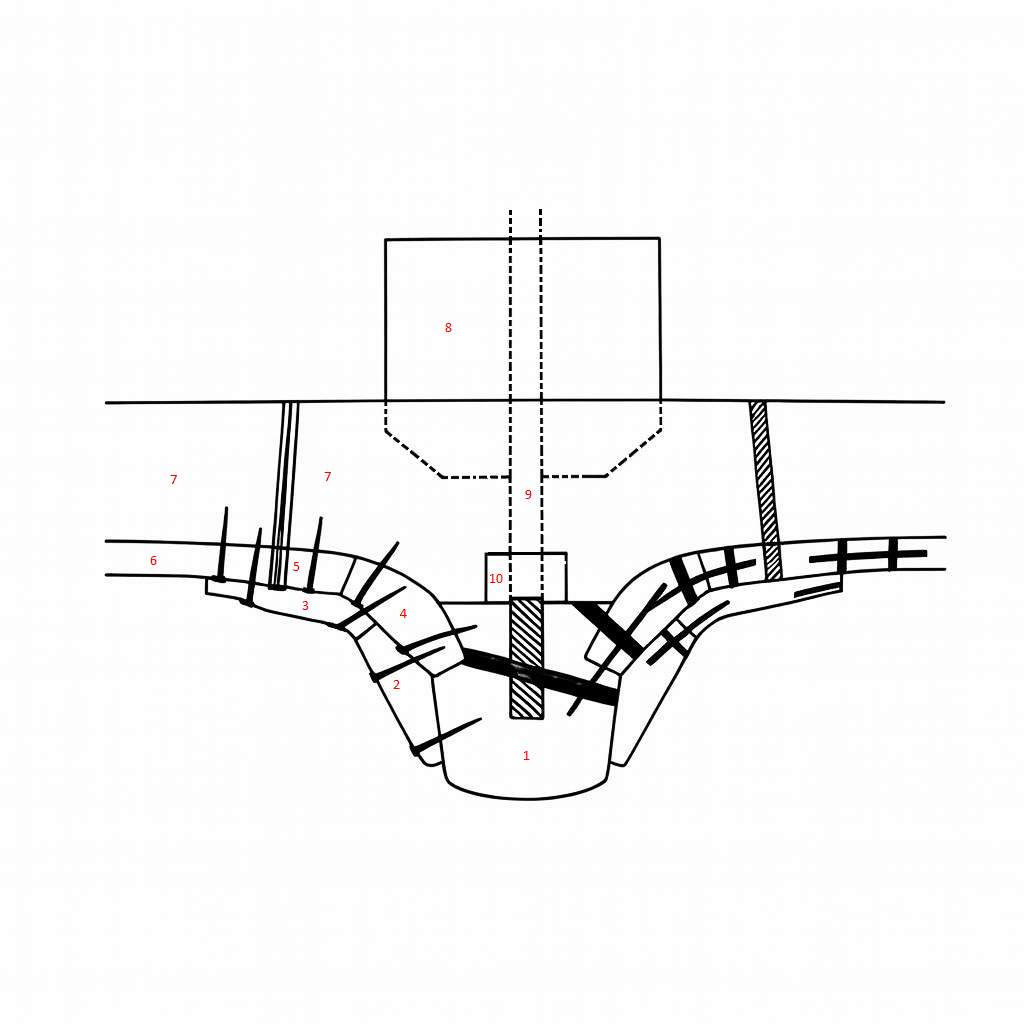
Two critical parts extend below the hull. The keel is a large, weighted fin that sticks down into the water. It serves two purposes: it prevents the boat from being pushed sideways by the wind, and its weight provides stability, keeping the boat from tipping over. Attached to the stern, under the water, is the rudder. This is a flat piece that can be turned to steer the boat. The rudder is controlled by the helm, which can be either a long lever called a tiller or a steering wheel.
On Deck
Most of the action happens on deck. The cockpit is the recessed area where the crew sits and the helm is located. On larger boats, a cabin provides a sheltered space below deck for sleeping, cooking, and navigation.
For safety, vertical posts called stanchions are mounted around the edge of the deck. Lifelines, typically made of wire, run through the stanchions to prevent crew from falling overboard. At the very bow, you'll often find a metal railing called a pulpit.
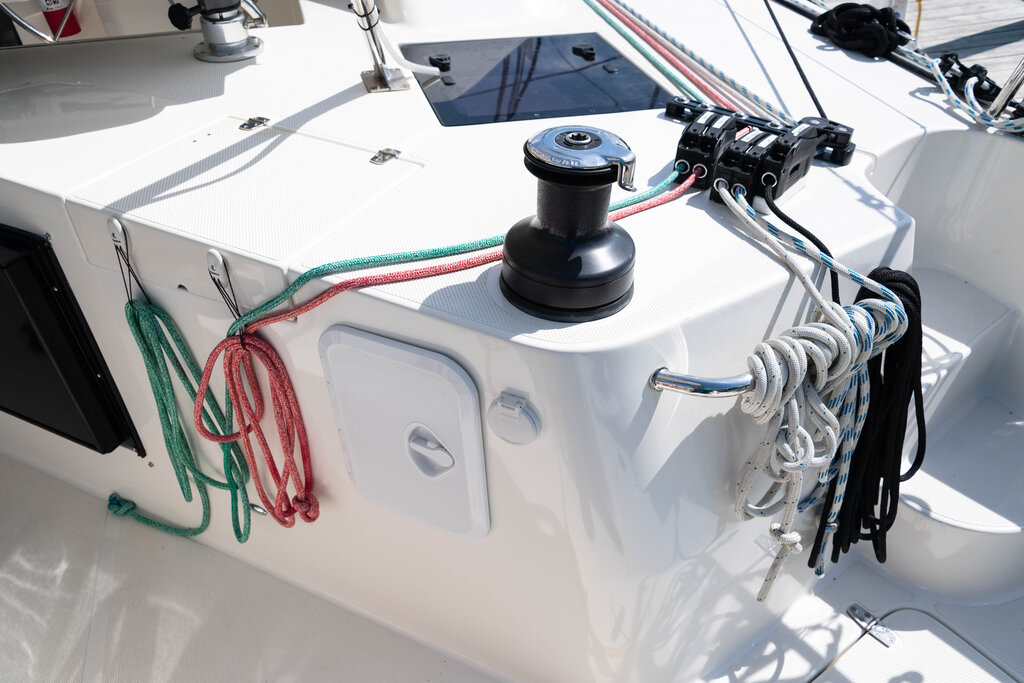
The deck is also covered in specialized hardware. A winch is a mechanical device that uses a rotating drum to pull in ropes, or "lines," under heavy load. It gives you a huge mechanical advantage. Lines are secured to cleats, which are T-shaped fittings. Pulleys on a boat are called blocks, and a fairlead is a fitting used to guide a rope in a specific direction.
When tied to a dock, sailors use fenders—cushions that hang over the side—to protect the hull from scraping against the pier. The ropes used to tie the boat to the dock are called docklines.
The Rigging and Sails
The rigging is the network of masts, spars, wires, and ropes that support and control the sails. It's divided into two categories.
Standing rigging is fixed and supports the mast. Running rigging is adjustable and is used to control the sails.
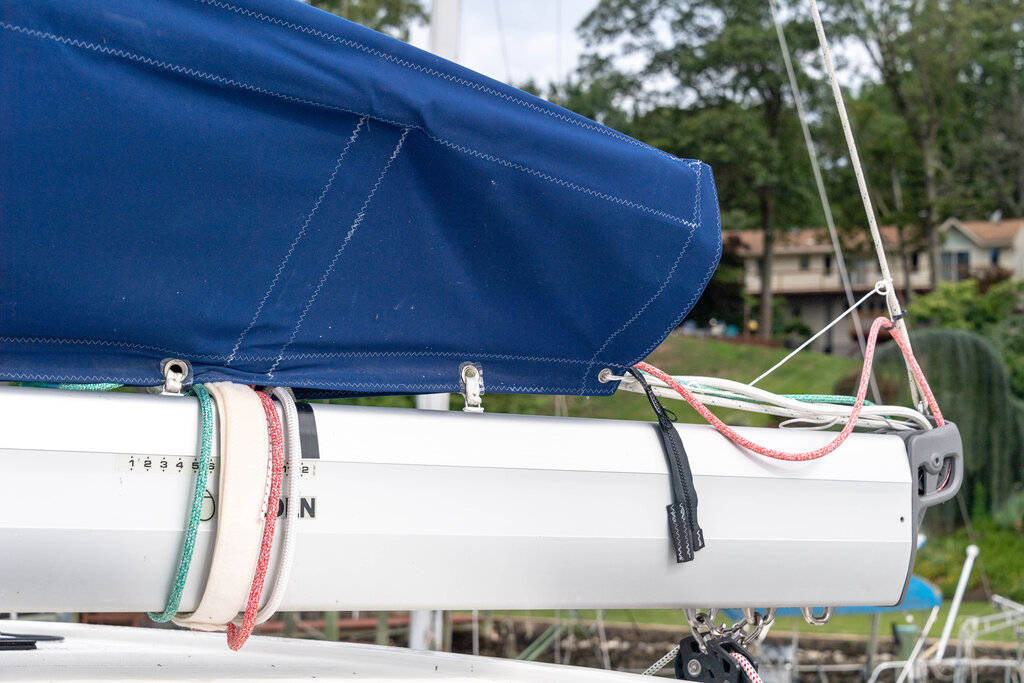
The main pole rising from the deck is the mast. The horizontal pole attached to the mast is the boom. The pivot fitting connecting them is the gooseneck.
The standing rigging that holds the mast up includes shrouds (wires running from the side of the mast down to the deck), spreaders (struts that push the shrouds out from the mast to increase the support angle), and chainplates (strong metal plates that anchor the shrouds to the hull). The headstay or forestay supports the mast from the front, and the backstay supports it from behind.
Now for the engine of the boat: the sails. The mainsail is the sail behind the mast, attached to the mast and the boom. The sail in front of the mast is a jib or genoa (a genoa is just a larger, overlapping jib).
Every triangular sail has three corners and three edges. The top corner is the head. The forward lower corner is the tack, and the aft lower corner is the clew. The front edge is the luff, the bottom edge is the foot, and the back edge is the leech.
Sails have other important features. Battens are stiff rods inserted into batten pockets on the leech of the mainsail to help it hold its shape. A bolt rope is sewn into the luff or foot to allow the sail to slide into a groove on the mast or boom. Jibs are often attached to the headstay with clips called hanks. You'll also see small strips of yarn or cloth on the sail called telltales, which help you visualize the airflow over the sail.
Now, for the running rigging—the lines that move. A halyard is a line used to hoist a sail. The mainsheet is the line used to control the angle of the boom (and thus the mainsail) relative to the wind. The lines that control the jib are called jibsheets.
A huge number of other lines help fine-tune sail shape. The boom vang pulls the boom down. The outhaul pulls the clew of the mainsail back along the boom to tighten the foot. The downhaul or Cunningham pulls the tack of the mainsail down to tighten the luff. The traveler is a track that allows the mainsheet's attachment point to move from side to side. And finally, a shackle is a U-shaped metal fitting used to connect things, like a halyard to the head of a sail. Many modern boats also have a roller furler, a mechanism that rolls the jib up around the headstay for easy storage.
That's a lot of new terminology. Let's review the most important parts.
Now, test your knowledge of how these parts work together.
What are the two primary functions of a sailboat's keel?
The aft, or back, edge of a triangular sail is called the leech.
Knowing the names and functions of these parts is the first step toward becoming a competent sailor. It's the language of the boat, allowing you to communicate effectively with your crew.