Introduction to Reinforcement Learning
Introduction to Reinforcement Learning
Learning from Experience
Imagine teaching a dog to fetch. You don't give it a textbook on the physics of a thrown ball. Instead, you throw a stick. If the dog brings it back, you give it a treat. If it just sits there, it gets nothing. Over time, the dog learns that bringing the stick back leads to a reward.
This is the core idea behind reinforcement learning (RL). It's a way for a machine to learn by doing. An RL system learns through trial and error, guided by rewards and penalties, without being explicitly told what to do.
Reinforcement Learning (RL) is a fascinating branch of Machine Learning where agents learn to make decisions by interacting with an environment to maximize cumulative rewards.
The Key Players
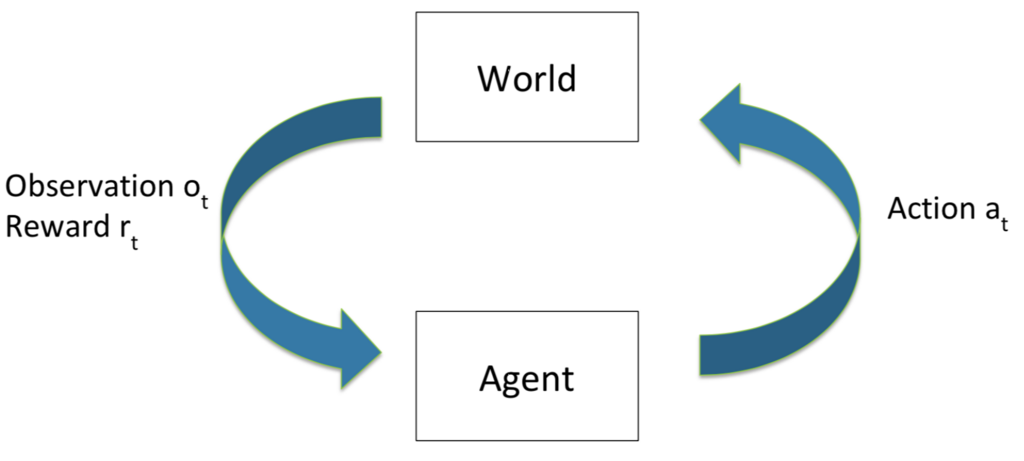
Every reinforcement learning scenario has a few key components that work together in a continuous loop. Let's break them down.
Agent
noun
The learner or decision-maker. This is the part of the system that we're trying to make smart.
The agent exists within a specific context.
Environment
noun
The world the agent operates in. It's everything outside of the agent.
At any given moment, the environment is in a particular situation.
State
noun
A snapshot of the environment at a specific time. It's the information the agent uses to make a decision.
Based on the state, the agent has to do something.
Action
noun
A move the agent can make. The set of all possible moves is called the action space.
After an action, the environment gives feedback.
Reward
noun
The feedback from the environment that tells the agent how good its action was. The agent's goal is to maximize its total reward.
These components form a cycle: the agent observes the environment's state, takes an action, and receives a reward. This process repeats, and with each cycle, the agent learns which actions lead to the best rewards in different states.
The Big Dilemma
Imagine you're choosing a place for dinner. You could go to your favorite restaurant, where you know you'll get a great meal. Or, you could try that new place down the street, which might be even better—or it could be terrible.
This is the exploration-exploitation trade-off, and it's a central challenge in reinforcement learning.
Exploitation: Using the knowledge you already have to get a known reward. (Going to your favorite restaurant.)
Exploration: Trying something new to potentially discover a better reward. (Trying the new restaurant.)
An agent needs to do both. If it only exploits, it might get stuck with a decent strategy but miss out on an amazing one. If it only explores, it will never use the good information it finds. A successful RL agent must strike a careful balance between exploring its environment to find new sources of reward and exploiting the ones it has already discovered.
Ready to test your knowledge on these foundational concepts?
What is the core principle of reinforcement learning?
In the reinforcement learning framework, the entity that observes, makes decisions, and takes actions is known as the ____.
Understanding these core ideas—the agent, environment, and the trade-off between exploring and exploiting—is the first step into the world of reinforcement learning.