Introduction to Regression Analysis
Introduction to Regression
Finding Relationships in Data
Regression analysis is a statistical tool for investigating the relationship between different variables. Think of it as a way to find a pattern in the noise. For instance, a company might want to know how its advertising budget affects its sales. Or a doctor might want to understand the link between a patient's weight and their blood pressure.
At its core, regression helps us understand how one variable changes when another one does. It's about modeling relationships and making predictions.
This process allows us to not only see if a relationship exists but also to measure its strength. It's a fundamental technique in fields ranging from finance and marketing to biology and engineering because it turns data into actionable insights.
The Key Ingredients
To perform a regression, you need two types of variables. The first is the main thing you are trying to predict or explain. This is known as the dependent variable.
Dependent Variable
noun
The main variable that you are trying to predict or understand. Its value is thought to depend on other variables.
The second type of variable is what you think influences the dependent variable. These are called independent variables.
Independent Variable
noun
A variable that is believed to have an effect on the dependent variable. It is the variable you change or observe to see how it affects the other.
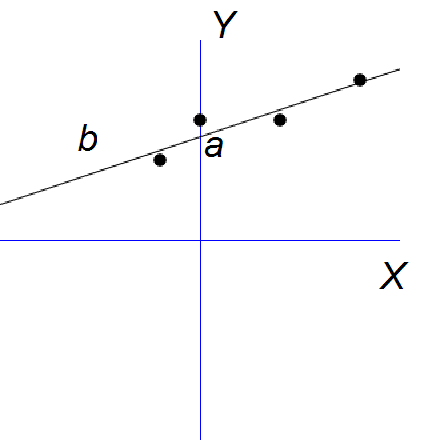
Let's stick with the crop example. We want to predict crop yield (the dependent variable). We suspect that rainfall and fertilizer (the independent variables) both play a role. Regression analysis helps us build a model of this relationship. The goal is often to draw a line that best fits the data points we've collected.
Building the Model
The line in the graph above is our model. It represents our best guess for the relationship between the X (independent) and Y (dependent) variables. The model is defined by numbers called coefficients. They are the mathematical description of the relationship.
Coefficient
noun
A number that represents the strength and direction of the relationship between an independent variable and the dependent variable.
Of course, the model is never perfect. The line won't pass through every single data point exactly. The distance between each actual data point and the line predicted by our model is called the residual, or the error.
Residual
noun
The difference between the observed value of the dependent variable and the value predicted by the regression model.
The goal in regression analysis is to find the coefficients that make these residuals as small as possible, on average. This gives us the line of 'best fit' and the most accurate model for making predictions.
What is the primary goal of regression analysis?
A researcher is studying how the hours of sleep a student gets affects their test scores. In this study, the test score is the...