Introduction to Real Analysis
Real Numbers
Ordering the Universe of Numbers
The real numbers feel familiar. We use them to measure distance, time, and temperature. A key feature is their sense of order. If you pick any two real numbers, you can always say which one is bigger, which is smaller, or if they're equal. This is called the trichotomy property: for any two numbers and , exactly one of these statements is true:
This property allows us to arrange all real numbers on an infinite line. Numbers to the right are always greater than numbers to the left. This order behaves predictably. If you add the same number to both sides of an inequality, the order doesn't change. If , then . The same holds for multiplication by a positive number. These rules provide a stable structure for arithmetic.
The Gaps in Rational Numbers
For a long time, mathematicians thought the only numbers needed were rational numbers—those that can be expressed as a fraction of two integers, like , , or . It seemed like these fractions could account for any point on the number line you could possibly want.
Then came a startling discovery. Imagine a simple square with sides of length 1. According to the Pythagorean theorem, the length of its diagonal is . The ancient Greeks tried to write as a fraction, but they couldn't. Eventually, they proved it was impossible. Numbers like are called irrational.
This meant the number line, if it only contained rational numbers, was full of tiny, invisible holes. There was a point for , and another for , and another for , but no point for the actual length of that diagonal. To create a continuous, unbroken line, these gaps needed to be filled.
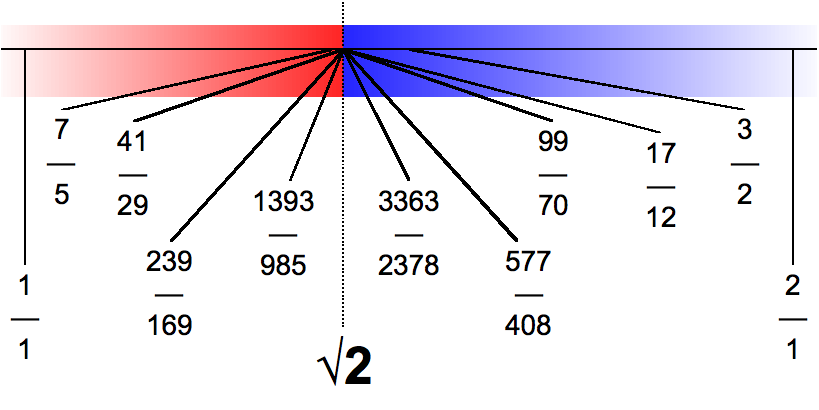
One way to conceptualize filling these gaps is with an idea called a Dedekind cut, named after the mathematician Richard Dedekind. The idea is to slice the number line into two sets at the precise location of a number. For an irrational number like , the cut divides all rational numbers into two groups:
Set A: All the negative rational numbers and all the positive rational numbers whose square is less than 2. Set B: All the positive rational numbers whose square is greater than 2.
In this setup, Set A has no largest number, and Set B has no smallest number. The cut itself defines the irrational number that fills the gap between them. By making a cut for every possible point, we construct the complete set of real numbers.
Making the Number Line Complete
Filling the gaps gives the real number line a crucial property: completeness. This is formalized in what's called the Completeness Axiom, which is a foundational rule for real numbers. To understand it, we first need two simple ideas.
An upper bound of a set of numbers is a number that is greater than or equal to every number in the set. For example, for the set of numbers less than 10, the numbers 10, 11, and 50 are all upper bounds.
The least upper bound is the smallest of all possible upper bounds. For the set of numbers less than 10, the least upper bound is exactly 10.
supremum
noun
The least upper bound of a set of numbers. It is the smallest number that is greater than or equal to every number in the set.
The Completeness Axiom states that every non-empty set of real numbers that has an upper bound must have a least upper bound that is also a real number. This might sound obvious, but it's not true for rational numbers.
Consider the set of all rational numbers whose square is less than 2. This set is certainly bounded above; for instance, 1.5 is an upper bound. But the set has no least upper bound within the rational numbers. Any rational upper bound you pick can always be replaced by a slightly smaller one that is still an upper bound. The true least upper bound is , which isn't a rational number.
This axiom guarantees that there are no holes in the real number line. Every bounded set points to a specific real number as its limit, ensuring the line is a perfect continuum. This property is the bedrock of calculus and many other areas of mathematics.
Ready to check your understanding of the real numbers?
According to the trichotomy property, if you are given any two distinct real numbers, what can you definitively say about their relationship?
The discovery of irrational numbers like revealed what important fact about the set of rational numbers?