Introduction to Quantum Physics
Introduction to Quantum Mechanics
When the Old Rules Break
For centuries, classical physics, built on the work of Isaac Newton, gave us a reliable way to understand the world. It described planets orbiting the sun and apples falling from trees with beautiful precision. These rules work perfectly for the large-scale objects we see and interact with every day. But as the 19th century turned to the 20th, scientists began peering into the world of the very small—the world of atoms and the particles within them. And things got weird.
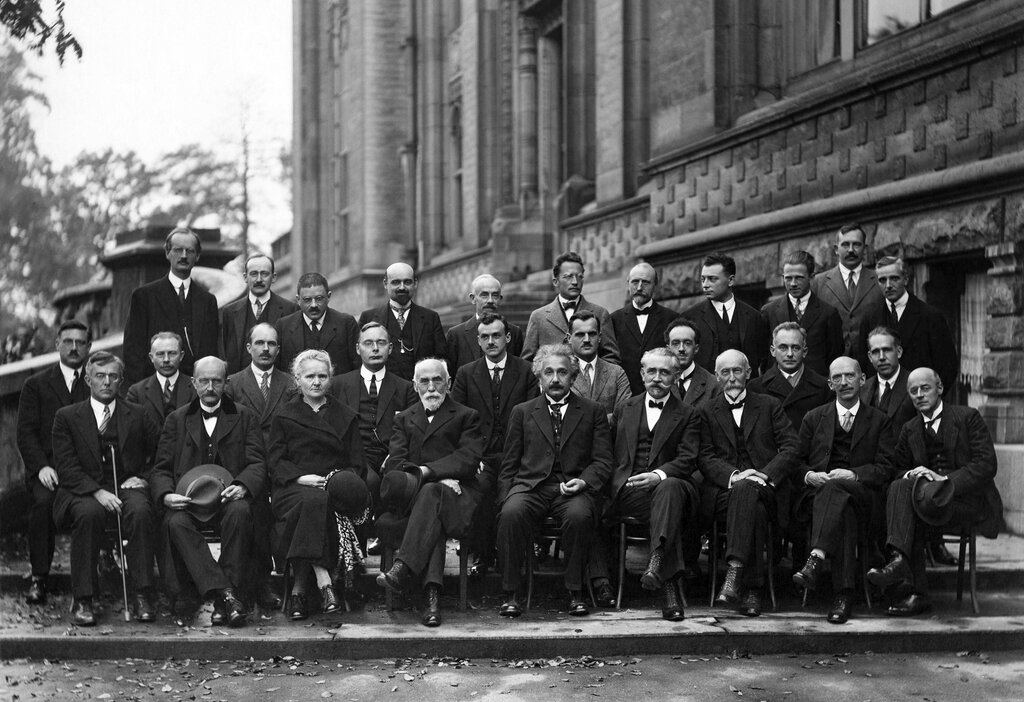
Experiments started yielding results that made no sense under the old rules. The way hot objects glowed, the specific colors of light emitted by different elements, and the behavior of electrons simply couldn't be explained. It became clear that the universe operates under a different set of rules at the subatomic level. This realization wasn't the work of one person, but a collective effort by some of the brightest minds in history, who together built the foundations of a new physics: quantum mechanics.
Energy Comes in Packets
One of the first major cracks in classical physics came from studying black-body radiation—the light emitted by a perfect absorber of heat. Classical theories predicted that such an object should emit an infinite amount of energy at high frequencies, a result so wrong it was called the "ultraviolet catastrophe."
In 1900, physicist Max Planck proposed a radical solution. He suggested that energy isn't continuous, like a ramp you can slide up and down. Instead, it comes in discrete packets, which he called "quanta." It's more like a staircase, where you can stand on one step or the next, but never in between. This idea, that energy is quantized, was revolutionary and marked the birth of quantum theory.
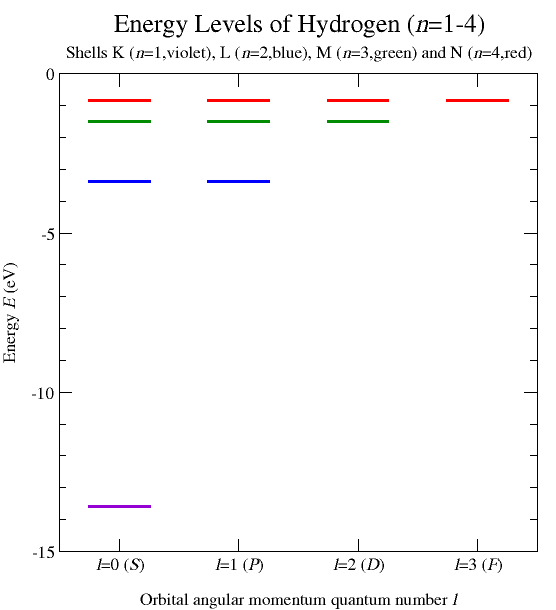
This concept of quantization beautifully explained the behavior of electrons in atoms. An electron can't just orbit the nucleus at any distance it pleases. It can only exist in specific, allowed energy levels. To move from a lower to a higher energy level, it must absorb an exact quantum of energy. When it falls back down, it emits that same quantum of energy as a particle of light, a photon. The specific colors of light emitted by an element are just the signature of its unique set of quantized energy levels.
The Wave Function
So if particles like electrons can only exist in specific energy states, how do we describe them? We can't track an electron's path like we would a planet. Instead, quantum mechanics uses a mathematical tool called the wave function, represented by the Greek letter psi ($ \Psi $).
The wave function contains everything we can possibly know about a quantum system. But it doesn't tell us where a particle is. Instead, it tells us about the probability of finding the particle at any given point in space if we were to look for it.
wave function
noun
A mathematical description of the quantum state of a system, used to determine the probability of finding a particle at a particular point in space.
Imagine you're trying to find a friend in a large park. The wave function is like a map of the park that's shaded to show where your friend is most likely to be. The darkest areas are high-probability spots, and the lightest areas are where you're unlikely to find them. The map doesn't say, "Your friend is sitting on this specific bench." It just gives you the odds for every possible location.
A World of Probabilities
This brings us to one of the most fundamental and mind-bending aspects of quantum mechanics: its probabilistic nature. Before we make a measurement, a quantum particle doesn't have a definite position. According to the wave function, it exists as a cloud of possibilities.
To find the actual probability of locating the particle at a certain point, we take the wave function ($ \Psi $) and square its magnitude, a value written as $ |\Psi|^2 $. This gives us something called the probability density.
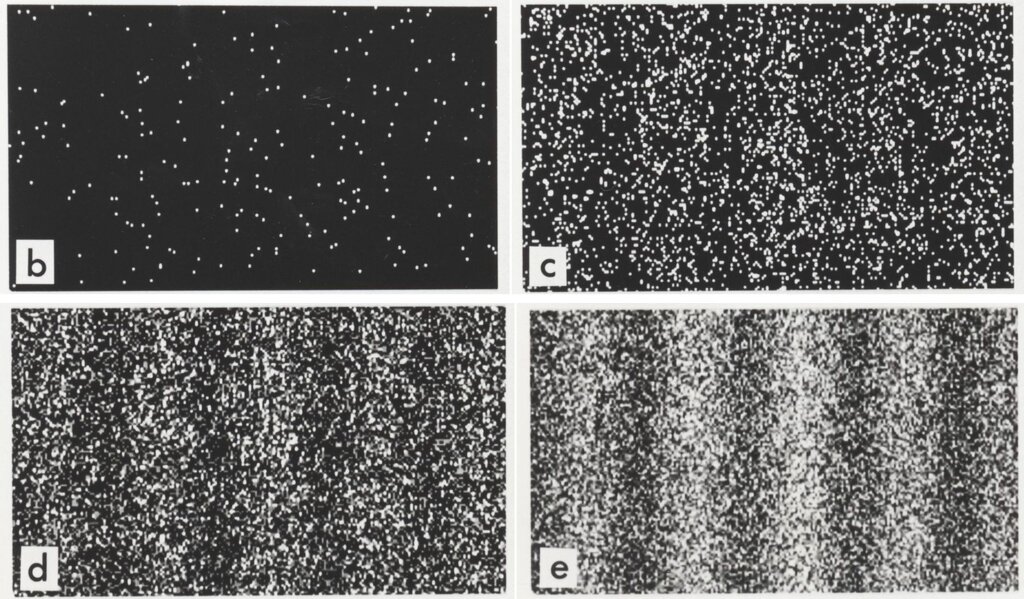
When we perform an experiment to measure the particle's position, this cloud of possibilities instantly "collapses" to a single, definite point. We find the particle in one specific location. The weird part? The location we find it in is governed by the probabilities described by $ |\Psi|^2 $. We can't predict with certainty where it will be, only the likelihood of finding it in different places.
This is a radical departure from classical physics, where everything is deterministic. If you know the starting position and velocity of a baseball, you can calculate its exact trajectory. In the quantum world, we can only calculate the odds. This inherent randomness isn't due to a lack of information; it's a fundamental feature of reality at the smallest scales.
These core ideas—quantized energy, the wave function, and a probabilistic universe—form the bedrock of quantum mechanics. They paint a picture of a world that is fuzzy, strange, and governed by the laws of chance. And they are the essential first steps to understanding even stranger quantum phenomena.