Introduction to Quantum Physics
Introduction to Quantum Mechanics
A Crack in the Foundation
At the end of the 19th century, physics seemed to be figured out. Newton's laws of motion described everything from a falling apple to the orbit of the moon. Maxwell's equations elegantly explained electricity, magnetism, and light. Scientists felt they were just tying up loose ends. It was a neat, orderly, and predictable world.
But a few nagging problems refused to go away. One of the most stubborn was the "ultraviolet catastrophe." According to the physics of the time, a perfect blackbody—an object that absorbs all radiation that hits it—should emit an infinite amount of energy as the wavelength of light gets shorter. This obviously didn't happen. Ovens don't sterilize the kitchen with gamma rays when you turn them on. The theory was clearly, deeply wrong about something.
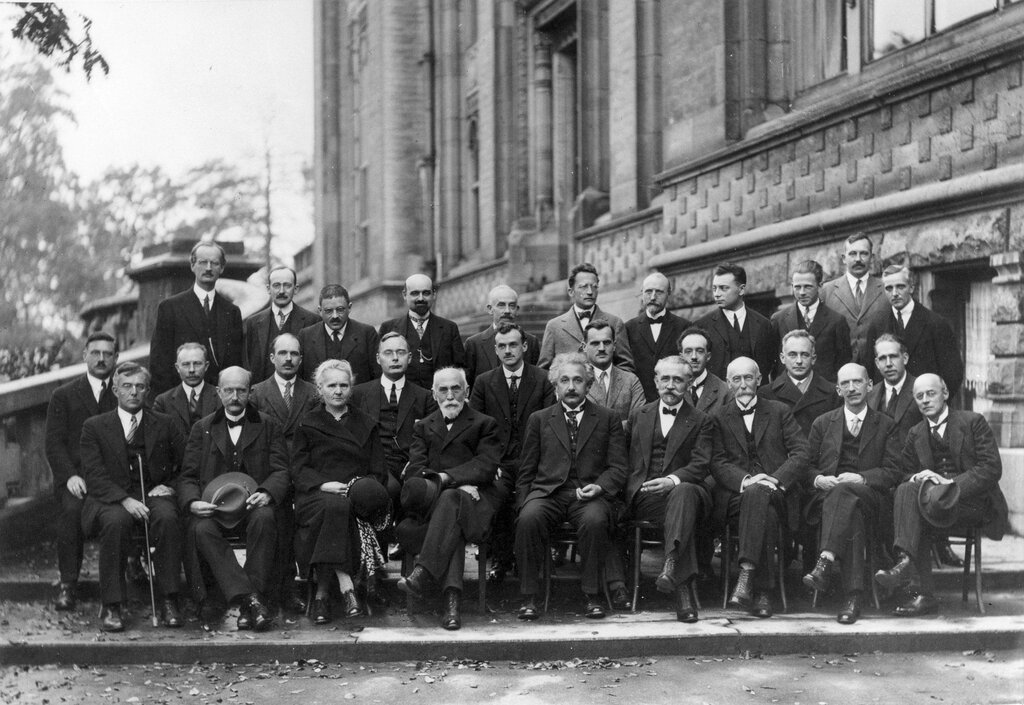
This puzzle, along with others like the photoelectric effect, showed that classical physics, while brilliant for describing the big world we see, was breaking down at the atomic scale. The rules that governed billiard balls didn't seem to apply to the tiny particles that make up matter and light.
Energy in Packets
In 1900, the German physicist Max Planck took a radical step. To solve the blackbody problem, he proposed that energy wasn't continuous. Instead, he suggested that energy could only be emitted or absorbed in discrete, bite-sized packets, which he called "quanta."
Imagine a ramp versus a staircase. In classical physics, you can have any amount of energy, like standing anywhere on the ramp. In quantum mechanics, you can only have specific amounts of energy, like being on one step or another, but never in between.
The size of these energy packets is determined by a new fundamental constant of nature, now known as Planck's constant. It's represented by the letter .
This number is incredibly small, which is why we don't notice energy packets in our everyday lives. A baseball can have what seems like any amount of kinetic energy because the individual steps are too tiny to perceive. But for an electron in an atom, these steps are everything. It can only jump between specific energy levels, absorbing or emitting a quantum of energy to do so.
quantum
noun
The minimum amount of any physical entity, like energy or matter, involved in an interaction.
Planck's idea was revolutionary. It suggested that at the most fundamental level, the universe is not smooth but grainy. This concept of quantization became the cornerstone of the new physics: quantum mechanics.
A New Set of Rules
The shift from classical to quantum thinking wasn't just an update. It was a complete rewrite of the rules of reality. The core differences are profound.
| Feature | Classical Physics | Quantum Mechanics |
|---|---|---|
| Scale | Macroscopic (planets, baseballs) | Microscopic (atoms, electrons) |
| Energy | Continuous (any value is possible) | Quantized (discrete energy levels) |
| Prediction | Deterministic (know the future if you know the present) | Probabilistic (can only predict the likelihood of outcomes) |
| Observation | Passive (observing doesn't change the system) | Active (the act of measuring affects the system) |
In the classical world, if you know the position and momentum of a baseball, you can predict its exact path. The universe runs like a clockwork machine. But in the quantum realm, this certainty vanishes. You can't know an electron's exact position and momentum at the same time. Instead, quantum mechanics gives you a wave function—a mathematical description that tells you the probability of finding the electron in any given spot.
The world at the smallest scales isn't a miniature version of the world we see. It's a place of probabilities, jumps, and fundamental uncertainty, governed by rules that defy our everyday intuition.
Let's test your understanding of these foundational ideas.
What major problem with classical physics led Max Planck to propose the idea of quantized energy?
In the quantum world, the wave function of a particle tells you its exact position and momentum.
These concepts marked the beginning of a scientific revolution that continues to shape our understanding of the universe and drive new technologies.