Introduction to Quantum Physics
Introduction to Quantum Mechanics
A New Kind of Physics
At the end of the 19th century, many physicists felt their work was nearly done. They had classical mechanics, which described the motion of everything from planets to billiard balls, and they had Maxwell's theory of electromagnetism, which explained light, electricity, and magnetism. It seemed like the fundamental laws of the universe were mostly understood.
But a few nagging problems, sometimes called "small clouds on the horizon," refused to go away. These weren't minor details; they were deep contradictions that classical physics just couldn't resolve. Trying to solve them led to a revolution in science and the birth of a strange and powerful new theory: quantum mechanics.
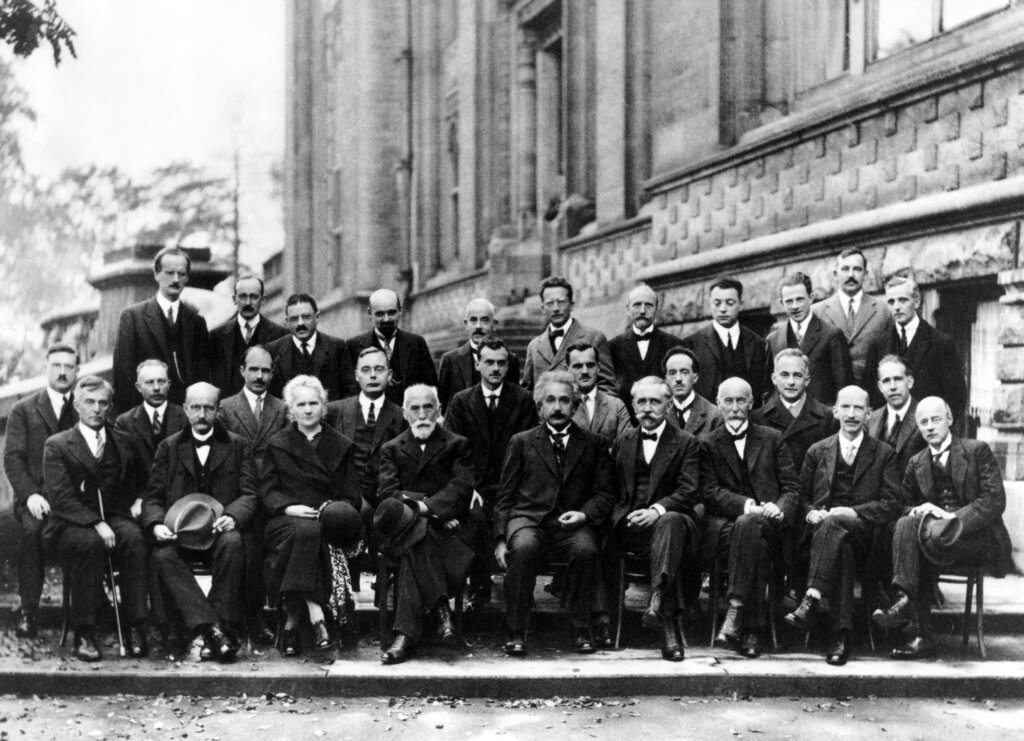
Cracks in the Foundation
One of the first major cracks appeared with something called black-body radiation. A black body is a theoretical object that absorbs all radiation that falls on it. When heated, it glows. Classical physics tried to predict the color and intensity of this glow at different temperatures.
The predictions worked well for low-frequency light (like red and infrared) but failed spectacularly for high-frequency light. The classical equations predicted that a hot object should emit an infinite amount of energy in the form of ultraviolet light and beyond. This was absurd and became known as the "ultraviolet catastrophe."
In 1900, Max Planck proposed a radical solution: What if energy wasn't continuous, but came in discrete packets, or "quanta"? This idea solved the black-body problem perfectly.
Another puzzle was the photoelectric effect. When light shines on a piece of metal, it can knock electrons loose. Classical wave theory predicted that brighter (more intense) light should give the electrons more energy. But experiments showed something different: the energy of the ejected electrons depended only on the light's frequency (its color), not its brightness. A dim blue light could eject electrons while a very bright red light did nothing.
In 1905, Albert Einstein took Planck's idea a step further. He suggested that light itself is made of these energy packets, later called photons. This explained the photoelectric effect: a single photon of blue light has enough energy to knock out an electron, while a photon of red light doesn't, no matter how many of them you have.
The Quantum Rules
These discoveries hinted at a new set of rules for the universe, ones that operate on the scale of atoms and particles. The core principles of quantum mechanics are very different from our everyday experience.
Quantization
noun
The principle that certain physical properties, like energy or charge, can only exist in discrete, specific amounts, rather than a continuous range of values.
Think of it like the difference between a ramp and a staircase. In classical physics, a ball can rest anywhere on a ramp; its potential energy is continuous. In quantum mechanics, the ball can only be on one of the steps; its energy is quantized. It can be on step one or step two, but never step one-and-a-half.
Another key principle is probability. Classical mechanics is deterministic. If you know the exact position and momentum of a baseball, you can calculate its exact trajectory. The future is set.
Quantum mechanics is probabilistic. We can't know a particle's exact position and momentum at the same time. Instead, the theory gives us probabilities. We can calculate the likelihood of finding an electron in a certain location, but we can never say for sure where it will be until we actually look for it. The quantum world is governed by chance and uncertainty at its most fundamental level.
The Role of the Observer
This leads to one of the most mind-bending aspects of quantum mechanics: the role of measurement. Before a quantum particle is observed, it can be described by a "wave function," a mathematical expression that contains all the probabilities for its possible states (like position or spin).
When a measurement is made, this cloud of possibilities suddenly collapses into a single, definite reality. The act of observing doesn't just reveal what was already there; it seems to force the particle to "choose" a state. This interaction between the observer and the quantum system is a fundamental part of the theory and has no parallel in the classical world.
In the quantum world, the act of looking at something changes it. This isn't because our tools are clumsy; it's a built-in feature of reality.
These core ideas—quantization, probability, and the observer effect—form the foundation of quantum mechanics. They paint a picture of reality that is granular, uncertain, and deeply strange, but it's a picture that has been confirmed by countless experiments and is the basis for much of modern technology.
What was the "ultraviolet catastrophe"?
According to experiments on the photoelectric effect, what property of light determines the energy of the electrons knocked loose from a metal surface?