Introduction to Quantum Physics
Introduction to Classical Physics
The Clockwork Universe
Before we dive into the strange world of quantum mechanics, we first need to understand the physics that governs our everyday lives. This is called classical physics. It's the science of falling apples, orbiting planets, and everything in between. It operates on a simple, powerful idea: the universe is a predictable system.
If you know the rules, you can predict the outcome. For centuries, this framework was built on two massive pillars: Newtonian mechanics, which describes motion, and electromagnetism, which describes light, electricity, and magnetism.
Newton's Rules of Motion
Isaac Newton laid down the fundamental laws that explain how and why things move. They are remarkably simple but describe everything from a thrown baseball to the orbits of moons.

His first law is the law of inertia. An object at rest will stay at rest, and an object in motion will stay in motion unless an outside force acts on it. A satellite in the vacuum of space will just keep going. A book on a table will stay put.
The second law is probably the most famous equation in all of physics: . It means the force () needed to move an object is equal to its mass () times its acceleration (). A bigger force produces more acceleration. It also means that for the same force, a heavier object (more mass) will accelerate less than a lighter one. It's why it's easier to get a shopping cart moving than a car.
Newton's third law states that for every action, there is an equal and opposite reaction. When a rocket expels gas downwards, the gas pushes the rocket upwards with equal force. When you push on a wall, the wall pushes back on you with the same force.
These laws, combined with his law of universal gravitation, gave humanity a mathematical toolkit to predict the motion of celestial bodies with incredible accuracy.
The Invisible Forces
The other major part of classical physics is electromagnetism. In the 19th century, scientists were studying the strange, separate phenomena of electricity and magnetism. It was physicist James Clerk Maxwell who realized they were two sides of the same coin.
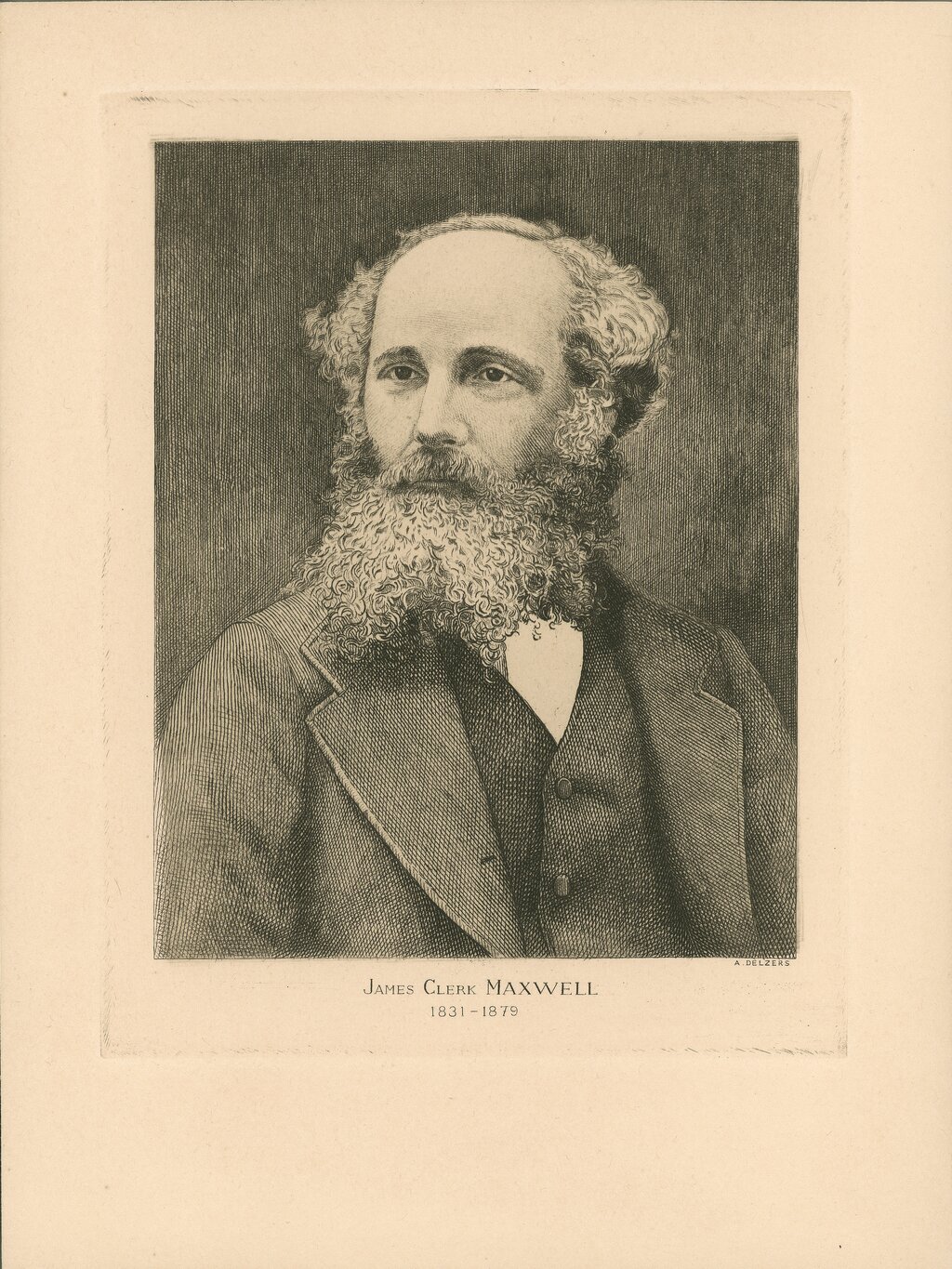
Maxwell's equations showed that a changing electric field creates a magnetic field, and a changing magnetic field creates an electric field. This interplay creates a self-propagating wave: an electromagnetic wave. He calculated the speed of this wave and found it was the speed of light. In a stunning insight, he realized that light itself is an electromagnetic wave.
This unified theory explained not just light, but also radio waves, X-rays, and other forms of radiation.
A World of Certainty
Together, Newtonian mechanics and electromagnetism painted a picture of a deterministic universe. Determinism is the idea that if you could know the exact position and momentum of every particle in the universe at one instant, you could calculate its entire past and future.
Think of a pool table. If you know the precise speed, angle, and spin of the cue ball as it strikes the rack, you could theoretically predict the final position of every single ball. The universe, according to classical physics, was just a much larger, more complicated game of pool.
In this classical view, everything from the fall of a leaf to the orbit of a planet is predetermined by the initial conditions and the laws of physics. There is no room for randomness or uncertainty.
This worldview also relies on continuous variables. This means that properties like energy, position, and speed can have any value. A car can travel at 50 miles per hour, or 50.1, or 50.11, or 50.111... with no gaps in between. The values can change smoothly and continuously.
This intuitive, clockwork vision of the universe works beautifully for the large-scale world we experience. But as we'll see, it breaks down completely when we start looking at the world of atoms and particles.