Introduction to Quantum Physics
Introduction to Quantum Mechanics
A Different Kind of Physics
At the end of the 19th century, physics seemed mostly figured out. Newton's laws described motion, from falling apples to orbiting planets. Maxwell's equations explained light, electricity, and magnetism. Scientists felt they had a complete picture of the universe. But a few nagging problems just wouldn't go away.
One major issue was known as the "ultraviolet catastrophe." According to the classical physics of the time, an ideal object that absorbs all radiation (a "black body") should also emit radiation at all frequencies. The theory predicted that it should blast out an infinite amount of high-frequency ultraviolet light. This, of course, doesn't happen. The theories were breaking down.
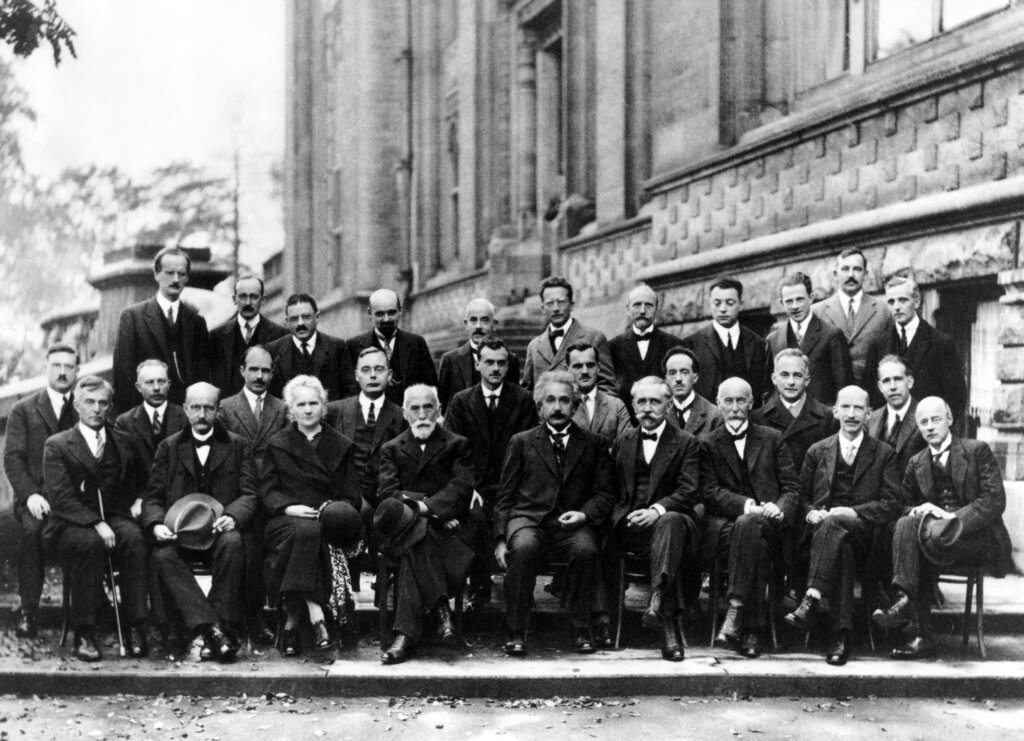
In 1900, German physicist Max Planck proposed a radical solution. He suggested that energy wasn't continuous, like a ramp you could smoothly walk up. Instead, he argued that energy comes in discrete packets, or chunks. He called these packets "quanta."
Imagine a staircase. You can stand on the first step, or the second step, but you can't hover in between. Planck's idea was that energy works the same way. An atom can only emit or absorb energy in specific, fixed amounts. This idea of quantization successfully explained the black-body radiation problem and marked the birth of quantum mechanics.
quantum
noun
The minimum amount of any physical entity, like energy or matter, involved in an interaction.
The Wave Function
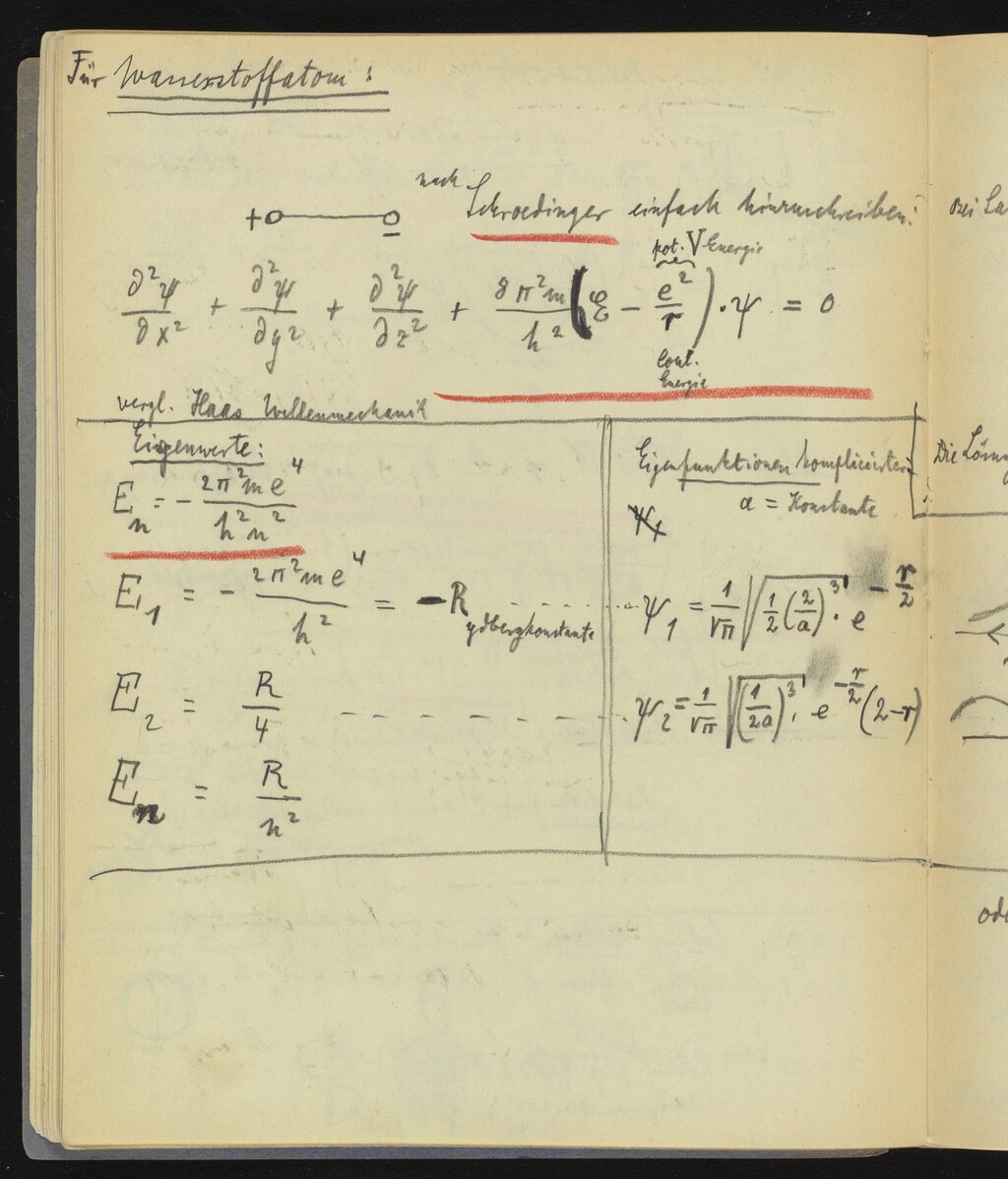
If energy is quantized, how do we describe particles like electrons at this tiny scale? In the 1920s, Austrian physicist Erwin Schrödinger developed a mathematical equation that became a cornerstone of quantum mechanics. The solution to this equation is called the wave function, represented by the Greek letter Psi ().
The wave function contains all the information it's possible to know about a quantum system. But what is it, exactly? It isn't a physical wave like a ripple in a pond. It's an abstract mathematical tool. Its true power lies in what it tells us about probabilities.
A World of Probabilities
Classical physics is deterministic. If you know the position and momentum of a baseball after it's hit, you can calculate its exact trajectory. You can say with certainty where it will land.
Quantum mechanics threw this certainty out the window. It tells us that we can never know with absolute certainty both the position and momentum of a particle like an electron. Instead, we can only calculate the probability of finding it in a particular place.
This is where the wave function becomes crucial. A rule developed by physicist Max Born states that the probability of finding a particle at any given point in space is related to the square of the wave function's magnitude at that point. Where the wave function's magnitude is large, there's a high probability of finding the particle. Where it's small, the probability is low.
This formula, known as the Born rule, is fundamental. It means that at its core, the quantum world is probabilistic. We can't predict a single outcome, only the odds for all possible outcomes. This shift from certainty to probability is one of the most profound and mind-bending aspects of quantum mechanics.
What major problem in classical physics, related to the radiation from an ideal object, led to the development of quantum mechanics?
What was Max Planck's fundamental proposal in 1900 to resolve the black-body radiation problem?