Introduction to Quantum Physics
Introduction to Quantum Mechanics
A Different Set of Rules
In our everyday world, things are predictable. A thrown ball follows a clear path. A car is either parked or it's moving. But when we zoom way, way down to the level of atoms and the particles inside them, these simple rules break down. Welcome to the world of quantum mechanics, where reality is governed by probability and observation changes everything.
Wave or Particle?
Imagine firing tiny pellets, like electrons, at a screen with two narrow slits in it. If electrons were just tiny balls, you'd expect to see two bands on the detector screen behind the slits, right where they passed through. But that's not what happens.
Instead, an interference pattern appears, the same kind you see when waves of water pass through two openings and interact with each other. It seems the electron acts like a wave, passing through both slits at once and interfering with itself. But here's the twist: if you place a detector at the slits to see which one the electron goes through, the interference pattern vanishes. The act of observing forces the electron to behave like a particle again, picking one slit or the other.
This is wave-particle duality. Every particle, whether it's an electron or a photon of light, has both wave-like and particle-like properties. It's not one or the other; it's somehow both at the same time.
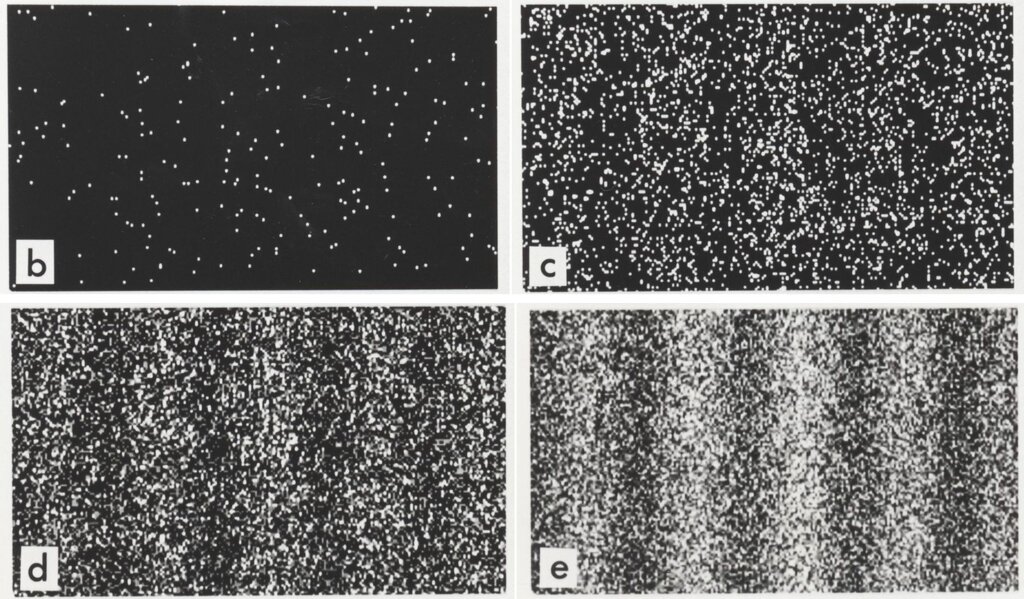
The fact that observing a particle changes its behavior is a central theme in quantum mechanics. It leads directly to another strange but fundamental idea.
A Fundamental Limit
In 1927, the physicist Werner Heisenberg realized there's a fundamental limit to what we can know about a particle. Think about trying to find an electron. To "see" it, you have to bounce a photon of light off it. But an electron is so small that the photon's impact drastically changes its momentum, sending it flying off in an unpredictable direction.
The more precisely you measure its position (by using a high-energy photon), the more you disturb its momentum. Conversely, if you use a low-energy photon to barely disturb its momentum, you get a fuzzy, imprecise picture of its location. You can never know both its exact position and its exact momentum at the same time.
uncertainty principle
noun
The principle stating that there is a fundamental limit to the precision with which certain pairs of physical properties of a particle, such as position and momentum, can be known simultaneously.
All States at Once
Before we measure a quantum system, it can exist in a combination of all its possible states at the same time. This is called superposition. For example, an electron has a property called spin, which can be measured as either "up" or "down." Before measurement, the electron isn't one or the other; it's in a superposition of both spin up and spin down.
It's only when a measurement is made that the system "chooses" a single state. We can calculate the probability of it landing in each state, but we can't know the outcome for sure until we look. Before the measurement, the particle exists as a haze of possibilities.
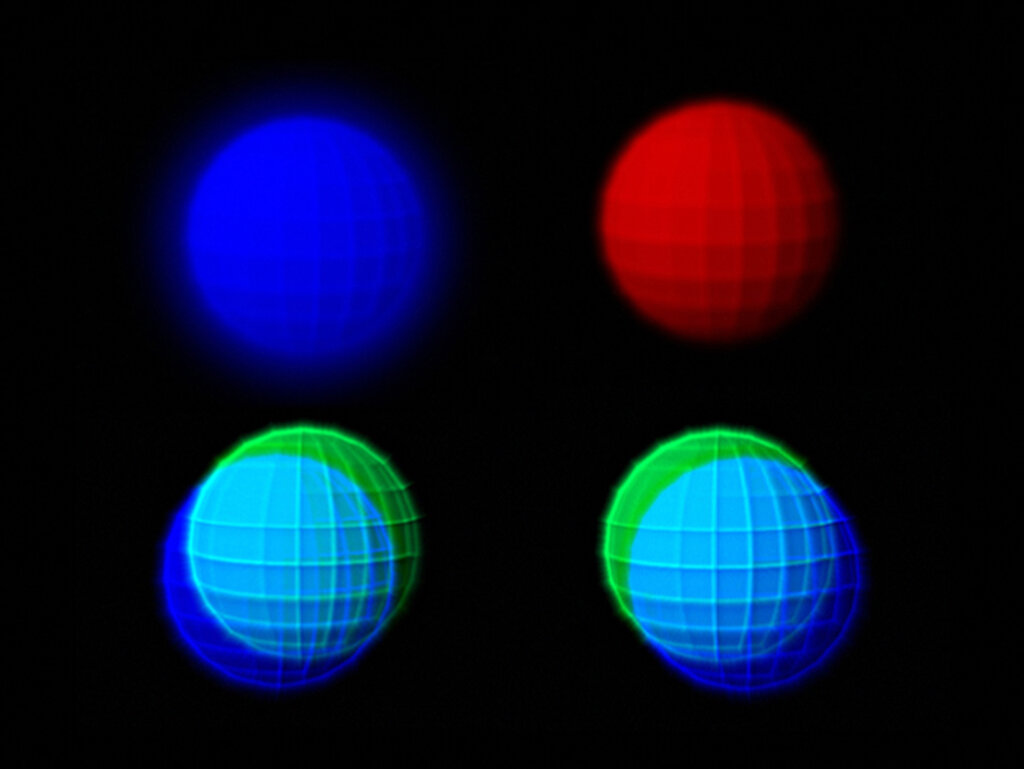
A quantum system isn't in state A or state B. It's in a state of A and B until the moment of measurement.
In the double-slit experiment, what pattern appears on a detector screen when electrons are fired at the slits without being observed?
What happens to the pattern in the double-slit experiment if you place a detector at the slits to observe which one each electron passes through?
These concepts might seem counterintuitive, but they form the bedrock of how we understand the universe at its most fundamental level.