Introduction to Quantum Physics
Introduction to Quantum Physics
A Crack in the Old Foundation
For centuries, what we call classical physics reigned supreme. Think of Isaac Newton's laws of motion. They were brilliant for predicting the arc of a cannonball or the orbit of a planet. This was a clockwork universe, predictable and deterministic. If you knew the starting conditions, you could calculate the future. Everything was a matter of cause and effect.
But as the 19th century ended, physicists started poking into the world of the very small. They ran experiments on things like light and atoms, and the results were strange. The old rules just didn't work. One major puzzle was called the "ultraviolet catastrophe." According to classical physics, a perfect radiator, a so-called "black body," should emit an infinite amount of energy as the wavelength of light gets shorter. This obviously doesn't happen. The universe wasn't awash in high-energy radiation. Something was deeply wrong with the existing theories.
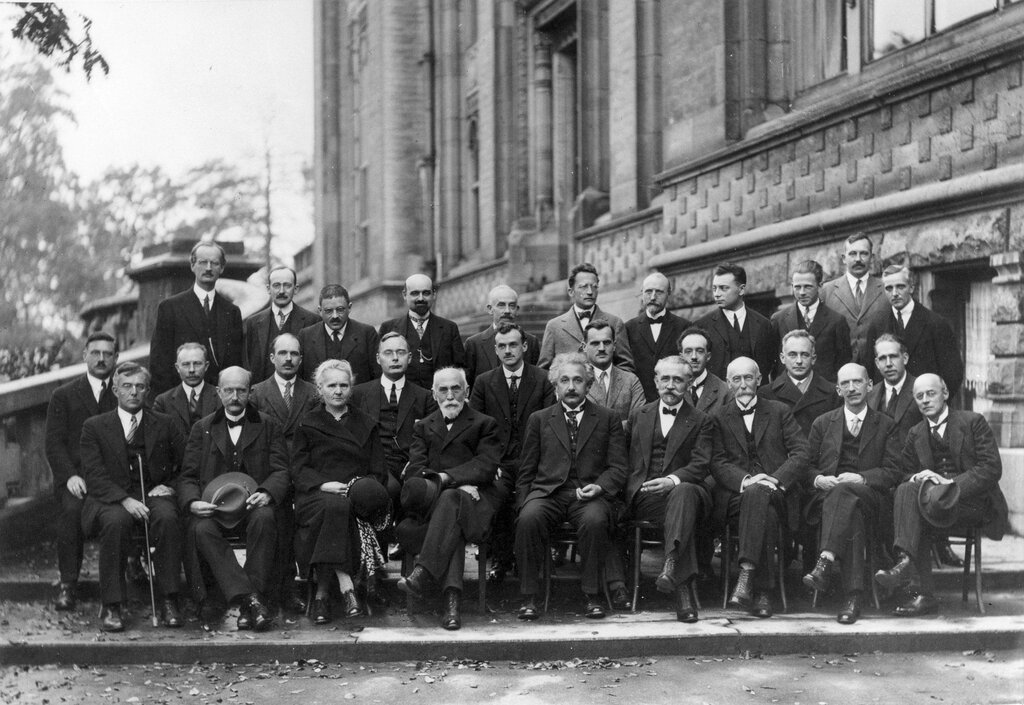
In 1900, physicist Max Planck proposed a radical idea to solve this problem. What if energy wasn't a continuous flow, like water from a tap? What if it came in tiny, discrete packets? He called these packets "quanta." This was the birth of a revolutionary concept: quantization.
Everything Comes in Packets
Quantization means that physical properties can only have certain specific values, not any value in between. It’s like a staircase instead of a ramp. On a ramp, you can stand at any height. On a staircase, you can only stand on one step or the next, never in between.
In the world around us, these "steps" are so incredibly tiny that we perceive everything as smooth and continuous. But at the atomic level, the staircase becomes apparent. An electron in an atom can't just have any old energy level. It must occupy one of several specific, allowed energy levels. To move between them, it must absorb or emit a precise packet, or quantum, of energy.
This idea of quantization solved the black-body radiation problem and opened the door to a whole new way of understanding the universe. It was the first step away from the smooth, predictable world of classical physics.
Certainty Gives Way to Chance
The next shock to the system involved probability. In classical physics, we use probability because of ignorance. We flip a coin and say there's a 50/50 chance of heads or tails because we don't know the exact force, spin, and air currents involved. If we knew everything, we could predict the outcome with 100% certainty.
Quantum mechanics introduced a new kind of probability, one that is fundamental to the way the universe works. At the subatomic level, things aren't just unknown, they're unknowable until you measure them. A particle like an electron doesn't have a definite position until we look for it. Before that, there's only a cloud of probabilities, described by a mathematical tool called a wave function, which tells you where the electron is likely to be found.
In the quantum world, we can't predict a single outcome. We can only predict the odds.
This brings us to the observer effect. In our everyday world, observing something doesn't really change it. Shining a flashlight on a bowling ball doesn't alter its path. But at the quantum scale, the act of measurement is a big deal. To "see" an electron, you have to interact with it, perhaps by bouncing a particle of light off it. That very act of measurement forces the electron to "choose" a single position from its cloud of possibilities and fundamentally changes its state.
The universe, it turns out, is not a deterministic machine. At its core, it's a game of chance, and the act of observation forces the dice to land.
What major problem in classical physics, known as the 'ultraviolet catastrophe', led to the development of quantum theory?
The concept of quantization is best described by which analogy?
These core ideas—quantization, probability, and the observer effect—form the bedrock of quantum physics. They shattered the classical view of a predictable universe, replacing it with one that is grainy, uncertain, and deeply strange.