Introduction to Quantum Physics
Introduction to Quantum Physics
A Crack in the Old Foundation
For centuries, the world seemed to follow a neat set of rules. Physicists, using the laws laid out by Isaac Newton and others, could predict the motion of planets, the arc of a cannonball, and the flow of rivers. This framework, known as classical mechanics, was incredibly successful. It described the big, visible world with stunning accuracy.
By the end of the 19th century, many believed that the fundamental laws of the universe were mostly understood. It seemed like all that was left was to tidy up the details. But a few strange, stubborn problems wouldn't go away. These weren't issues with planets or cannonballs, but with things at the smallest scales: light, heat, and the very nature of atoms.
Puzzles from the Small World
One major puzzle was something called “black-body radiation.” This isn't as mysterious as it sounds. A black body is just an object that absorbs all light that hits it. When you heat it up, it glows, like the burner on an electric stove. The puzzle was in the color and intensity of that glow.
Classical physics made a prediction about this glow that was spectacularly wrong. Its equations suggested that as you looked at higher and higher frequencies of light (like ultraviolet light), the object should release an infinite amount of energy. This was dubbed the “ultraviolet catastrophe” because it made no sense. If it were true, simply turning on your toaster would flood the room with deadly radiation.
Clearly, the old rules were breaking down.
This and other problems showed that the familiar world of classical mechanics didn't apply in the realm of the very small. The smooth, continuous motion we see every day was not how things worked at the atomic level. A completely new way of thinking was needed.
This new way of thinking became quantum mechanics. It wasn't just a small correction to the old theories; it was a fundamental revolution. It introduced bizarre new concepts that forced physicists to rethink the very nature of reality.
Quantum mechanics isn't just an update to classical physics. It's a completely different operating system for the universe at the smallest scales.
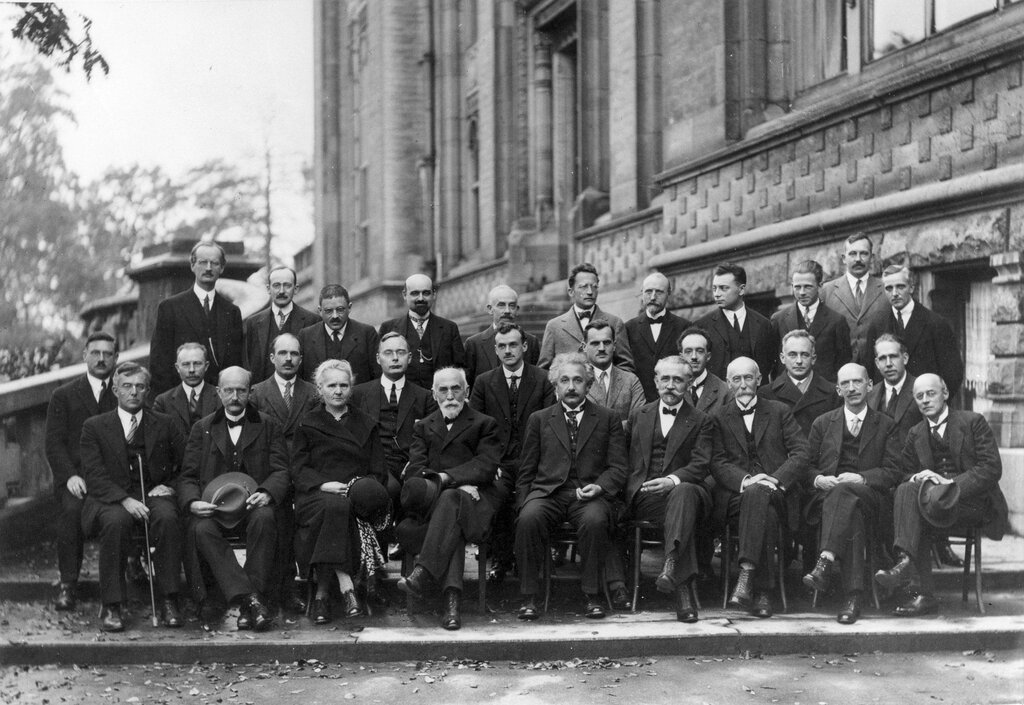
The development of quantum theory took place over several decades, starting with Max Planck's work in 1900 and continuing with contributions from Albert Einstein, Niels Bohr, Werner Heisenberg, Erwin Schrödinger, and many others. It was a collaborative and often contentious process, as even the creators of the theory struggled to grasp its strange implications.
What they built was a new framework that could accurately predict the behavior of atoms, electrons, and photons. It explained why the ultraviolet catastrophe doesn't happen and laid the groundwork for technologies like lasers, computers, and nuclear energy. The journey into the quantum world had begun.