Introduction to Quantum Physics
Introduction to Quantum Mechanics
A Crack in the Foundation
For centuries, classical physics reigned supreme. The laws laid out by Isaac Newton and others worked beautifully to describe the world we see. From the arc of a thrown ball to the orbits of planets, these principles were precise and predictable. They painted a picture of a clockwork universe, where if you knew the position and momentum of every particle, you could predict the future with perfect accuracy.
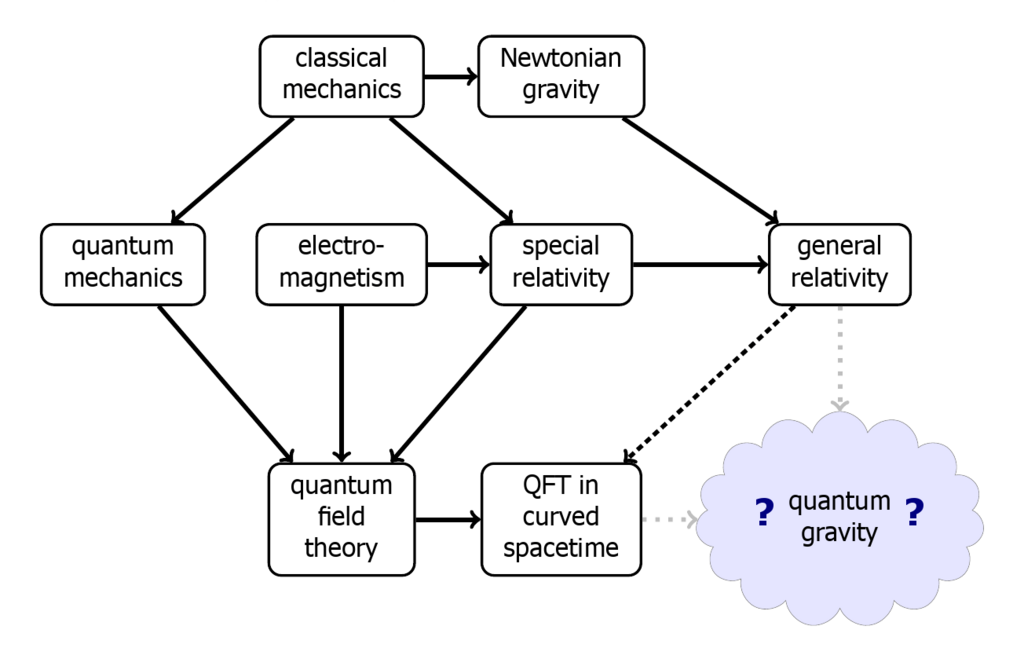
But as the 19th century came to a close, a few stubborn problems emerged. Scientists were studying phenomena at very small scales, and the old rules just didn't work. One major issue was something called "black-body radiation." A black body is a perfect absorber of all incoming light, and when heated, it emits light of its own. Classical theories predicted that as the wavelength of this emitted light got shorter, its intensity should increase infinitely. This led to an absurd conclusion known as the "ultraviolet catastrophe," because it suggested that even a warm object should emit blinding, high-energy radiation. This was obviously not what happened in reality.
Classical physics predicted infinite energy from heated objects, a clear sign that the theory was incomplete.
The solution came in 1900 from a physicist named Max Planck. He made a daring proposal: what if energy wasn't continuous? What if, at the atomic level, energy could only be emitted or absorbed in discrete packets, which he called "quanta"? This wasn't a gentle tweak to the existing laws; it was a radical break. Instead of energy flowing like water from a tap, Planck suggested it was more like dispensing water one bottle at a time. Each bottle, or quantum, contained a specific amount of energy determined by its frequency.
In this equation, is the energy of a single quantum, (the Greek letter nu) is the frequency of the radiation, and is a tiny number now known as Planck's constant. This idea of quantized energy neatly solved the black-body problem and marked the birth of quantum mechanics.
The Language of Probability
If energy comes in packets, how do we describe the particles that carry them? In the 1920s, Austrian physicist Erwin Schrödinger developed a mathematical tool that became central to quantum mechanics: the wave function. Represented by the Greek letter psi (), the wave function provides all the information available about a quantum system, like an electron in an atom.
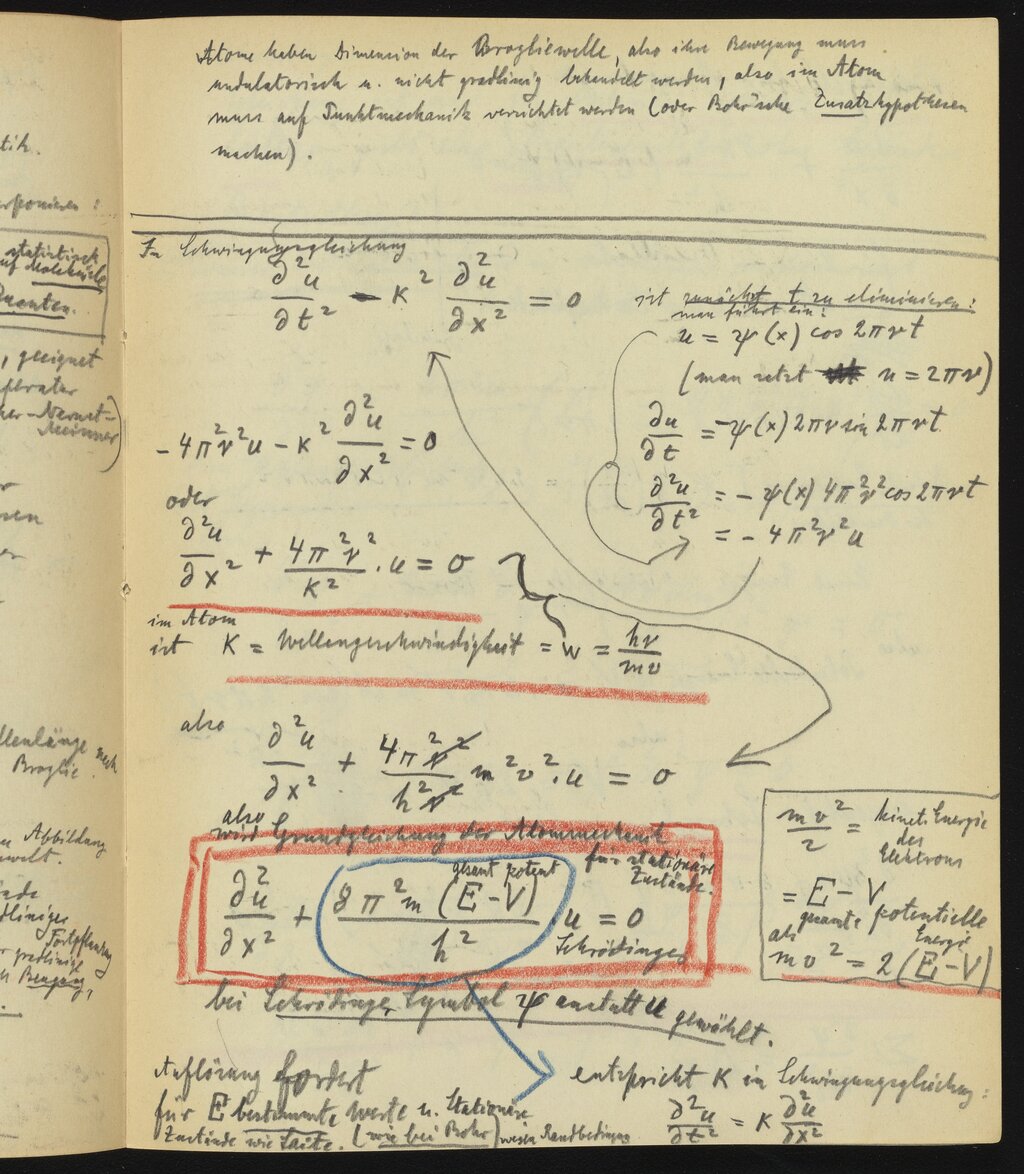
But here's the strange part. The wave function doesn't tell you where an electron is. Instead, it describes a field of possibilities. Think of it like a weather forecast map that shows the probability of rain. A dark green area doesn't mean it's definitely raining there, but that the chance is high. Similarly, the wave function tells us the probability of finding a particle at any given point in space.
The wave function replaces the certainty of classical mechanics with the probability of quantum mechanics.
To find this probability, we take the wave function and square its magnitude, a value represented as . Where this value is large, the probability of finding the particle is high. Where it's zero, the particle will never be found. This introduces a fundamental element of chance into the fabric of the universe. At its core, the quantum world is not a predictable clockwork machine, but a game of probabilities. We can calculate the odds with incredible precision, but we can never know the outcome of a single event with absolute certainty before it happens.
What fundamental problem in classical physics, related to the light emitted by heated objects, led to the development of quantum theory?
Max Planck proposed that the energy of a single quantum of radiation is directly proportional to its frequency. Which equation represents this relationship?