Introduction to Quantum Mechanics
Introduction to Quantum Mechanics
A Whole New Set of Rules
For centuries, the laws of classical physics, like those from Isaac Newton, seemed to explain everything perfectly. If you knew the position and speed of a baseball, you could predict its exact path. The universe felt like a giant clockwork machine: predictable and orderly.
But as scientists started looking at the universe's smallest building blocks, like electrons and photons, they found that the old rules didn't work. At the tiny, subatomic scale, reality is fuzzy, weird, and ruled by probability. This new set of rules is called quantum mechanics.
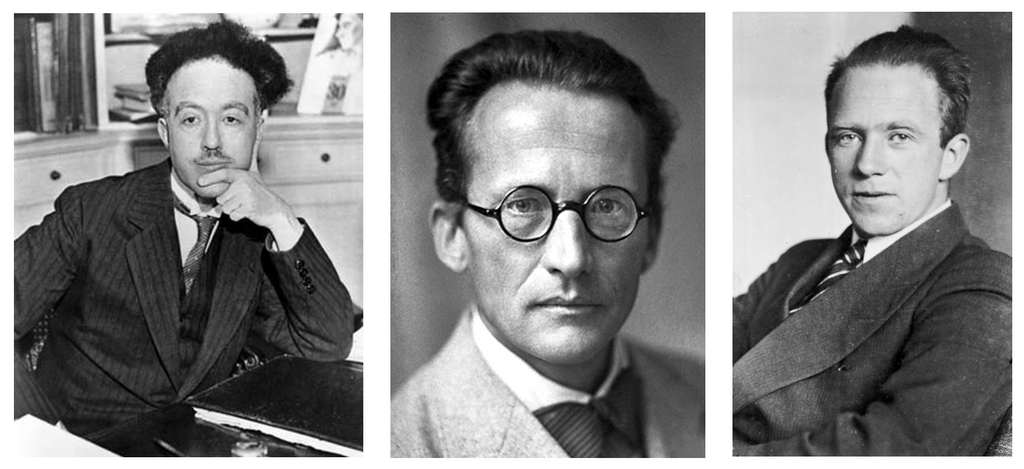
It’s a world where particles can be in multiple places at once and can be mysteriously linked across vast distances. It’s not just a different way of looking at physics; it’s a completely different reality.
Is It a Wave or a Particle?
In our everyday world, things are either objects (particles) or waves. A baseball is a particle. The ripples in a pond are waves. They seem like complete opposites. But in the quantum world, this distinction breaks down. Tiny entities like electrons can act like both.
This strange behavior is called wave-particle duality. It’s one of the cornerstones of quantum mechanics.
The most famous demonstration of this is the double-slit experiment. Imagine firing tiny particles, like electrons, at a screen with two narrow slits in it. Behind this screen is another screen that detects where the electrons land.
If electrons were just tiny baseballs, you’d expect to see two bands on the detector screen, right behind each slit. But that's not what happens. Instead, a complex pattern of many bands appears, an interference pattern. This is classic wave behavior. The waves passing through each slit interfere with each other, creating peaks and troughs, just like water waves.
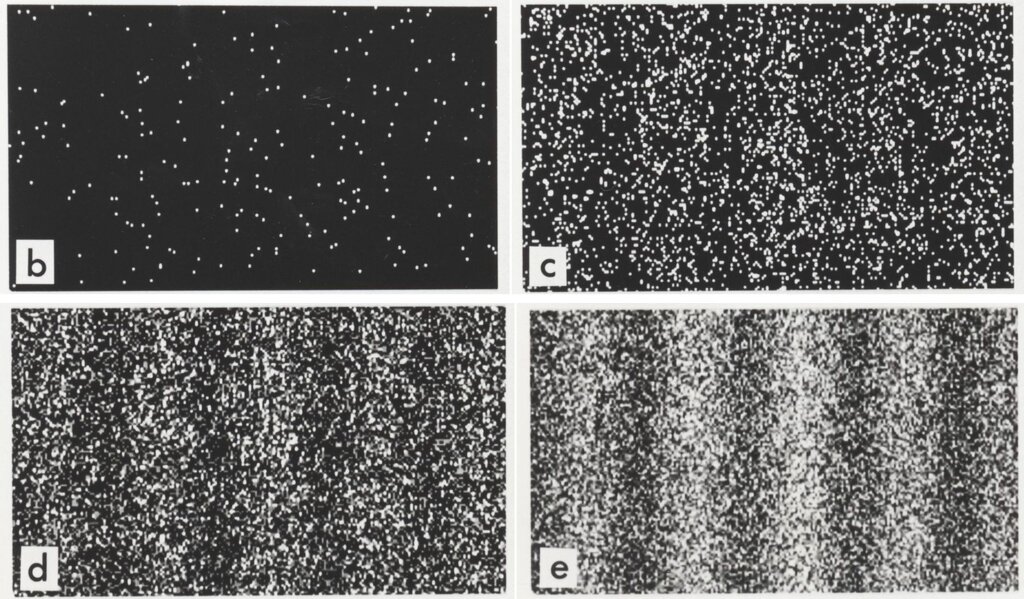
Here's where it gets truly strange. If you place a detector at the slits to see which one each electron goes through, the interference pattern vanishes. Suddenly, the electrons behave like particles again, and you see just two bands on the screen. The very act of observing them forces them to “choose” a state. They stop acting like a wave and behave like a particle.
Here, There, and Everywhere
Before we measure it, where is the electron? The answer from quantum mechanics is that it doesn't have a definite position. It exists in a cloud of probabilities, a state of being in all possible places at once. This is called superposition.
A quantum particle can exist in a combination of multiple states simultaneously. It's only when we measure it that it “collapses” into a single, definite state.
Think of it like a spinning coin. While it's in the air, it's not heads or tails. It's in a superposition of both states. Only when it lands (when we measure it) does it become one or the other.
In quantum mechanics, this cloud of possibilities is described by a mathematical tool called a wave function. The wave function doesn’t tell you where the particle is; it tells you the probability of finding it at any given point if you were to look.
Spooky Action at a Distance
Perhaps the most mind-bending quantum idea is entanglement. It’s possible to link two or more particles in such a way that they share the same fate, no matter how far apart they are. Their states become intertwined.
Imagine you have a pair of entangled electrons. They have a property called spin, which can be “up” or “down.” If they are entangled, their spins will be opposite. If one is spin-up, the other is guaranteed to be spin-down. The strange part is that neither has a definite spin until one is measured. They are both in a superposition of up and down.
The moment you measure one electron and find its spin is up, you instantly know the other one, even if it's across the galaxy, has a spin that is down. The information seems to travel faster than light, a phenomenon Albert Einstein famously called “spooky action at a distance.”
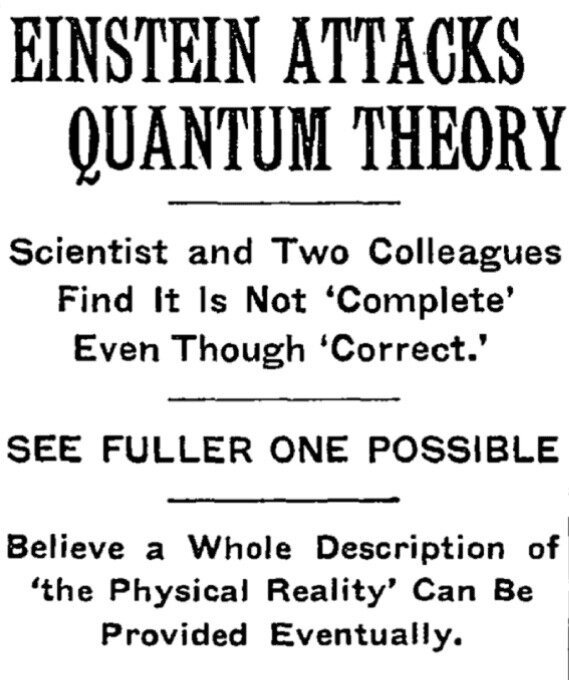
An analogy helps here. Imagine you have a pair of gloves, a left and a right. You put them into two identical boxes without looking, and you mail one box to your friend on Mars. You open your box and see a left-handed glove. You immediately know your friend has the right-handed one. There’s nothing spooky about that; the outcome was determined from the start.
But in the quantum world, it’s different. It’s as if neither box contained a specific glove until you opened one. The act of opening your box and finding a left glove instantly caused the other glove to become a right one. Experiments have repeatedly confirmed that this is how entanglement works, defying our classical intuition.
According to classical physics, the universe operates like a predictable clockwork machine. What fundamental concept of quantum mechanics most directly challenges this view?
In the double-slit experiment, when electrons are fired at a screen with two slits without being observed, what pattern do they create on the detector screen?
These three concepts—wave-particle duality, superposition, and entanglement—form the foundation of quantum mechanics. They paint a picture of the universe that is fundamentally probabilistic and interconnected in ways we’re still working to fully understand.