Introduction to Quantum Mechanics
Introduction to Quantum Mechanics
A Weird New World
For centuries, the laws of classical physics seemed to explain everything. From a thrown ball to the orbit of a planet, the universe appeared predictable and orderly. If you knew an object's position and momentum, you could, in theory, predict its entire future. But as scientists in the late 19th and early 20th centuries began to probe the world of atoms and electrons, this tidy picture started to fall apart. The rules that governed the large-scale world simply didn't work at the microscopic level. A new, strange, and probabilistic set of rules was needed. This was the birth of quantum mechanics.
Is It a Wave or a Particle?
One of the first and most profound shocks of quantum theory is the concept of wave-particle duality. In our everyday experience, things are either particles (like a grain of sand) or waves (like a ripple in a pond). They are distinct categories. Quantum mechanics tells us this distinction is an illusion. At the atomic scale, entities like electrons and photons can behave as both.
The most famous demonstration of this is the double-slit experiment. Imagine firing tiny pellets, like marbles, at a wall with two vertical slits in it. Some marbles will go through one slit, some through the other, and they will hit a back wall, forming two distinct bands. That's how particles behave.
Now, imagine sending waves, like water waves, at the same two slits. The waves pass through both slits at once and interfere with each other on the other side. Where crest meets crest, the wave gets bigger (constructive interference). Where a crest meets a trough, they cancel out (destructive interference). This creates a characteristic interference pattern on the back wall, a series of alternating bright and dark bands, not just two.
Here’s where it gets strange. When scientists fired individual electrons—which they thought of as tiny particles—at the two slits, the result was an interference pattern. It was as if each single electron went through both slits simultaneously, like a wave, and interfered with itself. But if you place a detector at the slits to see which one the electron goes through, the interference pattern vanishes. The very act of observing forces the electron to behave like a particle, and you get two simple bands again.
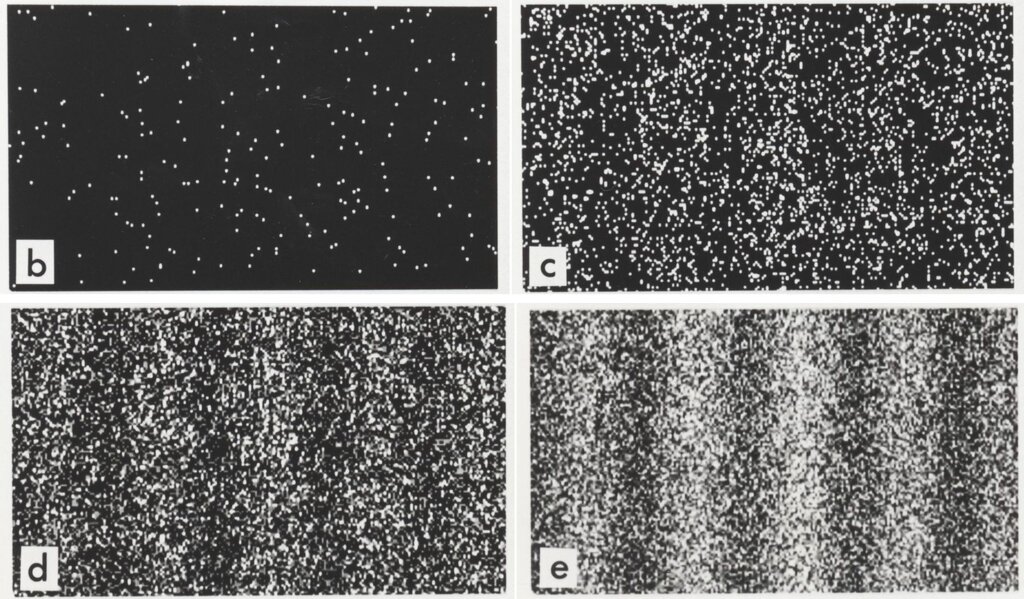
This is the core of wave-particle duality: A quantum object exists as a wave of possibilities until it is measured, at which point it behaves like a particle in a single, definite location.
All States at Once
This wave of possibilities leads us to another key quantum concept: superposition. Before it is measured, a quantum system can exist in a combination of all its possible states at the same time. Think of a spinning coin. While it's in the air, it's neither heads nor tails. It is in a superposition of both states. Only when it lands (the measurement) does it settle into a single, definite outcome.
For a quantum particle like an electron, this could mean being in multiple locations at once, or having multiple energy levels simultaneously. Its state is described by a mathematical tool called a wave function, which contains all the probabilities for all possible outcomes. The height of the wave at any point corresponds to the probability of finding the particle there.
superposition
noun
The principle that a quantum system can exist in a combination of multiple possible states at the same time.
When a measurement is made, this cloud of probabilities collapses into a single, concrete reality. This idea was famously illustrated by the Schrödinger's cat thought experiment, where a cat in a box is linked to a random quantum event. Until the box is opened, the cat is in a superposition of being both alive and dead. The act of looking forces nature to choose one reality.
Spooky Connections
Quantum entanglement is perhaps the most bizarre feature of this new world. It describes a situation where two or more quantum particles become linked in such a way that their fates are intertwined, no matter how far apart they are.
Imagine you have two of these linked particles. If one is in a "spin-up" state, you will instantly know that its entangled partner is in a "spin-down" state, and vice versa. Before you measure, both particles are in a superposition of spin-up and spin-down. But the moment you measure one, the state of the other is determined instantly, whether it's across the room or across the galaxy.
Albert Einstein famously called this "spooky action at a distance" because it seemed to violate the rule that nothing can travel faster than light. However, numerous experiments have confirmed that entanglement is a real feature of our universe.
Entanglement doesn't allow for faster-than-light communication. The outcome of the measurement on the first particle is random. You can't control it to send a specific message. But it does reveal a deep, non-local connection in the fabric of reality that classical physics never imagined.
These three concepts—wave-particle duality, superposition, and entanglement—form the bedrock of quantum mechanics. They challenge our intuition and paint a picture of the universe that is fundamentally probabilistic, interconnected, and far stranger than it appears.
Let's test your understanding of these foundational ideas.
In the double-slit experiment, when individual electrons are fired one at a time at two slits without any observation, what pattern do they form on the screen behind them?
The concept of a quantum system existing in all its possible states simultaneously before being measured is known as:
These principles, discovered through groundbreaking experiments a century ago, are not just philosophical curiosities. They are the foundation for technologies like lasers, semiconductors, and the ongoing development of quantum computing.