Introduction to Quantum Mechanics
Introduction to Quantum Mechanics
The End of the Old Physics
By the late 1800s, many physicists felt their work was nearly complete. They had two magnificent sets of rules that seemed to explain everything. First, there were Newton's laws of motion and gravity, which perfectly described the orbits of planets and the arc of a thrown ball. Second, there were Maxwell's equations, which unified electricity, magnetism, and light into a single theory of electromagnetism.
Together, these ideas formed the bedrock of classical physics. This view of the universe was wonderfully deterministic. If you knew the position and momentum of every particle, you could, in principle, predict the future with perfect accuracy. The universe was like a giant clockwork machine, ticking along with predictable precision. For the big world we see and touch, this worked flawlessly.
Cracks in the Foundation
But a few nagging problems began to appear, like strange results from experiments that just wouldn't go away. These puzzles all happened at the atomic scale, a world far smaller than anything Newton or Maxwell had considered.
One major issue was called the "black-body radiation" problem. According to classical physics, any hot object, like a glowing piece of iron, should emit a blinding, infinite amount of energy in the form of ultraviolet light. This was nicknamed the "ultraviolet catastrophe" because it was so obviously wrong. Hot objects glow, but they don't incinerate you with infinite energy.
Another mystery was the photoelectric effect. When light hits a metal surface, it can knock electrons loose. But experiments showed that this only happened if the light's frequency (its color) was high enough. A dim violet light could do it, but the brightest red light couldn't. This made no sense if light was just a continuous wave, as classical physics insisted. A more intense wave should have more energy, regardless of its frequency.
In 1900, the German physicist Max Planck took a radical step to solve the black-body problem. He proposed that energy isn't a continuous fluid but comes in tiny, individual packets. He called these packets "quanta." He saw it as a mathematical trick to make the equations work, but it was the first crack that would eventually shatter the old physics.
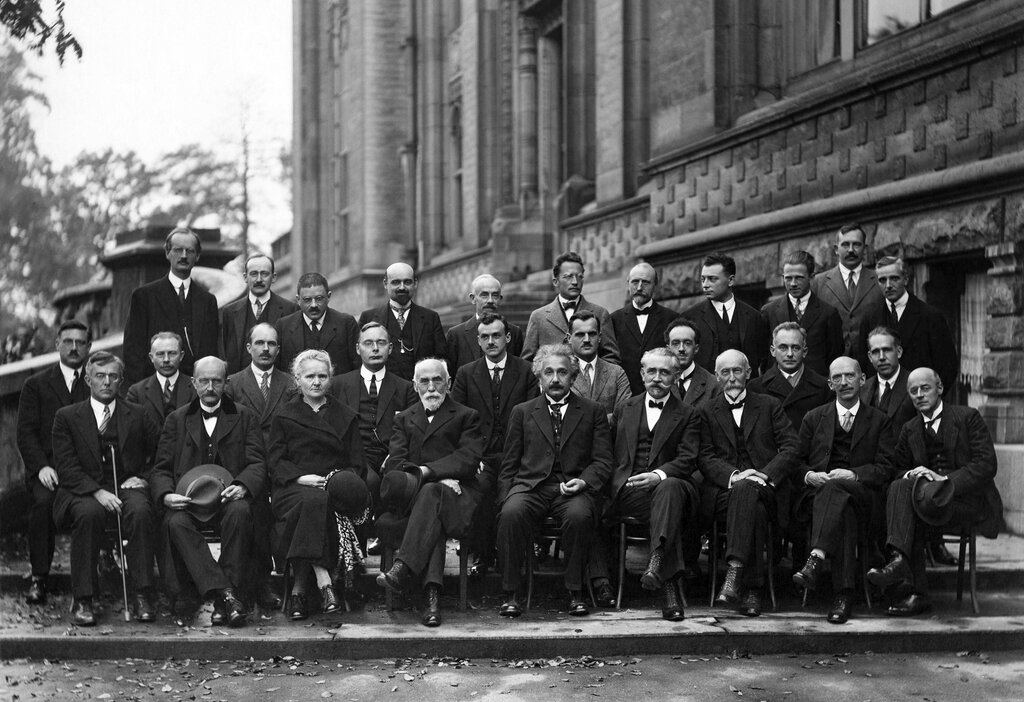
Five years later, Albert Einstein applied Planck's idea to the photoelectric effect. He suggested that light itself is made of these energy packets, later called photons. A photon's energy depends on its frequency. A high-frequency violet photon has enough energy to knock an electron out, while a low-frequency red photon does not, no matter how many of them you have.
A New Set of Rules
These discoveries opened the floodgates. Over the next few decades, scientists like Niels Bohr, Werner Heisenberg, and Erwin Schrödinger built a new theory to describe the atomic world: quantum mechanics. This theory came with a completely different set of principles.
Unlike the deterministic world of classical physics, the quantum world is fundamentally probabilistic. You can't know with certainty where a particle is and where it's going. You can only calculate the probability of finding it in a certain place. It's like a game of dice, where the outcome is governed by chance, not absolute prediction.
Another core idea is quantization. In the classical world, things can have any value. A car can go 50 or 50.1 or 50.11 miles per hour. In the quantum world, certain properties, like the energy of an electron in an atom, can only have specific, discrete values. It's like a staircase, where you can stand on one step or the next, but never in between.
| Feature | Classical Mechanics | Quantum Mechanics |
|---|---|---|
| Scale | Large objects (planets, balls) | Small objects (atoms, electrons) |
| Nature | Deterministic (predictable) | Probabilistic (based on chance) |
| Values | Continuous (any value) | Quantized (discrete levels) |
This was a revolution in thought. It replaced the comfortable, clockwork universe with one that was fuzzy, strange, and governed by the laws of probability. It set the stage for understanding the most fundamental aspects of our reality.
Let's check your understanding of these foundational ideas.
What were the two major theoretical frameworks that formed the bedrock of classical physics in the late 1800s?
The "ultraviolet catastrophe" was a prediction of classical physics that failed to match experimental results. What did this classical theory incorrectly predict about black-body radiation?
These basic principles are just the beginning. They lead to even stranger and more fascinating concepts that we'll explore next.