Introduction to Quantum Mechanics
Introduction to Quantum Mechanics
When the Old Rules Fail
For centuries, the laws of physics laid down by Isaac Newton seemed to describe everything perfectly. From the arc of a cannonball to the orbit of Mars, classical mechanics gave us a predictable, clockwork universe. If you knew where something was and how fast it was moving, you could predict its entire future. Everything was smooth, continuous, and certain.
But as the 19th century ended, strange cracks appeared in this tidy worldview. Scientists started probing the world of the very small—atoms, electrons, and light itself. The results were bizarre. Experiments produced outcomes that made no sense under the old rules.
One major puzzle was called the “black-body radiation” problem. A black body is a perfect absorber and emitter of radiation. According to classical physics, an object like this should glow with infinite energy at high frequencies, like ultraviolet light. This was a disaster, because it obviously didn't happen in reality. The theory was spectacularly wrong, a failure nicknamed the “ultraviolet catastrophe.” It was clear that a new kind of physics was needed.
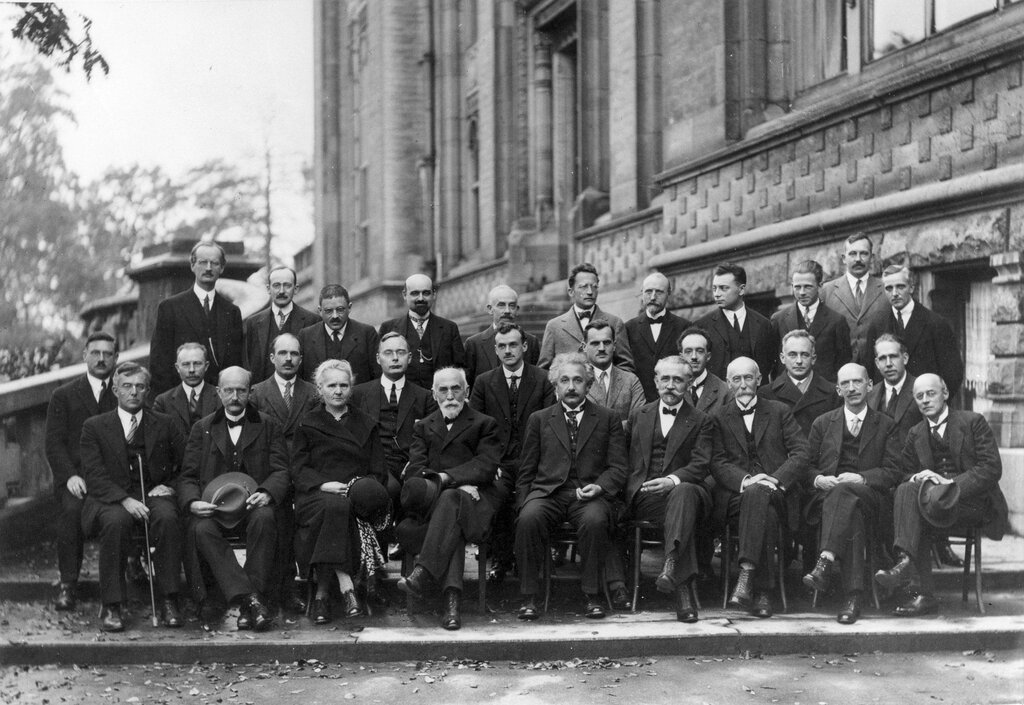
A Revolutionary Idea
In 1900, the physicist Max Planck took a bold and desperate step. To solve the black-body problem, he proposed that energy wasn't continuous. He suggested it could only be emitted or absorbed in tiny, discrete packets. He called these packets “quanta.”
quantum
noun
The minimum amount of any physical entity, like energy or matter, involved in an interaction.
This idea of quantization was revolutionary. Imagine a ramp versus a staircase. In classical physics, you can stand anywhere on the ramp—your energy can have any value. In Planck's new view, you can only stand on the steps of the staircase. You can be on step one or step two, but never in between. Energy levels are quantized.
Planck's idea fixed the math for black-body radiation perfectly. Soon after, Albert Einstein used the same concept to explain the photoelectric effect, where light shining on metal can knock electrons loose. He proposed that light itself comes in particles, or quanta, called photons. It seemed this strange new idea was here to stay.
A Different Reality
The move from classical to quantum physics was more than just a new equation. It was a fundamental shift in how we describe reality. Classical physics is deterministic; quantum physics is probabilistic. It deals in the likelihood of different outcomes, not certainties.
| Feature | Classical Physics | Quantum Mechanics |
|---|---|---|
| Scale | Macroscopic (planets, balls) | Microscopic (atoms, electrons) |
| Values | Continuous (a ramp) | Quantized (a staircase) |
| Prediction | Deterministic (certain outcome) | Probabilistic (likely outcomes) |
| Core Idea | Certainty and continuity | Probability and discreteness |
This new framework was necessary because the rules that govern a baseball flying through the air are simply not the same rules that govern an electron orbiting an atom. The microscopic world is fundamentally different, and quantum mechanics provides the language to describe it.
Let's test your understanding of these foundational ideas.
According to the principles of classical mechanics established by Isaac Newton, how was the universe perceived?
What major problem in physics, known as the 'ultraviolet catastrophe', demonstrated a significant failure of classical theory and led to the development of quantum mechanics?
While this is just the beginning, understanding quantization and the breakdown of classical physics is the first essential step into the strange and fascinating world of the quantum.