Introduction to Quantum Mechanics
Introduction to Quantum Mechanics
A Different Kind of Reality
The world we see and interact with every day follows predictable rules. If you throw a ball, you know where it will land. This is the realm of classical physics, the rules that govern big objects. But when we zoom in, way down to the level of atoms and the particles inside them, those familiar rules break down. Welcome to the world of quantum mechanics.
Quantum mechanics is the physics of the very small. It's a set of rules that describes how matter and energy behave at the atomic and subatomic scales. The principles here are often counterintuitive, challenging our everyday understanding of reality. Let's explore a few of the core ideas that make this world so strange and fascinating.
The Wave-Particle Puzzle
Imagine a tiny particle, like an electron. We tend to think of it as a minuscule ball, a single point in space. And sometimes, it behaves exactly like that. But other times, that same electron acts like a wave, spread out over a region, much like a ripple in a pond. This strange dual nature is called wave-particle duality.
At the quantum level, things can be both a particle and a wave at the same time. Which one you see depends on how you look at it.
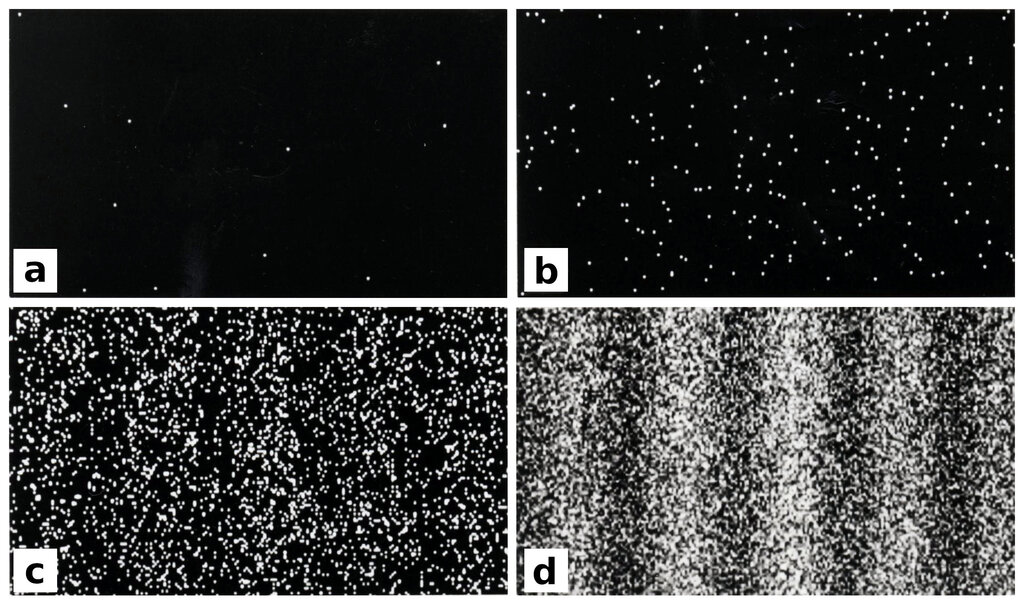
The most famous demonstration of this is the double-slit experiment. Scientists fired individual electrons at a barrier with two thin, parallel slits. If electrons were just particles, you'd expect to see two distinct bands on the detector screen behind the barrier, corresponding to the two slits.
But that’s not what happened. Instead, an interference pattern appeared—a series of many bands, similar to what you'd see if you sent waves of light or water through the slits. The only way to explain this is that each electron, traveling one by one, somehow passed through both slits at once, like a wave, and interfered with itself. The act of detecting which slit the electron went through would, strangely, destroy the interference pattern, forcing it to act like a particle again.
A State of Many Possibilities
Classical objects have definite properties. A car is either here or there. A light switch is either on or off. Quantum objects, however, can exist in a combination of all their possible states at once. This is called superposition.
superposition
noun
The principle that a quantum system can exist in multiple states or locations at the same time until it is measured.
Think of a spinning coin. While it's in the air, it’s not definitively heads or tails—it's a blur of both possibilities. Only when it lands (when we measure it) does it settle into a single, definite state. An unobserved electron can be in a superposition of multiple locations, or an atom can be in a superposition of different energy levels. This isn't just a matter of us not knowing its state; the particle is literally in all those states simultaneously.
Measurement is the key. The moment we try to measure a property of a quantum object in superposition, its wave-like nature collapses, and it “chooses” one single state. In the double-slit experiment, the electron is in a superposition of having gone through both slits until a detector is placed at one of the slits to see where it went.
Spooky Connections
Perhaps the most mind-bending quantum idea is entanglement. It's a special connection that can link two or more particles, no matter how far apart they are. If two particles are entangled, their fates are intertwined.
Imagine you have two entangled particles, A and B. They are created in such a way that their properties are correlated. For example, they might have an opposite
spin. Due to superposition, neither particle has a definite spin until it's measured. Particle A could be spin-up or spin-down, and so could Particle B.
Now, separate them. Send particle A to one side of the galaxy and particle B to the other. The moment you measure particle A and find it's spin-up, you instantly know that particle B, light-years away, must be spin-down. It's as if information traveled between them faster than the speed of light. Albert Einstein famously called this "spooky action at a distance."
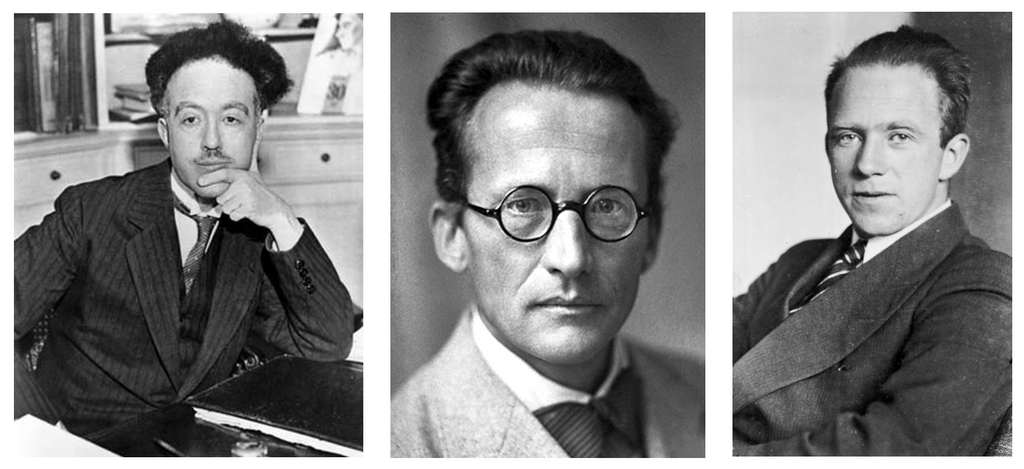
These three concepts—wave-particle duality, superposition, and entanglement—form the bedrock of quantum mechanics. They were developed in the early 20th century by a generation of brilliant physicists trying to make sense of experimental results that classical physics just couldn't explain. Their work completely changed our view of the universe.
Ready to test your understanding of these strange quantum ideas?
What does the concept of wave-particle duality describe?
In the double-slit experiment, firing single electrons one at a time results in an interference pattern on the detector screen. What does this outcome suggest?
While these ideas might seem like they belong in science fiction, they are the foundation of many modern technologies, from lasers to the transistors in your computer. The quantum world may be weird, but it's very real.