Introduction to Quantum Mechanics
Introduction to Quantum Mechanics
The Cracks in Classical Physics
For centuries, the world seemed to follow a neat set of rules. Physicists, using the laws laid out by Isaac Newton and others, could predict the motion of planets, the flow of water, and the trajectory of a cannonball. This framework, now called classical physics, worked beautifully for the large-scale world we see and interact with every day. It was a mechanical universe, predictable and deterministic. If you knew the starting conditions, you could know the future.
By the late 19th century, however, some strange experimental results started to appear. These were not just small errors; they were deep contradictions that classical physics couldn't explain, no matter how clever the adjustments.
One major puzzle was black-body radiation. Imagine a perfect oven that absorbs all light. When you heat it, it glows, first red, then orange, then white. Classical physics tried to predict the spectrum of light it would emit at a given temperature. The theory worked for long wavelengths but failed dramatically for shorter ones, like ultraviolet light. It predicted that the oven should release an infinite amount of energy at these short wavelengths, an outcome so absurd it was called the "ultraviolet catastrophe."
Another mystery was the photoelectric effect. When light shines on a metal surface, it can knock electrons loose. Classically, you'd expect a brighter light (more energy) to knock out electrons with more force. But experiments showed something different. Brighter light just knocked out more electrons, not more energetic ones. The energy of the ejected electrons depended only on the color (or frequency) of the light, and below a certain frequency, no electrons came out at all, no matter how bright the light was.
A Revolution Begins
The first crack in the old worldview came from German physicist Max Planck in 1900. To solve the black-body problem, he made a radical proposal. What if energy wasn't continuous, like a ramp, but came in discrete packets, like stairs? He called these packets "quanta."
This idea meant that an object could only absorb or emit energy in specific amounts. This simple but profound assumption fixed the ultraviolet catastrophe perfectly. Energy, he said, was related to frequency by a new fundamental constant, , now known as Planck's constant.
A few years later, Albert Einstein took Planck's idea a step further. He proposed that light itself is made of these energy packets, which we now call photons. This explained the photoelectric effect: one photon knocks out one electron. A brighter light has more photons, so it frees more electrons. But the energy of each individual electron depends on the energy of the single photon that hit it, which is determined by its frequency.
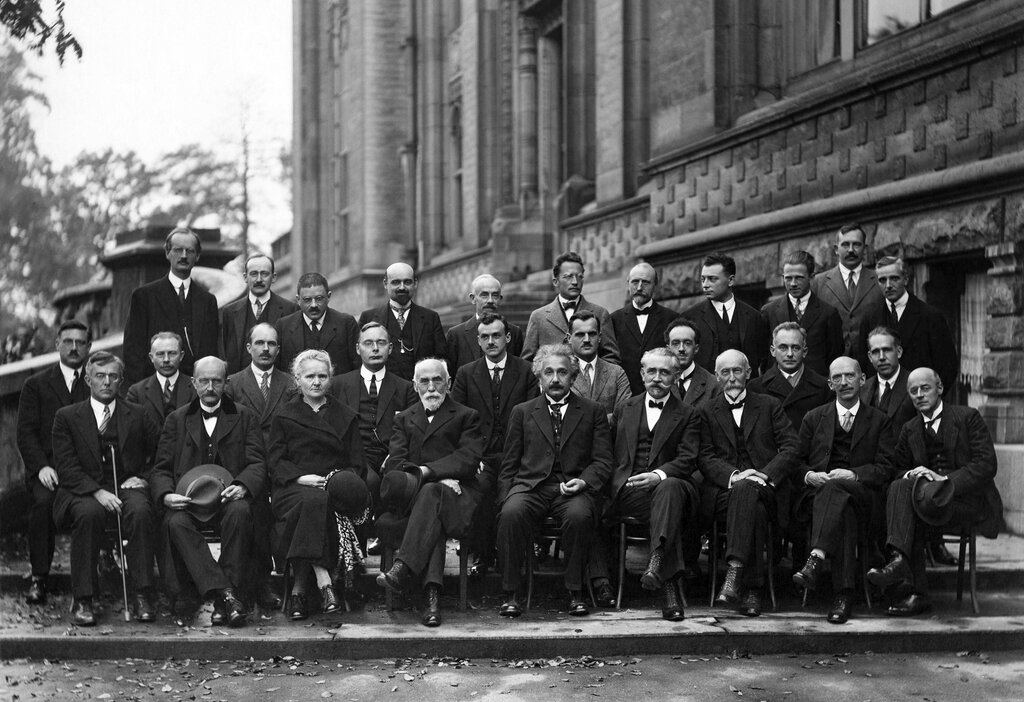
These early ideas kicked off a scientific revolution. Physicists like Niels Bohr, Werner Heisenberg, and Erwin Schrödinger built upon this foundation, developing a new set of rules to govern the atomic and subatomic world. This new framework was quantum mechanics.
Describing the Quantum World
In classical mechanics, we can describe a particle by its position and momentum. But in quantum mechanics, this certainty vanishes. Instead, we describe a particle using a mathematical object called the wave function, usually represented by the Greek letter psi ().
wave function
noun
A mathematical function that describes the quantum state of a particle, containing all the information that can be known about it.
The wave function doesn't tell you where a particle is; it tells you the probability of finding the particle at any given point in space. The higher the amplitude of the wave function at a certain location, the more likely you are to find the particle there if you look.
But how does this wave function change over time? In 1926, Erwin Schrödinger developed a master equation that governs the behavior of the wave function. The Schrödinger equation is to quantum mechanics what Newton's second law () is to classical mechanics.
This equation looks intimidating, but its core idea is simple: it describes how the wave function () evolves over time, influenced by the particle's mass () and the potential energy () it experiences. Solving this equation allows physicists to predict the probable outcomes of quantum experiments, from the energy levels of atoms to the behavior of particles in a quantum computer.
Let's check your understanding of these foundational concepts.
What was the "ultraviolet catastrophe"?
In the photoelectric effect, what determines the energy of the electrons knocked loose from a metal?
This new way of thinking was a radical departure from the clockwork universe of classical physics. It introduced probability and uncertainty at the most fundamental level, setting the stage for even stranger quantum phenomena.