Introduction to Quantum Computing
Introduction to Quantum Computing
A Different Kind of Computer
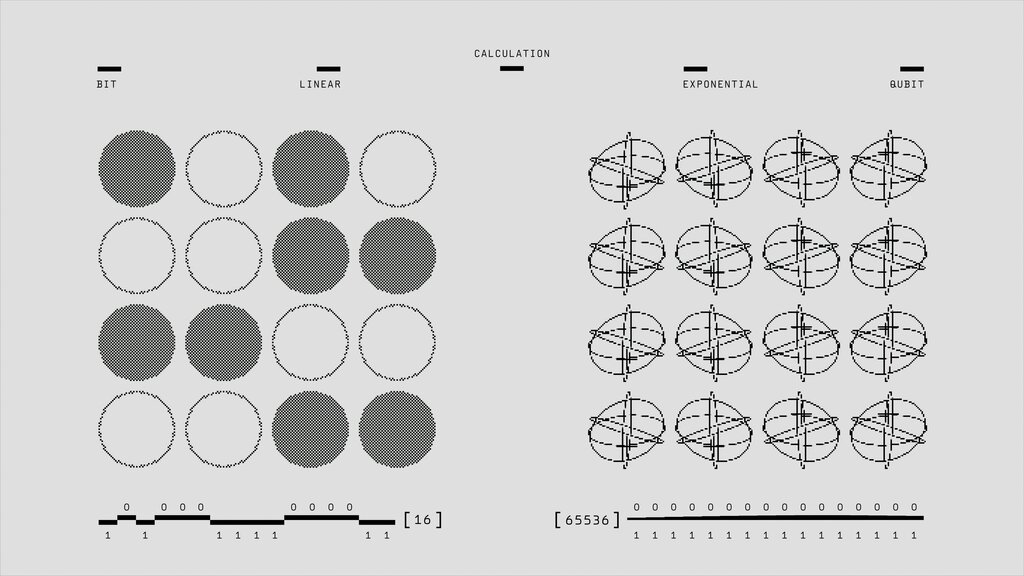
Classical computers, like the one you're using now, think in a very straightforward way. They use bits, which are tiny switches that can be either on or off, representing a 1 or a 0. Every task, from sending an email to playing a video, is broken down into a massive sequence of these simple choices.
Quantum computing throws that rulebook out the window. Instead of relying on classical physics, it harnesses the strange and wonderful rules of quantum mechanics. This allows quantum computers to process information in a fundamentally new way, tackling problems that would take a classical computer billions of years to solve.
Quantum computers approach solving problems in a fundamentally new way.
Bits vs. Qubits
The building block of a quantum computer isn't a bit, but a quantum bit, or qubit. While a classical bit is definitively a 0 or a 1, a qubit can be a 0, a 1, or both at the same time. This "both at once" property is called superposition.
qubit
noun
The basic unit of quantum information, the quantum analogue of the classical bit. A qubit can exist in a superposition of both 0 and 1 states.
Think of a spinning coin. While it's in the air, it's not heads and it's not tails—it's a blend of both possibilities. Only when it lands (or when we measure it) does it settle into one definite state. A qubit is like that spinning coin. This ability to exist in multiple states at once is what gives quantum computers their immense processing power. Just a handful of qubits can represent an enormous number of possibilities simultaneously.
Spooky Connections
Another quantum property that computers can exploit is entanglement. This is a counterintuitive phenomenon where two or more qubits become linked in a way that their fates are intertwined, no matter how far apart they are.
If you have two entangled qubits, measuring one instantly tells you the state of the other. If one is measured as a 0, you know with absolute certainty that the other is a 1, and vice versa. Albert Einstein famously called this "spooky action at a distance" because it seems to violate the idea that information can't travel faster than light. This connection allows for powerful computational shortcuts and is a key ingredient in many quantum algorithms.
Entanglement creates a deep connection between qubits, allowing them to work together in ways that classical bits simply can't.
Why Go Quantum?
So what's the point? The unique properties of qubits allow quantum computers to explore a vast landscape of potential solutions all at once. For certain types of problems, this provides an exponential speedup.
Classical computers are great for most everyday tasks, but they struggle with problems of immense complexity. Imagine trying to find the perfect chemical structure for a new medicine or designing a new material with specific properties. The number of possible combinations is astronomical.
A classical computer would have to check them one by one. A quantum computer could explore all possibilities simultaneously, finding the optimal solution in a fraction of the time. This could revolutionize fields like medicine, materials science, financial modeling, and artificial intelligence.
Now, let's test your understanding of these foundational concepts.
What is the fundamental building block of a quantum computer?
The quantum property that allows a qubit to be a 0, a 1, or both at the same time is called ____.
These concepts—qubits, superposition, and entanglement—are the pillars of quantum computing. They allow these machines to operate on principles that are completely different from the computers we use every day.