Introduction to Quantum Computing
Introduction to Quantum Computing
A New Kind of Computing
Classical computers, from your smartphone to the most powerful supercomputers, work with bits. A bit is a simple switch: it's either on or off, a 1 or a 0. All the amazing things they do boil down to manipulating these simple ones and zeros. Quantum computing is different. It's not just a faster version of what we have now; it's a completely new way of processing information based on the strange and wonderful rules of quantum mechanics, the physics of the very small.
Instead of using bits, quantum computers use qubits, which operate according to the principles of quantum physics.
By harnessing phenomena that happen at the atomic and subatomic levels, these machines can tackle problems that are practically impossible for even the fastest classical computers to solve.
Bits vs. Qubits
A classical bit is straightforward. Think of it like a light switch. It can only be in one of two states: on (1) or off (0). There's no in-between. Quantum computers use a different building block.
qubit
noun
The basic unit of quantum information. It is the quantum analogue of the classical bit.
A qubit can be a 0, a 1, or both at the same time. This mind-bending property is called superposition. Think of a spinning coin. While it's in the air, it's neither heads nor tails. It's in a superposition of both possibilities. Only when it lands and we measure it does it settle into a definite state of either heads or tails. A qubit is like that spinning coin, holding the potential for both 0 and 1 until it's measured.
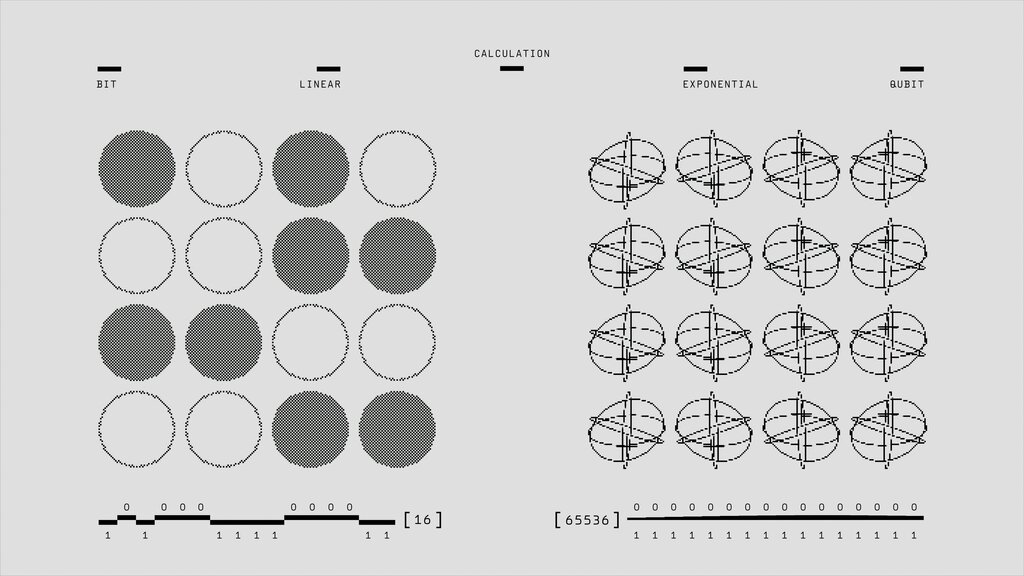
This ability to exist in multiple states at once is what gives quantum computers their power. If you have two classical bits, there are four possible combinations (00, 01, 10, 11), but they can only represent one of these at a time. Two qubits, however, can represent all four combinations simultaneously. With just 300 qubits, a quantum computer could represent more states than there are atoms in the known universe.
Spooky Connections
Another core concept is entanglement. This is a special connection that can link two or more qubits. When qubits are entangled, their fates are intertwined. No matter how far apart they are, the state of one instantly affects the other. If you measure one entangled qubit and find it's a 0, you'll instantly know its partner is a 1, and vice versa. Albert Einstein famously called this phenomenon "spooky action at a distance."
Another fundamental principle of quantum computing is entanglement, a phenomenon where two or more qubits become interconnected in such a way that the state of one qubit directly affects the state of another, regardless of the distance between them.
This isn't secret communication. It's a deep correlation that's built into the quantum states of the particles. This powerful link allows quantum computers to perform complex calculations and share information between qubits in ways that classical computers simply cannot.
A Different Approach to Problems
So, how does this all come together? A classical computer solves problems one step at a time, trying each possibility in sequence. Because a quantum computer can hold many possibilities in superposition at once, it can explore a vast number of potential solutions simultaneously. It's like being able to walk through every path in a maze at the same time, instead of trying them one by one.
| Feature | Classical Computing | Quantum Computing |
|---|---|---|
| Basic Unit | Bit | Qubit |
| State | 0 or 1 | 0, 1, or both (superposition) |
| Processing | Sequential | Parallel (explores many states at once) |
| Connections | Independent bits | Qubits can be entangled |
| Foundation | Classical Physics | Quantum Mechanics |
This doesn't mean quantum computers will replace your laptop for writing emails or browsing the web. Classical computers are excellent at those tasks. Instead, quantum computers are designed to tackle specific, incredibly complex problems in areas like medicine, materials science, and cryptography that are currently beyond our reach.
What is the property that allows a qubit to represent both a 0 and a 1 at the same time?
True or False: Quantum computers are designed to be faster replacements for classical computers for everyday tasks like browsing the web and writing emails.
This new computational frontier is just beginning. By understanding these core ideas of qubits, superposition, and entanglement, you have a foundation for exploring this exciting and rapidly evolving field.