Introduction to Quantum Computing
Introduction to Quantum Computing
Beyond Bits and Bytes
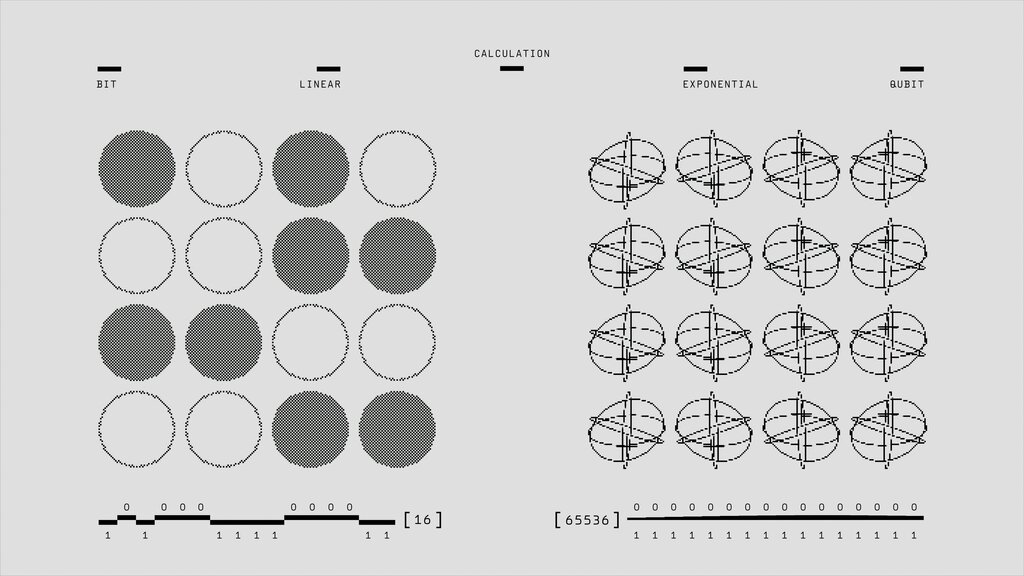
Your phone, laptop, and smartwatch all think in a very straightforward way. They use bits, which are like tiny light switches that can be either on or off. This on/off state is represented by a 1 or a 0. By stringing together billions of these switches, we can do amazing things, from streaming movies to sending messages across the globe.
This is classical computing. It's built on certainty. Every bit has a definite value at any given moment. But some problems in the world are too complex for this black-and-white approach. Simulating a new molecule for a life-saving drug or breaking a sophisticated encryption code involves navigating a mind-boggling number of possibilities. A classical computer would have to check them one by one, which could take thousands of years.
Quantum computers work differently. They operate on the principles of quantum mechanics, the strange and counterintuitive rules that govern the universe at the scale of atoms and particles.
The Quantum Toolkit
Instead of bits, quantum computers use qubits. A qubit can be a 0 or a 1, just like a classical bit. But it can also be in a combination of both states at the same time. This is a core concept of quantum mechanics called superposition.
qubit
noun
The basic unit of quantum information. A qubit can represent a 0, a 1, or a quantum superposition of both states.
Think of a spinning coin. While it's in the air, it's neither heads nor tails. It's a blur of both possibilities. Only when it lands (when we measure it) does it settle into a definite state. A qubit is like that spinning coin, holding multiple potential values at once.
This ability to exist in multiple states allows quantum computers to explore many possibilities simultaneously. Where a classical computer checks paths one by one, a quantum computer can check a huge number of them at the same time.
The second key principle is entanglement. This is a strange connection that can exist between two or more qubits. When qubits are entangled, their fates are linked. If you measure the state of one, you instantly know the state of the other, no matter how far apart they are.
Albert Einstein famously called this "spooky action at a distance." It’s another way quantum computers can process information in a powerful, interconnected way that classical computers can't.
Entanglement links qubits together, so that their collective state contains more information than the sum of its parts.
What's It Good For?
Quantum computing isn't going to replace your laptop for checking email or browsing the web. Classical computers are excellent at those tasks. Instead, quantum computers are designed to tackle specific, incredibly hard problems that are currently impossible to solve.
Potential applications are vast:
| Field | Potential Quantum Application |
|---|---|
| Medicine | Simulating molecules to design new drugs and treatments with incredible speed and accuracy. |
| Materials Science | Discovering new materials with desired properties, like more efficient batteries or superconductors that work at room temperature. |
| Finance | Optimizing investment strategies and creating more accurate financial models by analyzing huge datasets. |
| Cryptography | Breaking current encryption standards, but also creating new, un-hackable methods for secure communication. |
The technology is still in its early days. Building and controlling stable quantum computers is a massive scientific and engineering challenge. But the progress is rapid, and the potential to revolutionize entire industries is real.
Ready to check your understanding?
What is the fundamental unit of information in a quantum computer called?
The principle that allows a qubit to exist in a combination of both 0 and 1 states simultaneously is called:
By moving beyond simple 0s and 1s, quantum computing opens up a new frontier for computation, promising to solve some of the world's most complex and important problems.