Introduction to Quantum Computing
Introduction to Quantum Mechanics
The Quantum Realm
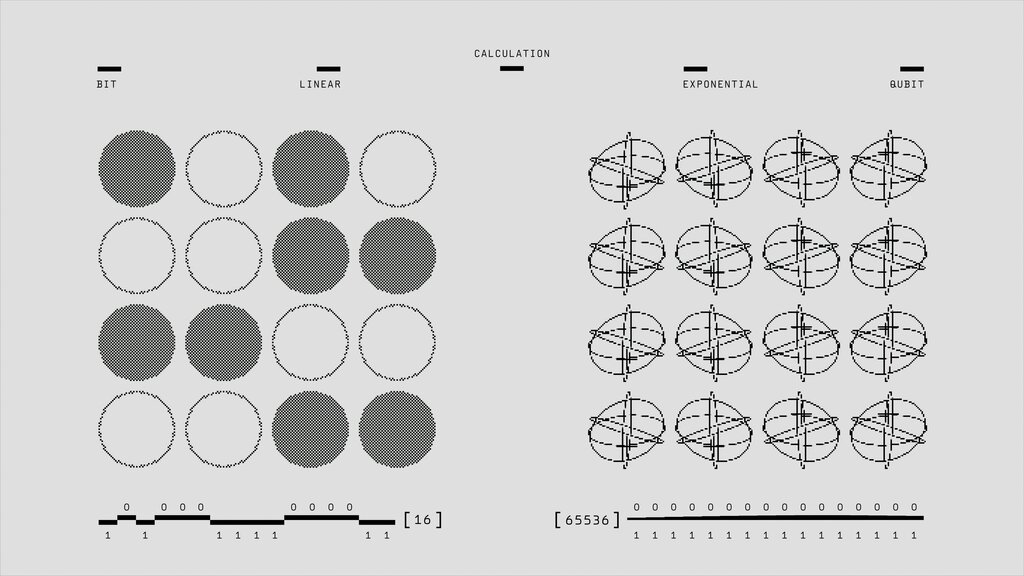
Classical computers think in bits. A bit is a simple switch, either on or off, representing a 1 or a 0. It’s a definite, predictable world. But when we shrink down to the scale of atoms and electrons, the rules change completely. This is the world of quantum mechanics, and it's where quantum computers get their power.
Instead of bits, quantum computers use “qubits.” While a bit must be either a 0 or a 1, a qubit can be a 0, a 1, or both at the same time. This strange “both-at-once” state is a core principle called superposition.
Superposition in Action
Imagine spinning a coin. While it’s in the air, spinning, it’s not quite heads and not quite tails. It's in a state of both possibilities. Only when it lands and you look at it does it settle into a definite state: heads or tails. A qubit in superposition is like that spinning coin. It exists in a combination of both 0 and 1.
Mathematically, we can describe this state, called |\[Psi\]\rangle (psi), as a combination of the basis states and .
Here, and are numbers called probability amplitudes. They tell us the likelihood of the qubit being a 0 or a 1 when we finally measure it. The key is that until we measure, the qubit is in both states at once, opening up a vast space for computation that a simple bit could never access.
Spooky Connections
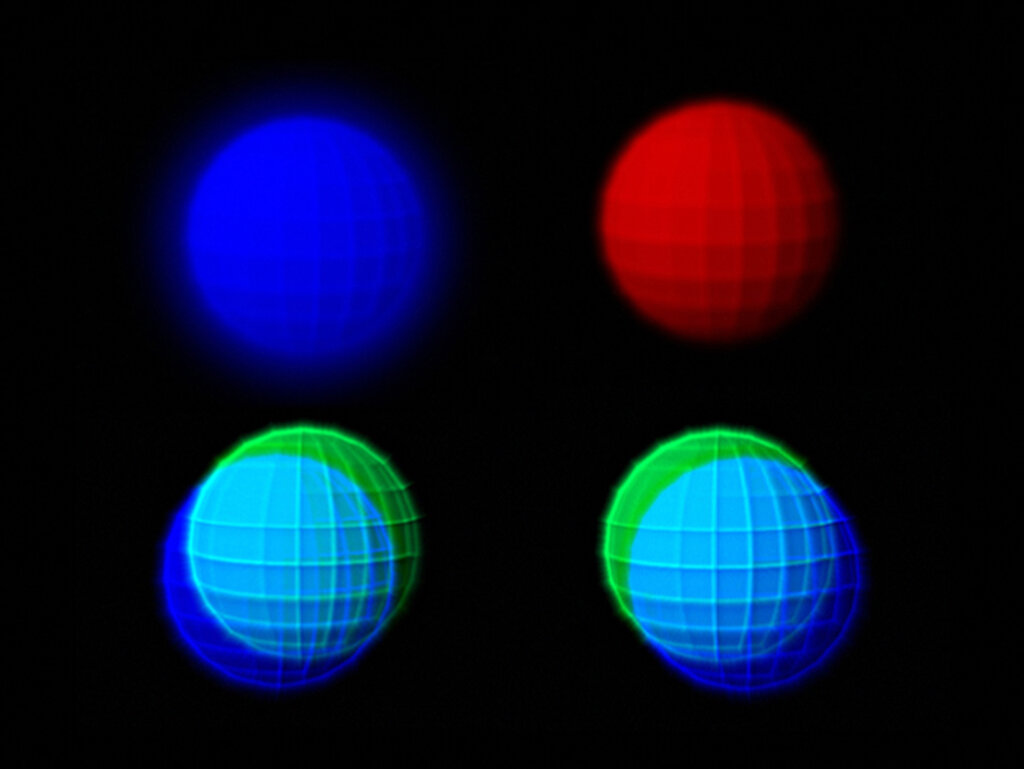
The quantum world gets even stranger with a property called entanglement. When two qubits are entangled, their fates become linked. Whatever happens to one instantly affects the other, no matter how far apart they are.
Another fundamental principle of quantum computing is entanglement, a phenomenon where two or more qubits become interconnected in such a way that the state of one qubit directly affects the state of another, regardless of the distance between them.
Think of it like having a pair of magic coins. You give one to a friend who travels to the other side of the galaxy. You both flip your coins at the same time. If yours lands on heads, you know with 100% certainty that your friend's coin landed on tails. Their outcomes are perfectly correlated, instantly, across any distance. Entangled qubits behave in this linked way.
The Role of Measurement
Superposition and entanglement are powerful but delicate. The moment we try to observe a qubit's state, the magic disappears. This is called quantum measurement.
When we measure a qubit that's in a superposition of 0 and 1, its state instantly collapses into one definite value. It will be either a 0 or a 1, just like a classical bit. The probability of which one it will be is determined by its amplitudes (\[\[alpha\]\] and \[\[beta\]\]) before the measurement. But the “both at once” state is gone forever.
Observing a quantum system forces it out of superposition and into a single, classical state.
This act of measurement is both a challenge and a tool in quantum computing. The entire goal is to set up qubits in clever superpositions and entangled states, let them interact to perform a calculation, and then measure the final outcome to get the answer. The trick is to design the process so the final collapsed state reveals the solution to a complex problem.
Time to see how well you've grasped these fundamental ideas.
What is the fundamental unit of information in a quantum computer?
The quantum principle of superposition is best described as a qubit's ability to...