Introduction to Quantum Computing
Introduction to Quantum Computing
A New Kind of Computing
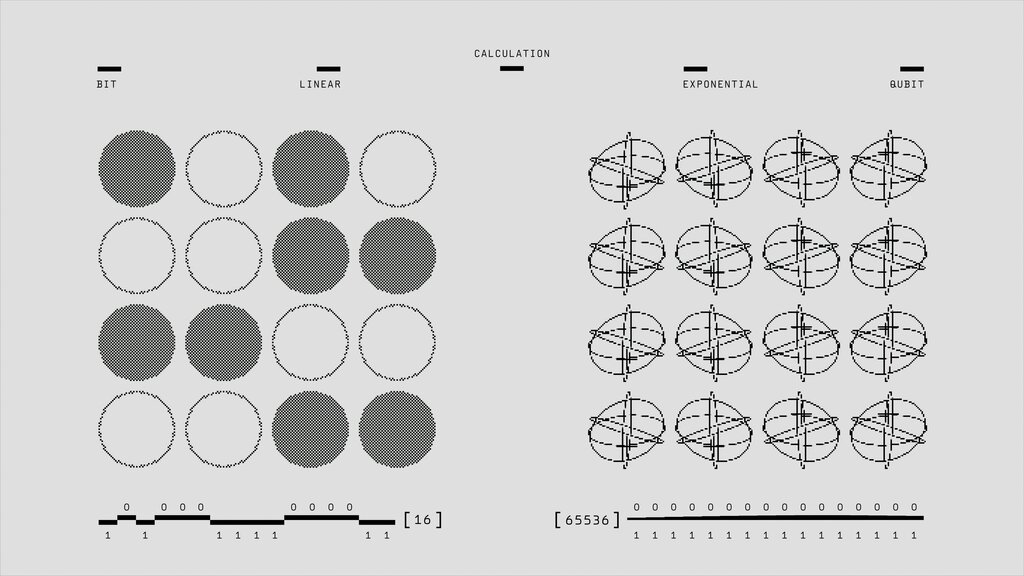
Classical computers, like the one you're using now, think in bits. A bit is a simple switch that can be either on or off, represented by a 1 or a 0. All the amazing things computers do boil down to manipulating billions of these tiny switches. Quantum computing takes a completely different approach. It uses the strange and wonderful rules of quantum mechanics to process information in a way that is impossible for classical computers.
Quantum computers approach solving problems in a fundamentally new way.
Instead of solving a problem by crunching through possibilities one by one, a quantum computer can explore many possibilities at once. This opens the door to solving certain types of complex problems that are currently intractable, from developing new medicines to creating revolutionary materials.
From Bits to Qubits
The fundamental building block of a quantum computer is the qubit. While a classical bit is restricted to being either a 0 or a 1, a qubit can be a 0, a 1, or both at the same time. This mind-bending property is called superposition.
superposition
noun
A principle of quantum mechanics that states an object can exist in multiple states at once until it is measured.
Think of a spinning coin. Before it lands, it's not definitively heads or tails—it's in a blur of both possibilities. A qubit is like that spinning coin. It exists in a combination of the states and . Only when we measure it does it "land" on a definite value, either 0 or 1.
In this equation, represents the state of the qubit. The coefficients and are complex numbers called probability amplitudes. The square of their magnitudes, and , gives the probability of the qubit collapsing to or upon measurement. Because of superposition, a handful of qubits can represent an enormous amount of information.
A Spooky Connection
Another key principle is entanglement. This is a counterintuitive quantum phenomenon where two or more qubits become linked in a way that their fates are intertwined, no matter how far apart they are. If you measure the state of one entangled qubit, you instantly know the state of the other.
Albert Einstein famously called entanglement "spooky action at a distance." Even if two entangled particles were on opposite sides of the universe, the connection between them would be instantaneous.
Imagine you have two coins that are magically linked. If you flip one and it lands on heads, you know with absolute certainty that the other coin, wherever it is, has landed on tails. Entanglement creates correlations between qubits that are much stronger than anything possible in the classical world. This powerful connection is a crucial resource for quantum algorithms, allowing for complex computations by performing operations on one qubit that affect the entire entangled system.
Promise and Problems
The combination of superposition and entanglement gives quantum computers their power. They can perform a massive number of calculations in parallel, offering the potential for exponential speedups on specific problems in fields like cryptography, materials science, and drug discovery.
However, building and operating quantum computers is incredibly difficult. Qubits are extremely fragile. The slightest disturbance from their environment, like a tiny change in temperature or a stray magnetic field, can destroy their quantum state in a process called decoherence. Keeping qubits stable long enough to perform useful calculations is one of the biggest challenges researchers face today. Current machines are small, error-prone, and a long way from solving the world-changing problems they promise to tackle.

Let's check your understanding of these foundational concepts.
What is the fundamental difference between a classical bit and a quantum qubit?
The quantum property where a qubit can be both 0 and 1 at the same time is called:
Quantum computing is a revolutionary field, but it's built on these few core ideas. Understanding qubits, superposition, and entanglement is the first step into a much larger, and stranger, world.