Introduction to Quantum Computing
Introduction to Quantum Computing
Beyond Bits and Bytes
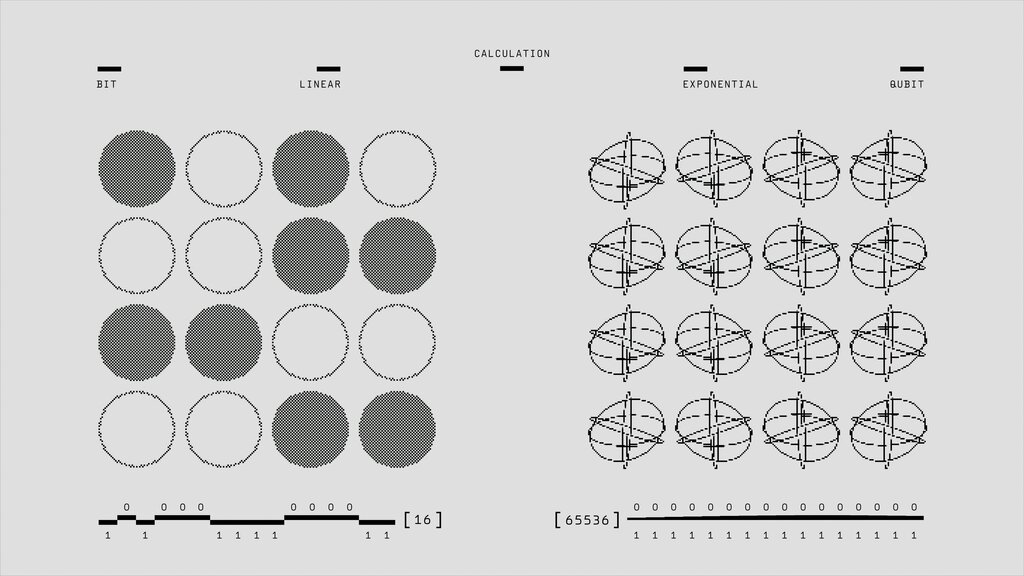
Classical computers, from your smartphone to the most powerful supercomputers, process information using bits. A bit is the smallest unit of data and has a simple job: it can be either a 0 or a 1. Think of it like a light switch. It's either on or off. There's no in-between.
Quantum computing operates on a completely different principle, using a unit called a qubit. A qubit can also be a 0 or a 1, but thanks to a property called superposition, it can also be a combination of both at the same time. Instead of a simple light switch, imagine a dimmer dial that can be at any position between fully off and fully on.
Qubit
noun
The basic unit of quantum information. It can represent a 0, a 1, or any quantum superposition of these two states.
This ability to exist in multiple states simultaneously is what gives quantum computers their power. We represent these fundamental states using a special notation: for the '0' state and for the '1' state. A qubit in superposition is a combination of these two.
The Power of Superposition
Superposition is one of the pillars of quantum mechanics. It means a quantum system, like a qubit, can be in multiple states at once until it's measured. The classic analogy is a spinning coin. While it's in the air, it's neither heads nor tails—it's in a mixture of both possibilities. Only when it lands and we look (make a measurement) does it settle into a definite state.
When a qubit in superposition is measured, its state instantly collapses to either a definite 0 or a definite 1. The probability of which outcome you'll get depends on its specific superposition.
Mathematically, we can describe the state of a qubit, written as |\[\textpsi\]\rangle, as a linear combination of its basis states, and .
Here, and are complex numbers called probability amplitudes. The square of their magnitudes tells us the probability of measuring the qubit as a 0 () or a 1 (). Because these are the only two possibilities, the probabilities must add up to 100%, or simply 1.
Because a single qubit can hold a blend of information, a quantum computer's processing power grows exponentially with each added qubit. Two qubits can represent four states at once (00, 01, 10, 11), three qubits can represent eight states, and so on. This exponential scaling is what promises to solve problems that are impossible for classical computers.
Spooky Connections
The other mind-bending concept at the heart of quantum computing is entanglement. This is a special connection between two or more qubits. When qubits are entangled, their fates are linked, no matter how far apart they are.
Imagine you have two entangled coins. You give one to a friend who travels to the other side of the world. The moment you flip your coin and it lands on heads, you instantly know your friend's coin will land on tails, and vice-versa. Before you measure, both outcomes were possible, but measuring one instantly determines the state of the other. Albert Einstein famously called this phenomenon "spooky action at a distance."
Entanglement doesn't allow for faster-than-light communication. You still need to classically communicate your measurement result to your friend for them to learn anything from their qubit's state.
This powerful linkage allows for complex correlations and is a key resource in quantum algorithms and communication protocols. An entangled pair isn't just two independent qubits; it's a single quantum system.
Quantum Gates and Circuits
Just as classical computers use logic gates (like AND, OR, and NOT) to manipulate bits, quantum computers use quantum gates to manipulate qubits. These gates are the building blocks of quantum algorithms.
Quantum gates are operations that rotate the state of a qubit on a conceptual sphere (called the Bloch sphere) or perform operations on multiple qubits at once. For example, a Hadamard gate is a common single-qubit gate that puts a qubit into an equal superposition of and . Another crucial gate is the Controlled-NOT (CNOT) gate, which operates on two qubits. It flips the state of the second qubit (the target) only if the first qubit (the control) is in the state . The CNOT gate is fundamental for creating entanglement.
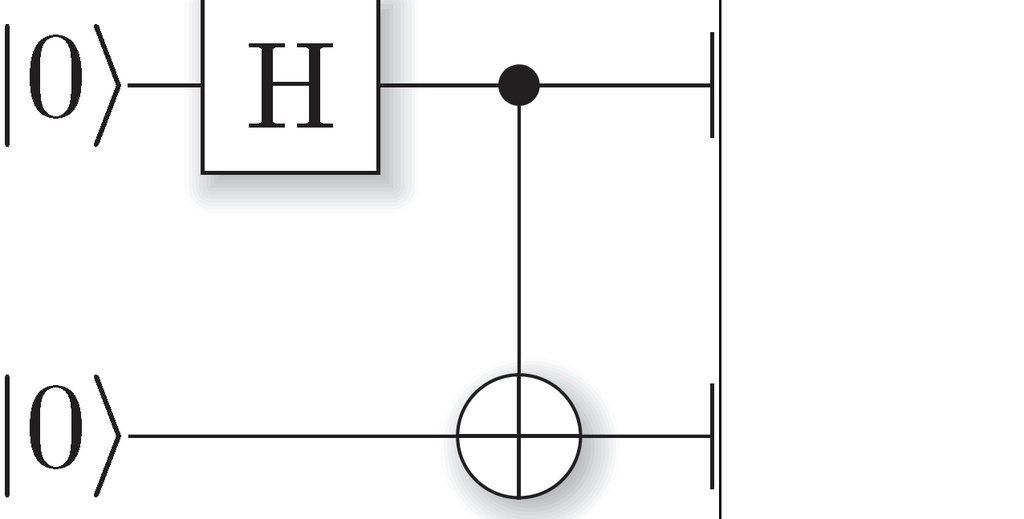
A sequence of these quantum gates applied to a set of qubits is called a quantum circuit. It's the quantum equivalent of a classical computer program, guiding the qubits through a calculation from an initial state to a final state, which is then measured to get the result.
Ready to check your understanding of these fundamental concepts?
What is the fundamental difference between a classical bit and a quantum bit (qubit)?
Which analogy best describes the quantum concept of superposition?
Understanding qubits, superposition, and entanglement is the first step into the strange and powerful world of quantum computing. These principles are the foundation for the revolutionary algorithms that could change fields like medicine, materials science, and artificial intelligence.