Introduction to Quantum Computing
Introduction to Quantum Computing
Beyond Bits and Bytes
Classical computers, from your smartphone to the most powerful supercomputers, think in a very straightforward language: the language of bits. A bit is the smallest unit of data and can only exist in one of two states: a 0 or a 1. Think of it like a light switch. It's either off (0) or on (1). All the amazing things classical computers do boil down to manipulating billions of these switches at incredible speeds.
Quantum computers operate on a completely different principle. They are built on the strange and counterintuitive rules of quantum mechanics. Instead of bits, they use something far more powerful.
Qubit
noun
The basic unit of quantum information. It is the quantum analogue of the classical bit.
A qubit, short for "quantum bit," can also be a 0 or a 1. But here’s the twist: it can also be both at the same time. This mind-bending property is called superposition.
Superposition is the ability of a quantum system to be in multiple states simultaneously until it is measured.
Imagine a spinning coin. While it's in the air, it’s not heads and it’s not tails. It's a blur of both possibilities. Only when it lands (when it's measured) does it settle on a definite state. A qubit in superposition is like that spinning coin. It exists in a combination of 0 and 1.
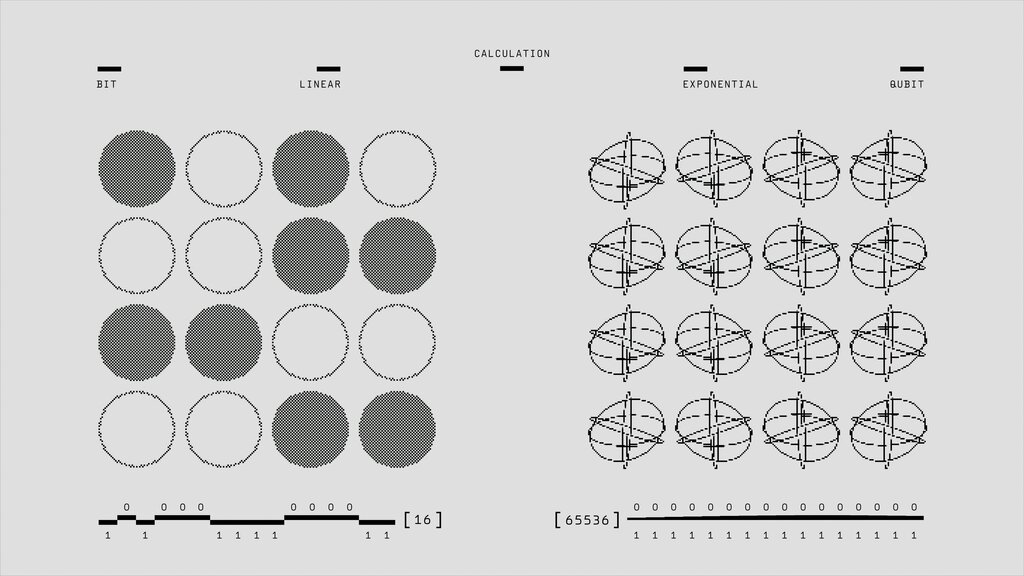
This allows quantum computers to process a huge number of possibilities at once. Where a classical computer with 4 bits can only represent one of 16 possible combinations at any given moment, a quantum computer with 4 qubits can represent all 16 combinations simultaneously. This parallel processing power is what gives quantum computers their incredible potential.
Mathematically, we can describe the state of a single qubit, which we call (pronounced "ket psi"), like this:
The squares of the amplitudes must sum to 1, representing the total probability.
The act of measuring a qubit in superposition forces it to "choose" a state. It snaps out of the spinning-coin state and lands on either heads (0) or tails (1). The probability of which state it chooses is determined by its amplitudes, and .
A Spooky Connection
If superposition weren't strange enough, there's another quantum property that's even more bizarre: entanglement.
Entanglement is a quantum mechanical phenomenon in which the quantum states of two or more objects have to be described with reference to each other, even though the individual objects may be spatially separated.
Imagine you have two qubits that are entangled. They are now linked in a fundamental way. If you measure one qubit and find it to be in the 0 state, you instantly know that the other qubit, no matter how far away it is, will be in the 0 state as well. It's as if they can communicate with each other faster than the speed of light.
This connection isn't just a simple correlation. It's a deep, non-local property of the universe. If you have two classical coins, knowing one is heads tells you nothing about the other. But with two entangled qubits, their fates are intertwined. This powerful link allows for complex computations and secure communication protocols that are impossible in the classical world.
Together, superposition and entanglement form the foundation of quantum computing. They allow qubits to store and process information in ways that are fundamentally different from classical bits, opening the door to solving problems that were once considered impossible.
What is the fundamental difference between a classical bit and a quantum bit (qubit)?
The quantum property that allows a qubit to be a 0 and a 1 at the same time is called ________.