Introduction to Quantum Computing
Introduction to Quantum Computing
Beyond Bits and Bytes
Classical computers, from your smartphone to the most powerful supercomputers, think in a very straightforward way. They use bits, which are like tiny light switches. A bit can be either on (represented by a 1) or off (represented by a 0). All the amazing things computers do boil down to manipulating billions of these switches at incredible speeds.
Quantum computing operates on a completely different level. Instead of relying on classical physics, it harnesses the strange and counterintuitive rules of quantum mechanics. This allows quantum computers to process information in ways that are impossible for even the most advanced classical machines.
Quantum computers approach solving problems in a fundamentally new way.
This new approach doesn't use bits. It uses something far more powerful.
The Quantum Bit
The fundamental unit of information in a quantum computer is the quantum bit, or qubit.
qubit
noun
A basic unit of quantum information. Unlike a classical bit, a qubit can represent a one, a zero, or both values at the same time.
While a classical bit must be either 0 or 1, a qubit can exist in a combination of both states simultaneously. This property is called superposition. Think of it like a spinning coin. While it's in the air, it's not heads and it's not tails—it's a blend of both possibilities. Only when it lands (or when we measure the qubit) does it settle into a definite state, either heads (0) or tails (1).
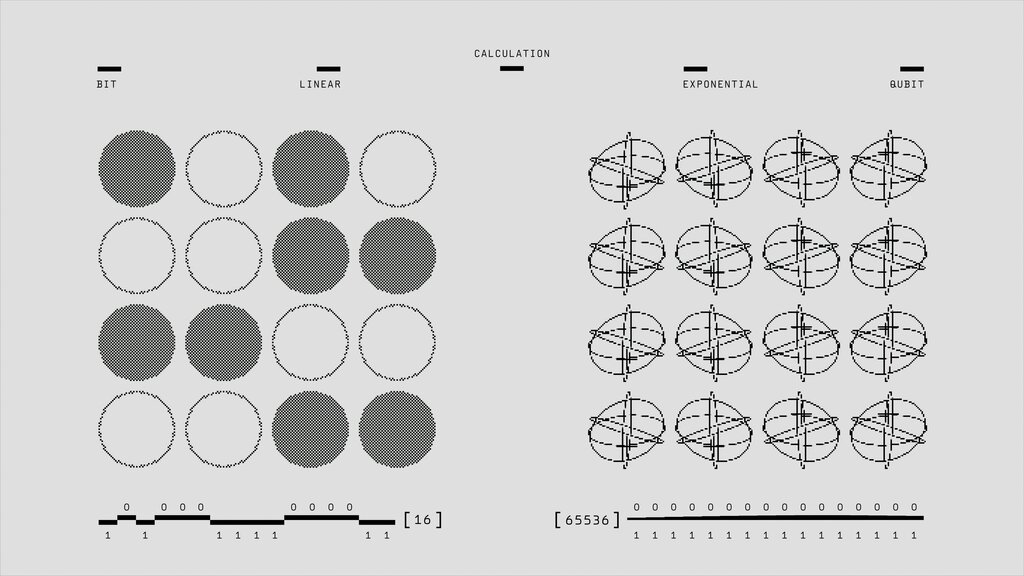
This ability to hold multiple values at once is what gives quantum computers their power. A system of two classical bits can be in one of four possible states (00, 01, 10, or 11). But a system of two qubits can be in a superposition of all four states at the same time. As you add more qubits, this computational space grows exponentially.
Mathematically, we can describe a qubit's state as a combination of its two basis states, and . The state of a qubit, written as |\[\psi\]\rangle (pronounced "ket psi"), is a linear combination of these states:
Here, and are complex numbers called probability amplitudes. The square of their magnitudes, |\[\alpha\]|^2 and |\[\beta\]|^2, represent the probability of the qubit collapsing to or upon measurement, with the condition that |\[\alpha\]|^2 + |\[\beta\]|^2 = 1.
Spooky Connections
Another core quantum concept is entanglement. This is a special connection between two or more qubits. When qubits are entangled, their fates are linked, no matter how far apart they are.
Imagine you have two "magic" coins that are entangled. You give one to a friend who travels to the other side of the world. If you flip your coin and it lands on heads, you instantly know that your friend's coin will land on tails. Entanglement creates a perfectly correlated system. Albert Einstein famously called this "spooky action at a distance."
Entanglement allows qubits to be highly interconnected. A single operation on one entangled qubit can affect the entire system, enabling complex computations that would take a classical computer an eternity.
These two principles, superposition and entanglement, are the engines of quantum computing. They allow quantum machines to explore a vast number of possibilities simultaneously.
Promise and Problems
So, what can we do with this power? Quantum computers aren't meant to replace your laptop for browsing the internet or writing emails. They are specialized machines designed to solve certain types of problems that are intractable for classical computers. Potential applications include:
- Drug Discovery & Materials Science: Simulating molecules to design new drugs and materials.
- Optimization: Solving complex logistical problems, like optimizing shipping routes or financial portfolios.
- Cryptography: Breaking current encryption standards, but also creating new, ultra-secure quantum communication methods.
- Machine Learning: Developing more powerful artificial intelligence models.
However, building a useful quantum computer is incredibly difficult. The quantum states of qubits are extremely fragile.
Any interaction with the outside world—a tiny change in temperature, a stray vibration, or an electromagnetic field—can disrupt the qubit's state and destroy the computation. This loss of quantumness is called decoherence.
To prevent decoherence, quantum computers must be built in highly controlled environments. They are often kept in special refrigerators that cool the qubits to temperatures colder than deep space. This engineering challenge, along with the difficulty of scaling up the number of stable, high-quality qubits, are the primary hurdles researchers face today.

Let's review some of the key terms we've just covered.
Now, test your knowledge of these foundational concepts.
What is the fundamental unit of information in a quantum computer?
The ability of a qubit to exist as a combination of both 0 and 1 at the same time is known as:
The field of quantum computing is still in its early days, much like classical computing was in the 1950s. While there are many challenges ahead, the potential to revolutionize science, medicine, and technology makes it one of the most exciting frontiers in science.