Introduction to Quantum Computing
Introduction to Quantum Computing
A Different Kind of Computer
For centuries, we've built computers on a simple idea: information can be broken down into bits. A bit is the smallest possible piece of data, and it can only be in one of two states, a 0 or a 1. Think of it like a light switch. It's either on or it's off. There's no in-between.
This binary system has been incredibly powerful, taking us from simple calculators to the supercomputers in our pockets. But some problems are so complex that even the fastest classical computers would take billions of years to solve them. To tackle these challenges, we need a completely new approach.
Quantum computers aren't just faster versions of the computers we use today. They work on entirely different principles, borrowed from the strange and fascinating world of quantum mechanics. Instead of bits, they use quantum bits, or qubits.
The Quantum Bit, or Qubit
A qubit, like a bit, can also be a 0 or a 1. But here's where things get interesting. Thanks to a principle called superposition, a qubit can also be a 0 and a 1 at the same time.
Imagine spinning a coin. While it's in the air, spinning, it's not heads and it's not tails. It's in a combination of both states. Only when it lands on the table—when we measure it—does it settle into one definite state, heads or tails. A qubit is like that spinning coin. It exists in a fuzzy cloud of possibilities until the moment you look at it.
qubit
noun
The basic unit of quantum information. It is the quantum analogue of the classical binary bit.
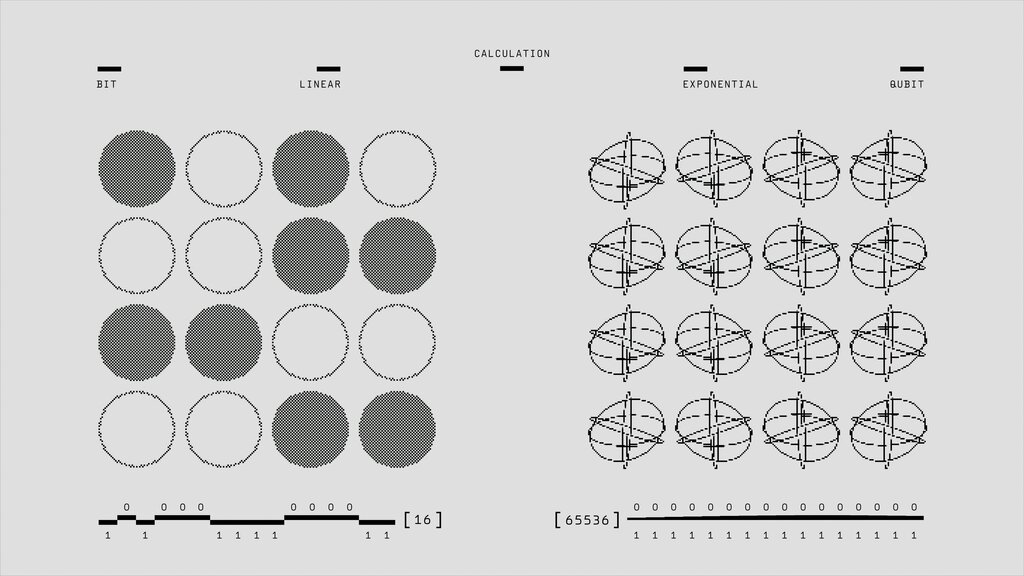
This ability to hold multiple values at once is what gives quantum computers their power. Where a classical computer with 4 bits can only store one of 16 possible combinations at a time (like 0001 or 1011), a quantum computer with 4 qubits can store all 16 of those combinations simultaneously. The number of states a quantum computer can explore grows exponentially with each added qubit.
Spooky Connections
Superposition is only half the story. The other key principle is entanglement. This is a strange, counterintuitive phenomenon where two or more qubits become linked in a deep way. Their fates are intertwined, no matter how far apart they are.
If you have two entangled qubits, measuring one instantly influences the other. For example, if you measure one and find it's a 0, you'll know instantly that the other one is also a 0, even if it's on the other side of the galaxy. Albert Einstein famously called this "spooky action at a distance."
Entanglement creates a single system out of multiple qubits. The state of one part of the system can't be described without considering the others.
This doesn't mean information is traveling faster than light. Rather, it's as if the two qubits were never separate entities to begin with. They are two parts of a single quantum state. Think of a pair of gloves. If you open a box and find the left-handed glove, you immediately know the other glove is right-handed, without having to see it.
By harnessing superposition and entanglement, scientists and engineers are building powerful new machines that can explore vast computational spaces all at once. This opens the door to solving problems that are currently impossible for classical computers, from designing new medicines to creating novel materials.
Let's review the core ideas we've covered before we move on.
Now, test your understanding of these foundational concepts.
What is the fundamental unit of information in a quantum computer?
The principle of superposition is best described by which analogy?
While we are still in the early days of quantum computing, these fundamental principles are the building blocks for a new era of computation.