Introduction to Quantum Computing
Introduction to Quantum Mechanics
The Quantum World
At the scale of everyday life, things are predictable. A thrown baseball follows a clear path. A spinning top has a definite position and speed. But when we zoom in to the world of atoms and electrons, these familiar rules break down. Welcome to quantum mechanics, the physics of the very small.
This isn't just a different version of classical physics. It's a completely new way of describing reality, one built on probability, uncertainty, and strange dualities.
Wave or Particle?
Imagine firing a stream of tiny particles, like microscopic paintballs, at a wall with two narrow slits in it. Behind this wall is a detector screen. You'd expect to see two distinct lines on the screen, right where the paintballs flew through the slits.
Now, what if we do this with electrons? Electrons are tiny particles of matter. Yet, when we fire them one by one at a double-slit setup, something bizarre happens. Instead of two lines, we get a pattern of many lines—an interference pattern. This is the hallmark of waves, where peaks and troughs add up or cancel each other out.
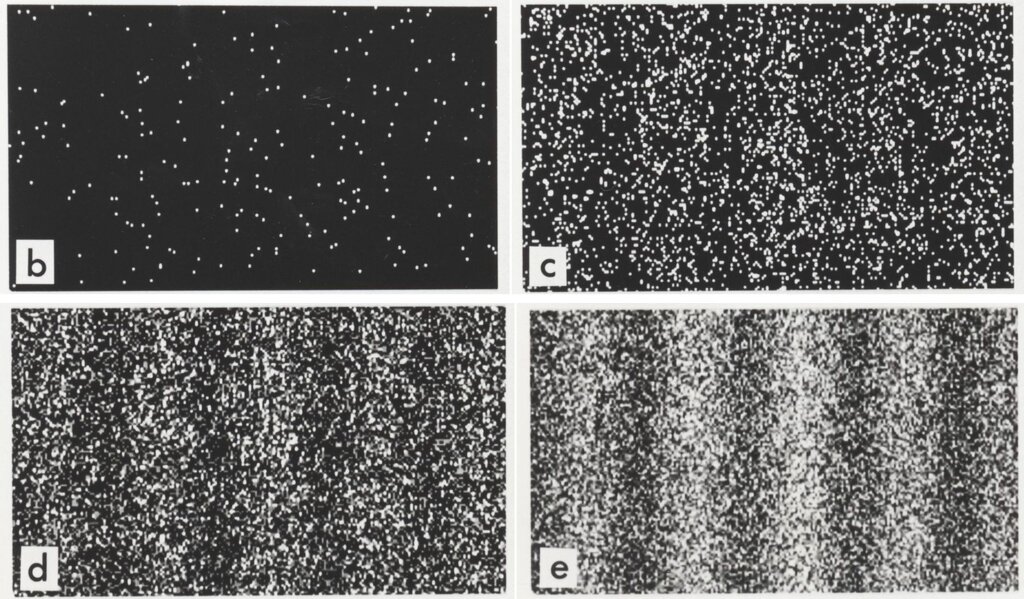
Each electron, acting alone, seems to pass through both slits at once, like a wave, and interfere with itself. But the moment we try to observe which slit the electron goes through, the interference pattern vanishes. We're left with just two lines, as if the electron suddenly decided to act like a well-behaved particle.
This is wave-particle duality. Quantum objects don't choose to be one or the other; they are both simultaneously. Their wave-like nature describes the probability of where we might find them, while their particle-like nature appears when we measure them.
At the quantum level, objects are not strictly particles or waves—they are a strange combination of both.
A Fuzzy Reality
This inherent weirdness leads to another core concept: the Uncertainty Principle. Developed by Werner Heisenberg, it states that there's a fundamental limit to how precisely we can know certain pairs of properties of a particle at the same time.
The most famous pair is position and momentum (which is mass times velocity). The more precisely you measure a particle's position, the less precisely you can know its momentum. And the more precisely you measure its momentum, the fuzzier its position becomes.
This isn't a limitation of our measurement tools. It's a fundamental property of nature. A quantum particle doesn't have a single, precise position and momentum. Its existence is described by a range of possibilities, a cloud of probability. When you pin down one value, you inherently spread out the possibilities for the other.
The Rulebook of Reality
So, how do physicists describe this probabilistic, wave-like behavior? The cornerstone of quantum mechanics is the Schrödinger equation. It's the quantum equivalent of Newton's laws of motion.
Instead of predicting a definite path for a particle, the Schrödinger equation describes the evolution of a mathematical object called the wave function, represented by the Greek letter psi ().
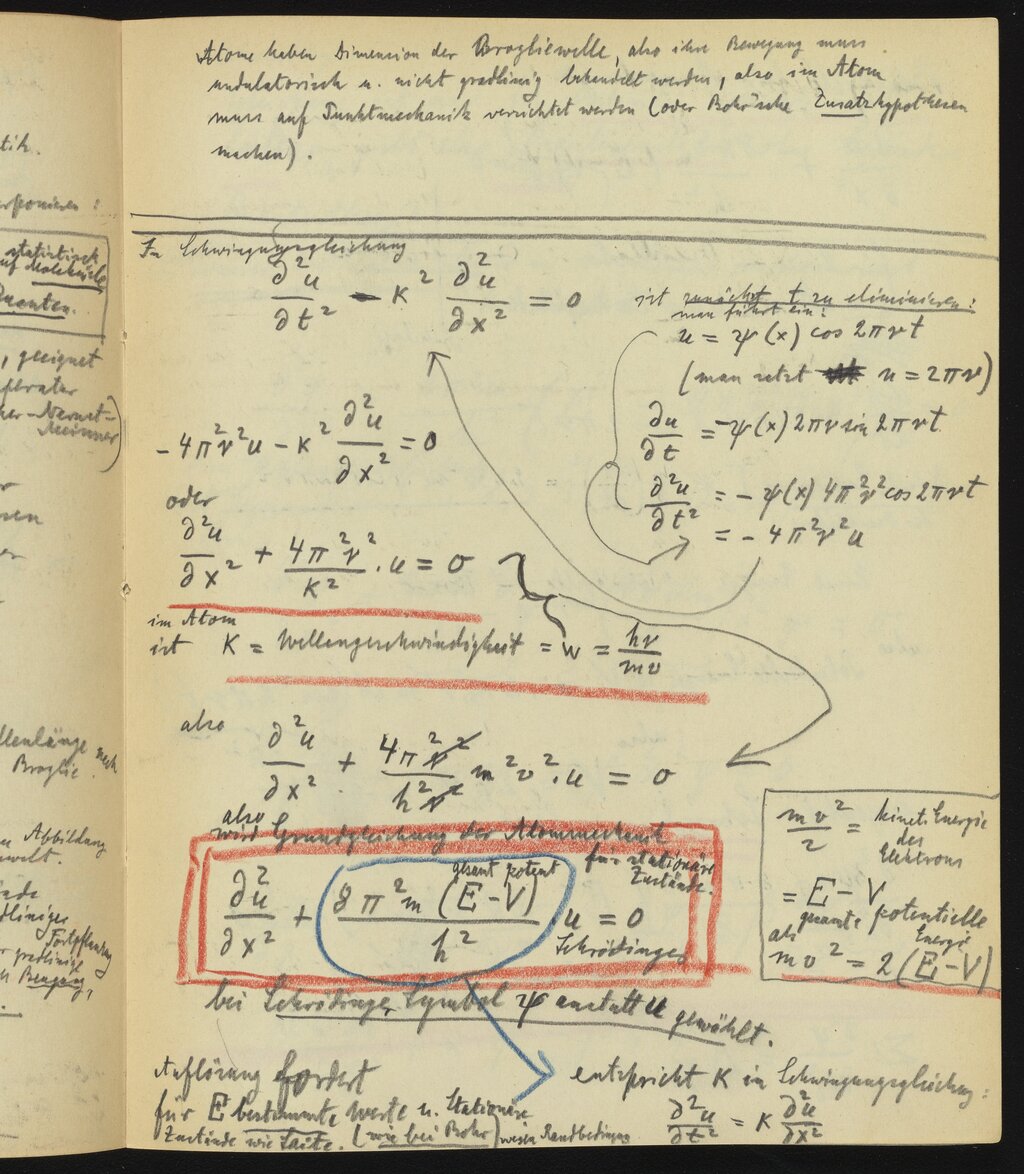
The wave function contains all the information about a quantum system. It doesn't tell you where an electron is; it tells you the probability of finding the electron at any given point in space if you were to look for it. The equation looks complicated, but its job is simple: given the state of a quantum system now, it tells you what its state will be at any time in the future.
The Schrödinger equation governs the wave function, which in turn governs the probabilities that define the quantum world.
These three ideas—wave-particle duality, the uncertainty principle, and the Schrödinger equation—form the foundation of quantum mechanics. They describe a world that is fundamentally different from our everyday experience, a world built on probability and inherent fuzziness.