Introduction to Quantum Computing
Introduction to Quantum Mechanics
A Different Kind of Reality
In our everyday world, objects behave predictably. A thrown ball follows a clear path. A spinning top has a definite position and speed. This is the realm of classical physics, governed by rules laid out by figures like Isaac Newton. But when we zoom in to the scale of atoms and electrons, these familiar rules break down. Welcome to the strange and fascinating world of quantum mechanics.
Here, particles don't follow neat trajectories. Instead, their existence is described by probabilities and waves of possibility. It's a fundamental shift in how we understand reality, and it's built on a few core ideas that challenge our intuition.
Wave or Particle?
One of the first puzzles of the quantum world is that tiny things like electrons and photons don't commit to being either a particle or a wave. They act as both. This is called wave-particle duality.
Imagine firing single electrons at a screen with two narrow slits. If electrons were just tiny balls, you'd expect to see two bands on the detector screen behind the slits, right where they passed through. But that's not what happens. Instead, an interference pattern emerges, a series of bright and dark bands, just like you'd see if waves of water were passing through the slits and interfering with each other. Each individual electron lands as a single point—a particle—but the collective pattern they form over time reveals their wave-like nature.
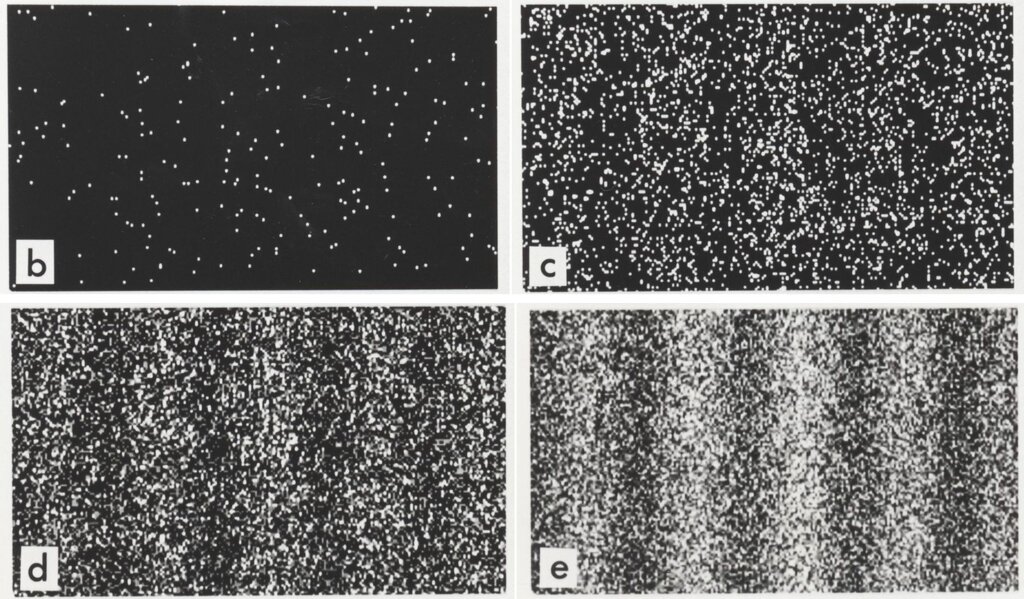
This means a single electron doesn't go through one slit or the other. In a sense, its wave of probability passes through both slits simultaneously and interferes with itself. This duality isn't just a clever trick; it's a fundamental property of matter at the smallest scales.
The Limit of Knowing
In classical physics, we can know everything about an object if we measure carefully enough. We can find a car's exact position and its exact speed at the same time. But in the quantum world, there's a hard limit to what we can know. This is captured by Werner Heisenberg's Uncertainty Principle.
The principle states that there's a trade-off when measuring certain pairs of properties. The more precisely you know a particle's position, the less precisely you know its momentum (its mass times its velocity), and vice-versa. It’s not about having imperfect instruments; it's a fundamental property of nature. The very act of measuring one property inevitably disturbs the other.
Imagine trying to find a single dust mote in a dark room by bouncing a tennis ball off it. You might find its position when the ball hits, but the collision will send the mote flying off in an unknown direction, completely changing its momentum.
Mathematically, this relationship is expressed as:
Here, is the uncertainty in position, is the uncertainty in momentum, and is the reduced Planck constant—a very, very small number. This formula tells us that we can never make both uncertainties zero at the same time. This inherent fuzziness is a key feature of the quantum world.
Describing the Wave
If particles are also waves, how do we describe them? Erwin Schrödinger provided the answer with a groundbreaking equation that became a cornerstone of quantum mechanics. The Schrödinger equation describes how the quantum state of a system changes over time.
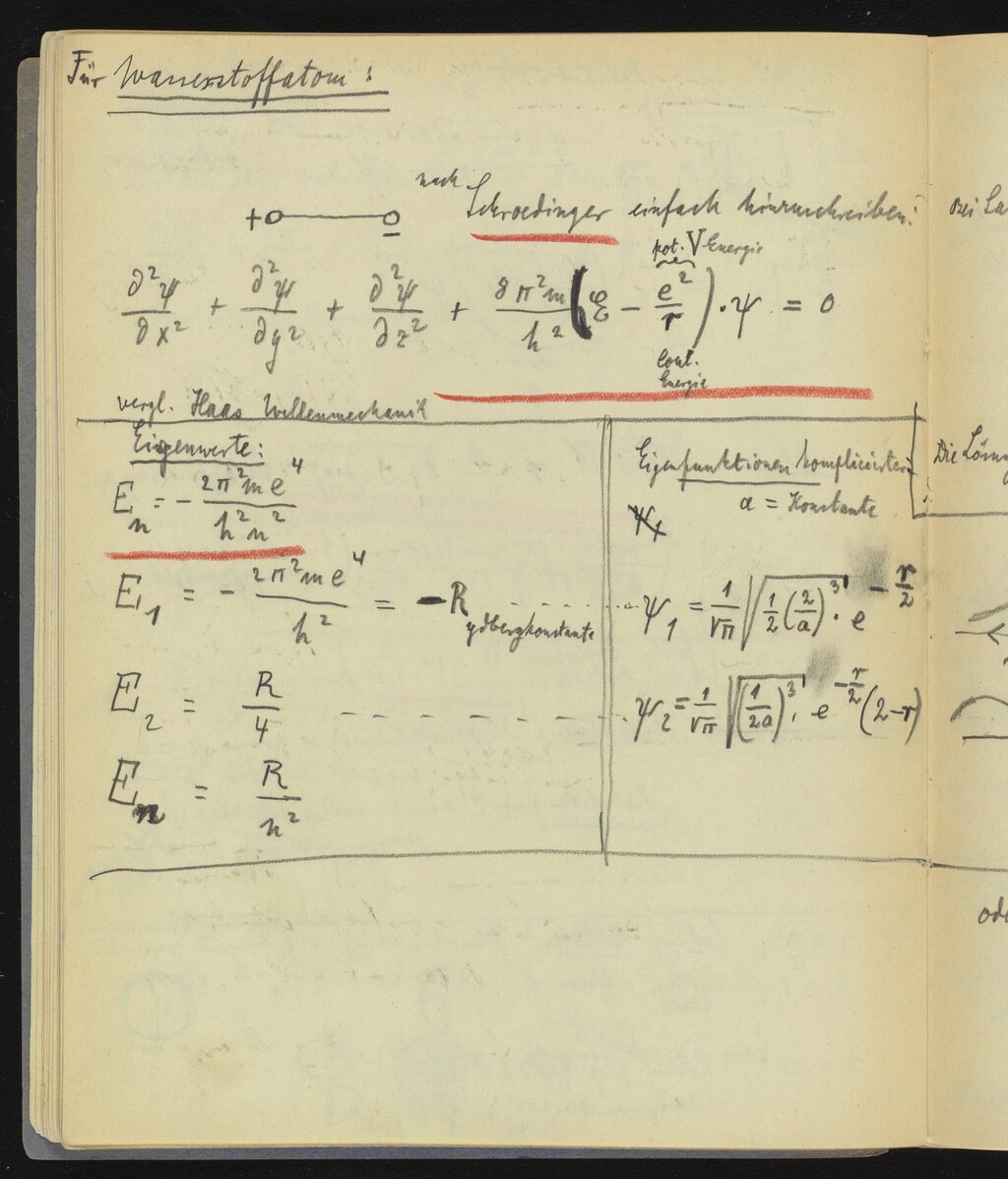
The equation's solution is a mathematical entity called the wave function, represented by the Greek letter psi, . The wave function itself isn't something we can directly observe. Instead, it contains all the information about the particle's probable properties. For example, the square of the wave function's magnitude, , gives us the probability of finding the particle at a certain position at a certain time.
This is the time-dependent Schrödinger equation. It looks complex, but its core idea is that the evolution of the wave function (left side) is determined by the particle's kinetic and potential energy (right side). It allows physicists to predict the probability of different outcomes for a quantum system, replacing the certainty of classical mechanics with the calculated probabilities of the quantum realm.
These three concepts—wave-particle duality, the uncertainty principle, and the Schrödinger equation—form the foundation of quantum mechanics. They paint a picture of a universe that is probabilistic, interconnected, and fundamentally different from the world we experience every day.
Ready to test your knowledge?
In the double-slit experiment, when single electrons are fired one at a time, what pattern eventually forms on the detector screen?
According to the Heisenberg Uncertainty Principle, the more precisely you know a particle's position, the less precisely you know its momentum.
These principles may seem abstract, but they are the bedrock upon which our modern understanding of the physical world is built.