Introduction to Quantum Computing
Introduction to Quantum Computing
A Different Kind of Computer
Quantum computers aren't just more powerful versions of the computers we use every day. They operate on completely different principles, borrowed from the strange and fascinating world of quantum mechanics. Instead of processing information with simple on-or-off switches, they tap into the unique behaviors of particles at the atomic and subatomic levels.
Think of it this way: a classical computer is like a light switch. It can be on or off. A quantum computer is like a dimmer switch, capable of being at any point between fully on and fully off, and even in multiple of those states at once.
From Bits to Qubits
Classical computers run on bits. A bit is the most basic unit of information, and it can only have one of two values: 0 or 1. Every email you send, video you watch, and app you use is ultimately broken down into a massive sequence of these simple zeros and ones.
Quantum computers use a different building block called a qubit.
qubit
noun
The basic unit of quantum information. A qubit can represent a one, a zero, or a quantum superposition of both states.
While a bit is forced to be either a 0 or a 1, a qubit can be a 0, a 1, or both at the same time. This strange property is called superposition, and it's one of the keys to a quantum computer's power.
Superposition: More Than On or Off
Imagine a spinning coin. While it's in the air, it's not definitively heads or tails. It's in a state that is a combination of both possibilities. Only when it lands and you look at it—when you measure it—does it settle into one definite state, either heads or tails.
A qubit in superposition is like that spinning coin. It exists as a blend of both the 0 and 1 states. This doesn't mean it has an unknown value; it means it has both values simultaneously.
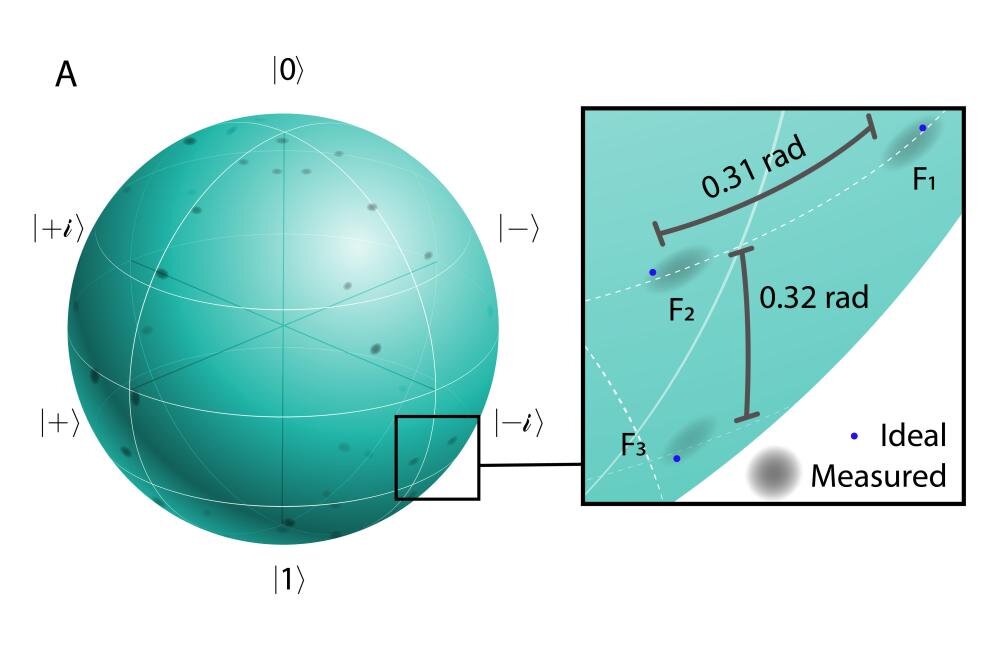
Mathematically, we can describe the state of a qubit, represented as |\[\psi\]\rangle (pronounced "ket psi"), as a combination of the basis states and .
Here, and are complex numbers called amplitudes. They describe the probability of the qubit collapsing to 0 or 1 when measured. The squares of their magnitudes must sum to 1, representing 100% probability.
Because a single qubit can hold a combination of 0 and 1, a quantum computer with just a few qubits can represent an enormous number of values at the same time. This exponential scaling is what makes them so powerful for certain types of problems.
Entanglement: A Spooky Connection
The other mind-bending principle is entanglement. Albert Einstein famously called it "spooky action at a distance." Entanglement is a special connection that can link two or more qubits together.
When qubits are entangled, their fates are intertwined. No matter how far apart they are—in the same room or on opposite sides of the galaxy—the state of one instantly affects the other. If you measure one entangled qubit and find it in the state, you instantly know the state of its partner without measuring it.
Consider a pair of magical gloves. You put them in separate boxes and mail one to a friend. The moment you open your box and see a left-handed glove, you know for certain that your friend has the right-handed one. Entangled qubits behave in a similarly correlated way.
This connection allows quantum computers to perform complex calculations where the information is distributed across the entire system, not just in individual qubits. It creates correlations that are impossible in classical computers, enabling powerful computational shortcuts for specific problems.
| Feature | Classical Computer | Quantum Computer |
|---|---|---|
| Basic Unit | Bit | Qubit |
| Value | 0 or 1 | Superposition of 0 and 1 |
| State | Independent | Can be entangled with others |
| Core Principle | Boolean Logic | Quantum Mechanics |
These fundamental differences mean quantum computers aren't here to replace your laptop for browsing the web or writing documents. Instead, they are specialized machines designed to tackle problems that are currently intractable for even the most powerful supercomputers, like discovering new materials, designing drugs, and breaking complex codes.
What is the fundamental difference between how classical and quantum computers process information?
The ability of a qubit to exist as a combination of both 0 and 1 at the same time is known as: