Introduction to Quantum Computing
Introduction to Quantum Computing
A New Kind of Computing
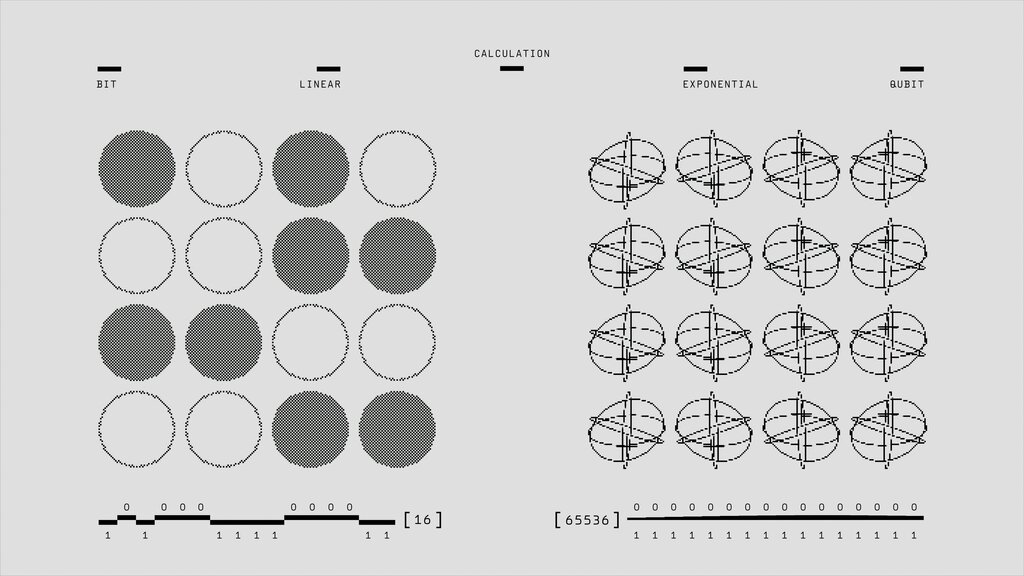
The computer, phone, or tablet you're using right now is a classical computer. It thinks in a very straightforward way, using bits of information that are either a 0 or a 1. It's like a series of light switches: each one is either on or off. This simple binary system is incredibly powerful and has gotten us very far.
Quantum computing is a completely different approach. It's built on the strange and fascinating rules of quantum mechanics, the science that describes how matter and energy behave at the atomic and subatomic levels. Instead of bits, quantum computers use qubits.
Quantum computing harnesses quantum mechanics to solve complex problems faster than classical computers.
A qubit can be a 0, a 1, or both at the same time. This doesn't mean it's undecided; it's in a state of multiple possibilities at once. This single difference opens up a whole new world of computational power.
| Feature | Classical Bit | Quantum Bit (Qubit) |
|---|---|---|
| Basic Unit | Bit | Qubit |
| Possible States | 0 or 1 | 0, 1, or both (superposition) |
| How it Works | Electrical switches (on/off) | Quantum-mechanical systems |
| Power | Linear growth | Exponential growth |
The Quantum Rules
Two key principles of quantum mechanics make quantum computers tick: superposition and entanglement. They sound complex, but the ideas are quite intuitive.
Superposition is the ability of a qubit to be in multiple states at once. Think of a spinning coin. While it's in the air, it’s not heads and it’s not tails—it’s a mix of both possibilities. Only when it lands (when we measure it) does it settle into a single, definite state. A qubit is like that spinning coin, holding multiple values simultaneously.
Entanglement is even stranger. When two qubits are entangled, their fates are linked, no matter how far apart they are. If you measure one and find it's a 0, you instantly know the other is a 1, and vice versa.
Imagine you have a pair of magical gloves. You put them in two separate boxes and mail one to a friend on the other side of the world. The moment you open your box and see a left-handed glove, you know for a fact that your friend has the right-handed one. Before anyone looked, the gloves were linked. Entangled qubits work in a similar, connected way.
superposition
noun
The principle that a quantum system can exist in multiple states at the same time. When measured, it collapses into a single, definite state.
entanglement
noun
A quantum phenomenon in which two or more qubits become linked in such a way that their states are correlated, regardless of the distance separating them.
Why Go Quantum?
Quantum computers aren't here to replace your laptop. They won't make video games run faster or help you browse the internet more quickly. Instead, they are designed to tackle specific, incredibly complex problems that are impossible for even the most powerful supercomputers to solve.
Think of problems with a staggering number of variables, like designing new molecules for medicine or creating novel materials with specific properties. A classical computer would have to check every possibility one by one, which could take thousands of years. A quantum computer, by using superposition and entanglement, can explore many possibilities at once, finding a solution much more efficiently.
Other potential applications include:
- Drug Discovery: Simulating molecules to find new cures for diseases.
- Financial Modeling: Optimizing investment strategies and managing risk.
- Cryptography: Creating unbreakable codes and, on the flip side, breaking current encryption standards.
- Artificial Intelligence: Developing more powerful machine learning algorithms.
The field is still young, but it holds the promise of solving some of humanity's biggest challenges.
Let's check your understanding of these fundamental concepts.
What is the fundamental unit of information in a quantum computer called?
The principle that allows a qubit to be in a state of 0 and 1 simultaneously is known as: