Introduction to Quantum Computing
Introduction to Quantum Computing
A Different Kind of Computer
Classical computers, from your smartphone to the most powerful supercomputers, think in a very straightforward way. They use bits, which are like tiny light switches. A bit can either be on (represented by a 1) or off (represented by a 0). All the amazing things classical computers do boil down to manipulating billions of these simple 1s and 0s.
Quantum computing is a completely different approach. It's built on the strange and fascinating rules of quantum mechanics, the physics that governs the world of atoms and subatomic particles. Instead of bits, quantum computers use something far more powerful: qubits.
| Feature | Classical Computing | Quantum Computing |
|---|---|---|
| Basic Unit | Bit | Qubit |
| Possible Values | 0 or 1 | 0, 1, or both (superposition) |
| Core Principle | Deterministic states | Probabilistic states, entanglement |
Meet the Qubit
The qubit is the heart of quantum computing. Like a classical bit, it can be a 0 or a 1. But here’s the twist: it can also be a combination of both 0 and 1 at the same time. This is a property called superposition.
Imagine a spinning coin. While it's in the air, it’s neither heads nor tails. It's a blur of both possibilities. Only when it lands (or when we measure it) does it settle into a definite state. A qubit is like that spinning coin, holding multiple potential values simultaneously.
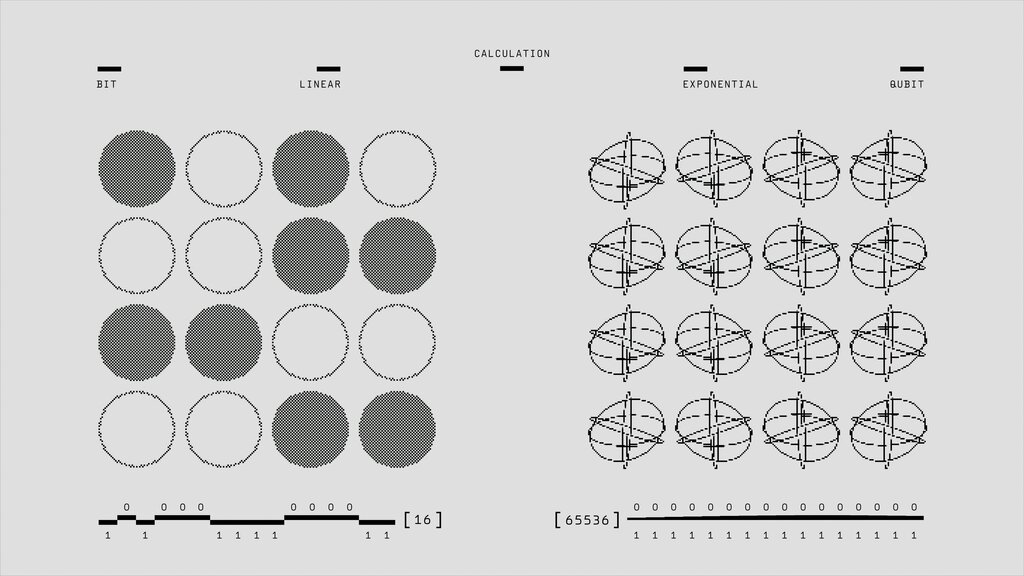
This ability to exist in multiple states at once is what gives quantum computers their incredible potential. A qubit's state isn't just a simple value; it's a vector in a complex space. We can write its state like this:
Here, and are the basic states, similar to the classical 0 and 1. The symbols and are called probability amplitudes. When we measure the qubit, the probability of it collapsing to is , and the probability of it collapsing to is . The sum of these probabilities must always be 1.
Superposition allows a single qubit to explore two possibilities at once. Two qubits can explore four possibilities, three can explore eight, and so on. This power grows exponentially.
A Spooky Connection
If superposition isn't strange enough, there's another quantum property that's even more counterintuitive: entanglement. This is a special connection that can exist between two or more qubits. When qubits are entangled, their fates are linked, no matter how far apart they are.
Imagine you have two of our special spinning coins, and they're entangled. If you catch one and it lands on heads, you instantly know the other one, wherever it is in the universe, will land on tails. This connection is instant and unbreakable.
entanglement
noun
A quantum mechanical phenomenon in which the quantum states of two or more objects have to be described with reference to each other, even though the individual objects may be spatially separated.
This doesn't allow for faster-than-light communication, because you still have to send classical information to know what to do with the measurement result. However, entanglement creates powerful correlations that are impossible in the classical world. It allows quantum computers to perform complex calculations and create intricate states that would be impossible to simulate on even the most powerful classical supercomputers.
Superposition and entanglement are the two core principles that separate quantum computing from the classical world. They enable a new form of information processing with the potential to solve problems we can only dream of today.
Let's check your understanding of these foundational ideas.
What is the primary difference between a classical bit and a quantum bit (qubit)?
The quantum property that allows a qubit to be in a combination of both 0 and 1 at the same time is called __________.
By moving beyond simple on/off switches, quantum computing opens up an entirely new landscape for computation.