Introduction to Quantum Computing
Introduction to Quantum Computing
Beyond Bits and Bytes
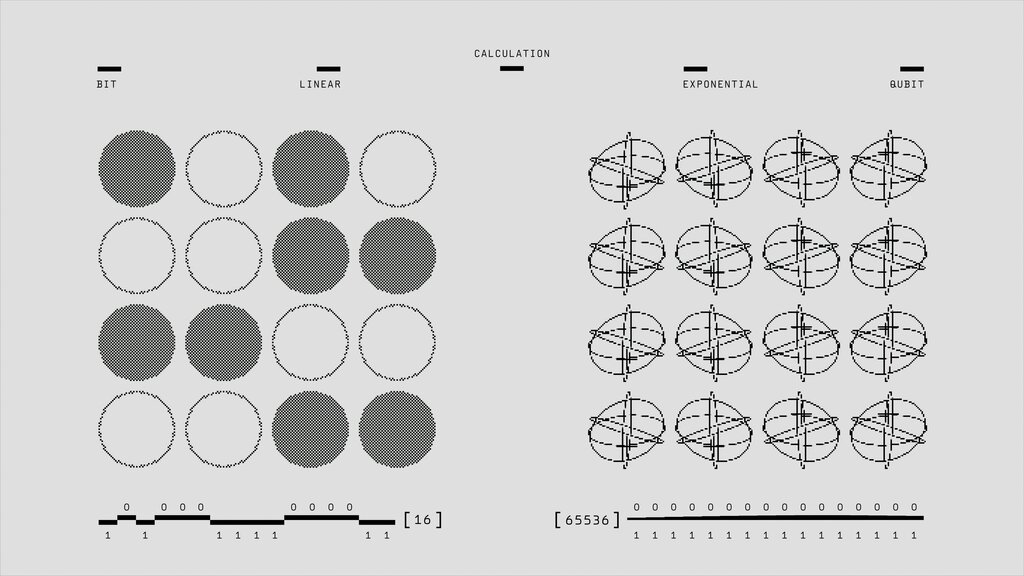
Classical computers, from your smartphone to the most powerful supercomputers, think in a very straightforward way. Everything is broken down into a language of bits, which are like tiny light switches. A bit can either be off, represented by a 0, or on, represented by a 1. There are no other options. This binary system is the foundation of all digital technology.
Quantum computers operate on a completely different principle. Instead of bits, they use quantum bits, or qubits. A qubit can be a 0 or a 1, just like a classical bit. But it can also be in a combination of both states at the same time. This strange property is called superposition.
Imagine a spinning coin. While it's in the air, it's neither heads nor tails—it's a blend of both possibilities. A qubit in superposition is like that spinning coin. Only when you measure it does it 'choose' a state and land on either 0 or 1.
qubit
noun
The basic unit of quantum information. It is the quantum analogue of the classical bit.
The Power of Superposition
Superposition is what gives quantum computers their immense potential. Because a qubit can exist as a mix of 0 and 1, a quantum computer with multiple qubits can explore a vast number of possibilities simultaneously. Two classical bits can be in one of four combinations (00, 01, 10, or 11) at any given time. But two qubits in superposition can represent all four of those combinations at once.
We can describe the state of a qubit mathematically. A qubit's state, represented as |\[\textpsi\]\rangle (pronounced 'ket psi'), is a combination of the basis states and .
Here, and are complex numbers called probability amplitudes. When you measure the qubit, the probability of it collapsing to is |\[\textalpha\]|^2, and the probability of it collapsing to is |\[\textbeta\]|^2. Because these are the only two outcomes, the probabilities must add up to 1.
This ability to exist in multiple states grows exponentially. With just 300 qubits, a quantum computer could represent more states than there are atoms in the known universe. This massive parallelism is what allows quantum computers to tackle problems that are impossible for even the most powerful classical supercomputers.
A Spooky Connection
The other mind-bending principle of quantum mechanics is entanglement. This happens when two or more qubits become linked in a way that their fates are intertwined, no matter how far apart they are. Albert Einstein famously called it "spooky action at a distance."
Imagine you have a pair of entangled qubits. If you measure one and find it's in the state 0, you instantly know the other one is in the state 1, and vice versa. This connection is instantaneous, seemingly faster than the speed of light. It's not that one qubit sends a signal to the other; it's that they are part of a single, unified quantum state.
Another fundamental principle of quantum computing is entanglement, a phenomenon where two or more qubits become interconnected in such a way that the state of one qubit directly affects the state of another, regardless of the distance between them.
Entanglement is a crucial resource in quantum computing. It allows for complex correlations between qubits, which is essential for running powerful quantum algorithms and for secure quantum communication.
Quantum vs. Classical
So, how do these ideas stack up against the computers we use every day? Here’s a quick comparison:
| Feature | Classical Computing | Quantum Computing |
|---|---|---|
| Basic Unit | Bit | Qubit |
| State | 0 or 1 | Superposition of 0 and 1 |
| Processing | Sequential | Parallel (explores many outcomes at once) |
| Key Principle | Boolean Logic | Superposition & Entanglement |
| Error Rate | Very low | High and sensitive to environment |
It's important to know that quantum computers won't replace your laptop for everyday tasks like browsing the web or writing emails. Classical computers are excellent at those things. Instead, quantum computers are specialized machines designed to solve specific, incredibly complex problems that are currently intractable.
Potential applications include discovering new drugs and materials by simulating molecules, optimizing complex financial models, breaking modern encryption, and advancing artificial intelligence. These are areas where the ability to analyze a massive number of possibilities at once provides a fundamental advantage.
Let's review the key concepts we've covered.
Ready to test your understanding?
What is the fundamental difference between a classical bit and a quantum bit (qubit)?
The principle of superposition allows a single qubit to exist in only one definite state (either 0 or 1) at any given time.
By harnessing the principles of superposition and entanglement, quantum computing opens up a new frontier for computation, promising to solve some of the world's most challenging problems.