Introduction to Quantum Computing
Introduction to Quantum Computing
Beyond Bits and Bytes
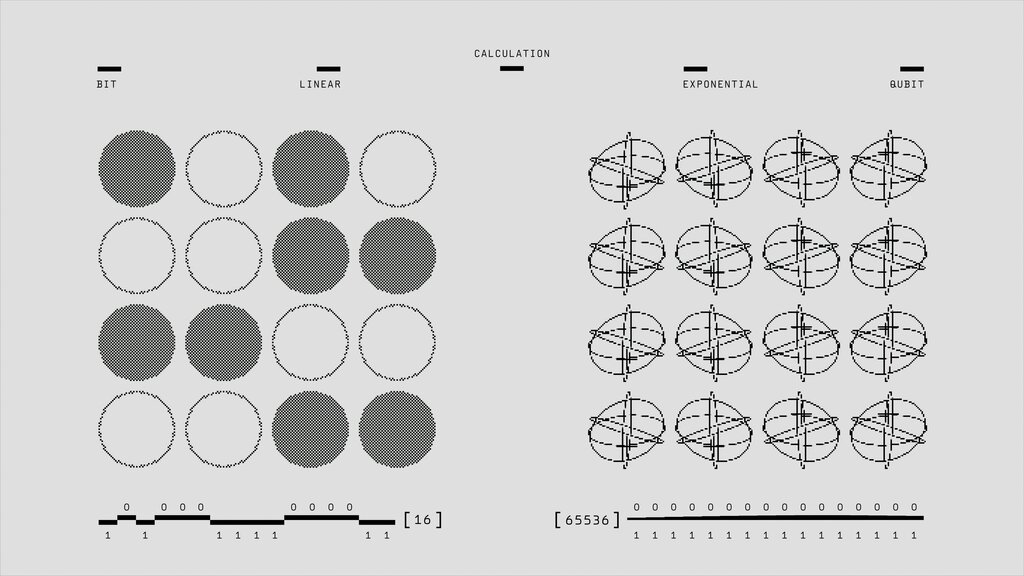
Classical computers, from your smartphone to the most powerful supercomputers, think in a very straightforward way. They use bits, which are like tiny light switches. A bit can either be off, represented by a 0, or on, represented by a 1. Every app you use, photo you see, and message you send is ultimately broken down into a massive sequence of these simple zeros and ones.
Quantum computers operate on a completely different principle. Instead of bits, they use quantum bits, or qubits for short. A qubit can be a 0 or a 1, just like a classical bit. But it can also be in a combination of both states at the same time. This strange property is called superposition.
qubit
noun
The basic unit of quantum information. It can represent a 0, a 1, or any quantum superposition of the two states.
The Power of Superposition
Imagine a spinning coin. Before it lands, it's not quite heads and not quite tails. In a sense, it's both simultaneously. Superposition is a bit like that. A qubit exists in a blend of 0 and 1, a spectrum of possibilities, until you measure it. The moment you measure a qubit, it “chooses” a state and collapses to either a definite 0 or a 1. It’s like the spinning coin finally landing on one side.
This ability to hold multiple values at once is what makes quantum computers so powerful. A classical computer with two bits can only represent one of four possible combinations (00, 01, 10, or 11) at any given time. But two qubits in superposition can represent all four of those combinations simultaneously. As you add more qubits, this power grows exponentially. This allows a quantum computer to explore a vast number of possibilities at the same time.
Spooky Connections
As if superposition weren't strange enough, qubits have another trick up their sleeve: entanglement. This is a special, deep connection between two or more qubits. When qubits are entangled, their fates are linked. Measuring the state of one qubit instantly influences the state of the other, no matter how far apart they are.
Albert Einstein famously called this phenomenon “spooky action at a distance.” Imagine you have two entangled coins. You give one to a friend who travels to the other side of the world. The moment you look at your coin and see it's heads, you know with absolute certainty that your friend's coin is tails. This isn't just a lucky guess; their outcomes are perfectly correlated.
Entanglement links qubits together, allowing them to act as a single, coordinated system, even when physically separated. This interconnectedness is crucial for complex quantum computations.
Superposition and entanglement are the twin pillars of quantum computing. They allow these machines to process information in a way that is fundamentally different from their classical counterparts, opening the door to solving problems that are currently impossible to tackle.
What is the fundamental unit of information in a classical computer?
The principle that allows a qubit to be a 0, a 1, or a combination of both at the same time is called:
These concepts form the very foundation of quantum computing. Grasping them is the first step toward understanding this revolutionary new field.