Introduction to Quantum Computing
Introduction to Quantum Mechanics
The Quantum Realm
In our everyday world, things are predictable. If you drop a ball, it falls. If you shine a light, it travels in a straight line. But when you zoom way down to the level of atoms and the particles inside them, the rules change completely. This is the realm of quantum mechanics, and it's where things get strange.
Imagine a world where a particle can be in multiple places at once, and where simply looking at something changes what it's doing. It’s not science fiction; it’s the fundamental reality of our universe. Let's explore some of the core ideas that make the quantum world so different from our own.
Wave or Particle?
One of the most mind-bending ideas in quantum mechanics is that tiny particles, like electrons, can act as both particles and waves. This is called wave-particle duality.
To understand this, think about a famous experiment called the double-slit experiment. Imagine a wall with two vertical slits in it. On one side, you have a device that shoots something, and on the other side, there's a screen that detects where it lands.
If you shoot tiny paintballs (particles) at the wall, some will go through the slits and hit the screen behind them. You'd expect to see two distinct lines on the screen, corresponding to the two slits. Simple enough.
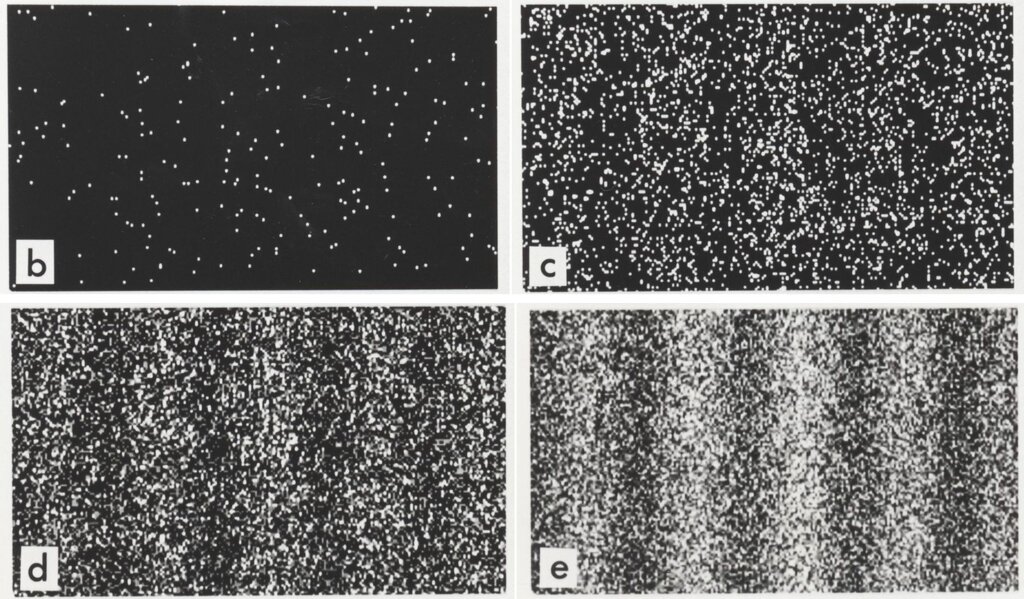
Now, imagine sending waves (like water waves) toward the slits. As the waves pass through, they spread out and interfere with each other. Where two wave crests meet, they create a bigger wave. Where a crest meets a trough, they cancel out. The result on the screen is an interference pattern: a series of bright and dark bands, not just two lines.
Here's the weird part. When scientists shot individual electrons—which we think of as particles—one at a time through the slits, an interference pattern emerged. It's as if each electron went through both slits at once, like a wave, and interfered with itself. But if they placed a detector at the slits to see which one the electron went through, the interference pattern vanished. The electrons started acting like paintballs again, forming just two lines.
The very act of observing changed the outcome. This suggests that at the quantum level, particles exist in a cloud of possibilities until they are measured.
The Uncertainty Principle
This strange wave-like nature leads to another key idea: the Uncertainty Principle, formulated by Werner Heisenberg. It states that there's a fundamental limit to how precisely we can know certain pairs of properties of a particle at the same time. The most famous pair is position and momentum (which is mass times velocity).
The more precisely you measure a particle's position, the less precisely you can know its momentum, and vice versa. There's always a trade-off.
Think of it like trying to measure the exact position of a wave on the ocean. A wave isn't in one single spot; it's spread out. To find its momentum (related to its wavelength), you need to see the whole wave. But to find its position, you need to pinpoint a single location. You can't do both perfectly at once.
Since quantum particles have wave-like properties, this same limitation applies to them. This isn't a problem with our measuring instruments; it's a fundamental property of nature. The universe has a built-in fuzziness.
Describing Quantum States
So, if we can't know a particle's exact position and momentum, how do we describe it? We use a mathematical concept called a quantum state. A quantum state doesn't give us definite answers. Instead, it gives us probabilities.
A quantum state is often represented by a mathematical object called a wave function. This function contains all the information about a particle. It can tell you the probability of finding the particle at any given location if you were to measure it.
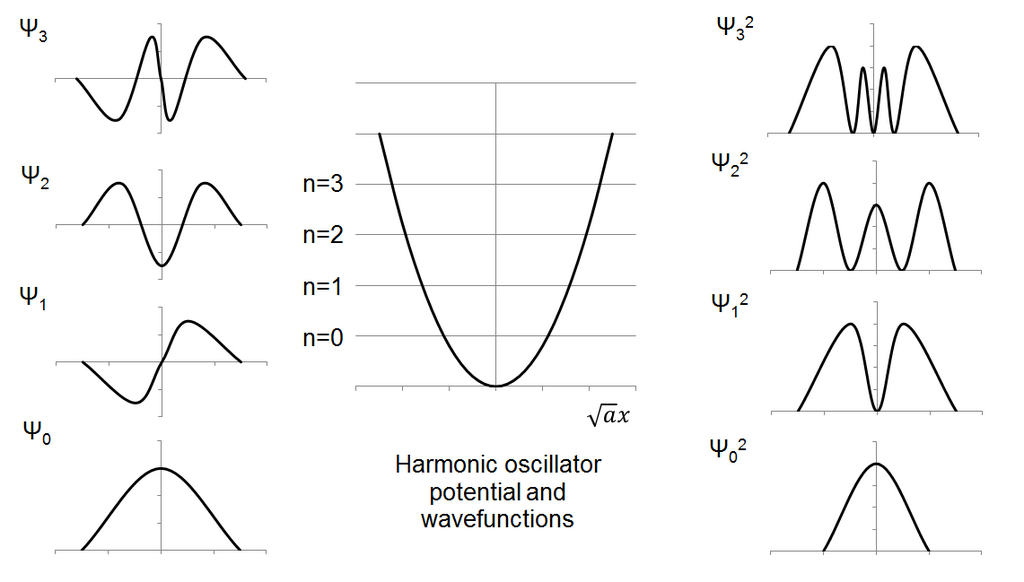
Before a measurement, a particle exists in a superposition of all its possible states at once. It has a certain probability of being here, and another probability of being there. When you make a measurement—like looking to see where the electron hit the screen—the wave function "collapses," and the particle settles into one definite state. We can't predict which state it will choose, only the odds.
These principles—wave-particle duality, uncertainty, and the probabilistic nature of quantum states—form the bedrock of quantum mechanics. They challenge our classical intuition but are essential for understanding how the universe works at its most fundamental level.