Introduction to Quantum Computing
Introduction to Quantum Computing
A New Kind of Computing
For decades, computers have worked on a simple, powerful principle. Information is stored and processed as a series of bits, which can be either a 0 or a 1. Think of it like a light switch: it's either on or off. This binary system powers everything from your phone to the most massive supercomputers.
But some problems are just too complex for this approach. Simulating new molecules for medicine, designing revolutionary materials, or breaking sophisticated encryption can involve a staggering number of possibilities. Even the fastest supercomputers would take thousands of years to sift through them all.
Quantum computing offers a completely different way to calculate. It's a new kind of machine built on the strange and wonderful rules of quantum mechanics, the physics that governs the world at the scale of atoms and particles.
Quantum computers approach solving problems in a fundamentally new way.
Why Go Quantum?
The goal of quantum computing isn't to replace your laptop. Classical computers are excellent at everyday tasks like sending emails, browsing the web, and running spreadsheets. Quantum computers are specialized tools designed to tackle problems that are currently impossible to solve.
Imagine trying to design a new battery material. You'd need to simulate how all the individual atoms and electrons interact, a process with a mind-boggling number of variables. A classical computer would have to check each possibility one by one. A quantum computer could explore all of them at the same time.
This opens doors to huge advancements in fields like:
- Medicine: Creating new drugs and therapies by modeling molecular interactions with incredible precision.
- Materials Science: Discovering materials with new properties, like more efficient solar cells or superconductors that work at room temperature.
- Finance: Building better financial models to manage risk and optimize investments.
- Artificial Intelligence: Supercharging machine learning algorithms to solve more complex problems.
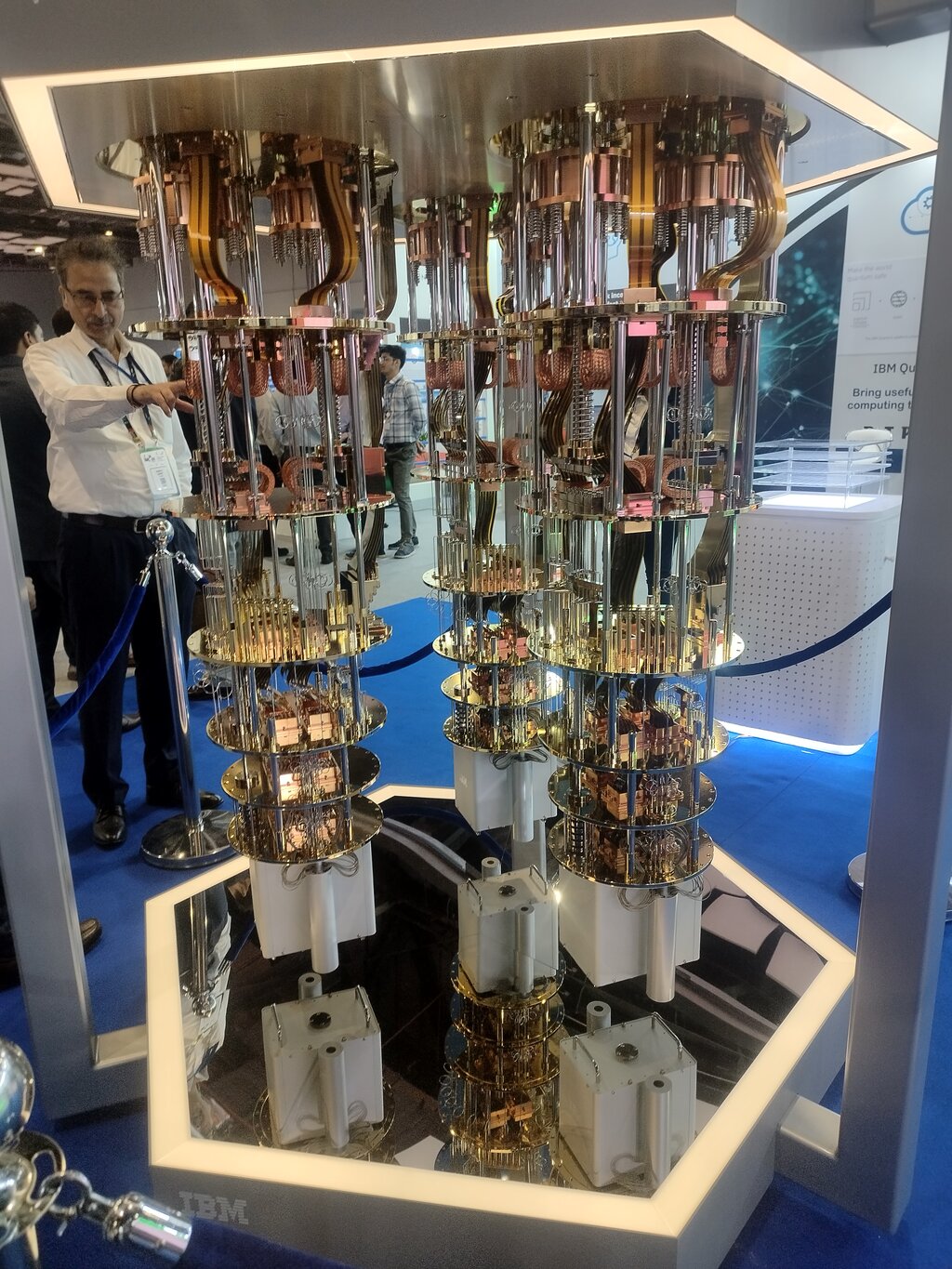
Bits vs. Qubits
The fundamental difference between classical and quantum computing lies in how they handle information.
A classical computer uses bits. Each bit is a clear-cut 0 or 1. There is no in-between.
A quantum computer uses qubits. A qubit can also be a 0 or a 1. But thanks to a quantum principle called superposition, it can also be a combination of both 0 and 1 at the same time. Think of a spinning coin. While it's in the air, it's neither heads nor tails, but a blend of both possibilities. Only when it lands (or is measured) does it settle into a definite state.
This ability to exist in multiple states at once is what gives quantum computers their power. If you have two qubits, they can represent four states (00, 01, 10, 11) simultaneously. With three qubits, it's eight states. The power grows exponentially. A system with just 300 qubits could represent more possible states than there are atoms in the known universe.
This allows a quantum computer to analyze a huge problem space in a single operation, finding patterns and solutions that would be forever out of reach for a classical machine.
Time to check your understanding of these core concepts.
Which of the following tasks is the best-suited application for a quantum computer, as opposed to a classical computer?
A classical computer uses bits to process information. A quantum computer uses ____ to do the same.
This new frontier of computing is still in its early days, but its potential to reshape science, industry, and our world is immense.