Introduction to Quantum Computing
Introduction to Quantum Computing
Beyond Bits and Bytes
For decades, computers have operated on a simple principle: bits. A bit is a switch that is either on or off, representing a 1 or a 0. Every email you send, every video you watch, is built from billions of these tiny, definite switches. This binary system has been incredibly powerful, fueling the digital revolution.
But some problems are just too complex for classical computers. Simulating molecules for drug discovery, optimizing global logistics, or breaking modern encryption can involve a staggering number of variables. For these tasks, even the fastest supercomputers would take thousands of years to find a solution. We need a different approach.
Quantum computing doesn't just improve on the classical computer; it reimagines it from the ground up. It operates on the strange and counterintuitive laws of quantum mechanics, the physics that governs the world of atoms and subatomic particles.
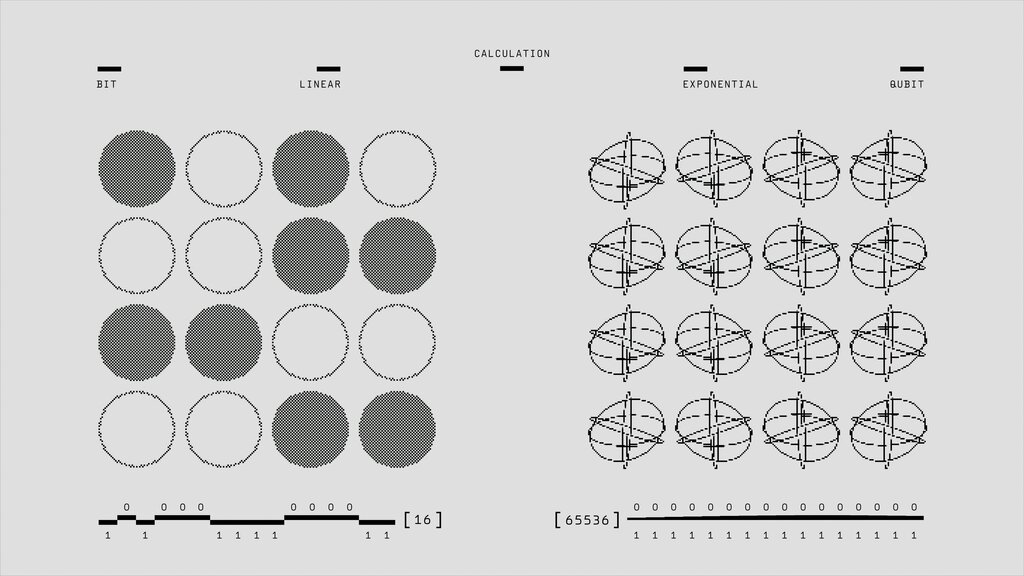
Instead of bits, quantum computers use something far more flexible: qubits.
The Quantum Bit
A qubit, short for quantum bit, is the basic unit of information in a quantum computer. Like a classical bit, a qubit can be a 0 or a 1. But it can also be something else—a combination of both 0 and 1 at the same time.
This isn't just a philosophical idea. Physicists can create qubits using tiny physical systems, like the spin of an electron (up or down) or the polarization of a photon (vertical or horizontal). These systems naturally follow the rules of quantum mechanics.
qubit
noun
A quantum bit; the basic unit of quantum information. It can exist in a state of 0, 1, or a superposition of both.
Superposition
The ability of a qubit to be in a combination of 0 and 1 is called superposition. Think of a spinning coin. While it's in the air, it’s not definitively heads or tails—it's a blur of both possibilities. Only when you catch it (a process called measurement) does it land on one specific outcome.
A qubit in superposition is like that spinning coin. It exists in a spectrum of possibilities between 0 and 1. When we measure the qubit, its superposition collapses, and it commits to being either a 0 or a 1. The outcome isn't random; it's based on the qubit's state right before measurement.
Superposition allows a single qubit to process much more information than a single classical bit.
We can represent the state of a qubit, which we call |\[\psi\]\rangle (pronounced "ket psi"), as a combination of the basis states and . The amount of "0-ness" and "1-ness" is determined by two numbers, and , called probability amplitudes.
The squares of these amplitudes give the probability of measuring the qubit as a 0 or a 1. So, |\[\alpha\]|^2 is the probability of finding the qubit in state , and |\[\beta\]|^2 is the probability of finding it in state . Naturally, these probabilities must add up to 100%, so |\[\alpha\]|^2 + |\[\beta\]|^2 = 1.
Because of superposition, a quantum computer with just a few dozen qubits can explore a vast number of states simultaneously. With qubits, you can represent states at once. For a classical computer, you'd need bits to do the same. This exponential scaling is a key source of a quantum computer's potential power.
Entanglement
The other mind-bending principle is entanglement. This happens when two or more qubits become linked in a way that their fates are intertwined, no matter how far apart they are. Albert Einstein famously called it "spooky action at a distance."
Imagine you have a pair of "entangled" coins. You give one to a friend and keep the other. Without looking, your friend flies to the other side of the world. The moment you look at your coin and see that it's heads, you instantly know your friend's coin is tails. And vice-versa. Before you looked, both coins were in an uncertain state, but your measurement of one immediately determined the state of the other.
Entangled qubits behave similarly. If you have two entangled qubits, measuring one as a 0 might guarantee that the other will be a 1. This connection is perfect and instantaneous, and it's a crucial resource for quantum algorithms and communication.
Another fundamental principle of quantum computing is entanglement, a phenomenon where two or more qubits become interconnected in such a way that the state of one qubit directly affects the state of another, regardless of the distance between them.
Together, superposition and entanglement allow quantum computers to process information in a fundamentally different way. They don't just calculate one path at a time; they explore a multitude of possibilities at once, finding solutions to problems that are simply out of reach for even the most powerful classical machines.
What is the basic unit of information in a quantum computer called?
The principle that allows a qubit to be in a combination of both 0 and 1 at the same time is known as ________.